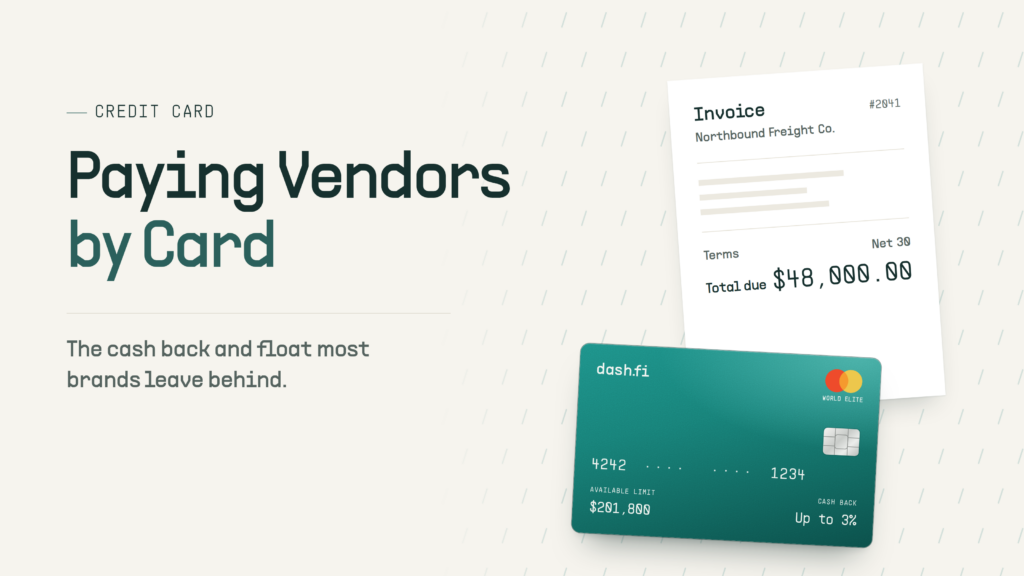
Paying vendors by credit card means settling supplier invoices (inventory, freight, software, agencies, ad platforms) with a business card instead of ACH or check. Done on the right bills, it earns cash back on spend you were going to make anyway and delays your actual cash outflow until your card payment is due, potentially providing several additional weeks of flexibility.
Most brands run their card on SaaS and travel, and then pay their biggest invoices by ACH out of habit. But that habit has a price. On $1 million in annual vendor spend, the cash back and float you skip can run well past $25,000 a year.
This guide covers:
- When it makes sense to pay vendors with a credit card
- When it doesn’t
- How to handle vendors that push back
- How to calculate what the rewards and extra payment time are actually worth
How Paying Vendors by Credit Card Works
Here are the three most common ways to put a vendor bill on a card:
- The vendor accepts cards directly. You pay through their invoice portal, a payment link, or by giving them card details over the phone. Most SaaS tools, ad platforms, carriers, and marketplaces work this way.
- You send a single-use virtual card. Your bill pay or card platform generates a card number for one invoice, locked to the exact amount, and emails it to the vendor. The vendor runs it like any other card. (More on this in our guide to virtual corporate credit cards for vendor expenses.)
- The vendor only takes ACH or wire. Here, you can’t use a card directly, but you can still get extended payment time through a financing layer that pays the vendor by bank transfer now, while you repay later. We cover this option below.
With any of these scenarios, the vendor gets paid on time. What changes is when the cash leaves your operating account and whether that spend earns anything.
What Are the Benefits of Paying Vendors With a Credit Card?
You benefit from paying your vendors with a card in two ways: money you earn and time you buy.
1. Cash back on your largest expense line
Vendor payments are usually a brand’s biggest expense after payroll. Inventory, 3PL fees, freight, and ad spend can each run six or seven figures a year. Putting even part of that on a card that pays 2% to 3% back turns a cost center into a small revenue line. And rates matter. A 1.5% flat card and a card that pays up to 3% on ad and shipping spend produce very different numbers at scale. Dash.fi, for example, pays up to 3% on ad, shipping, and AI spend and up to 1.5% on everything else.
2. Float: extra days before cash leaves your account
Float is the gap between when your vendor gets paid and when you actually pay for it. If you pay a net-30 invoice by card on day 30, and your card statement isn’t due for another few weeks, you’ve stacked your vendor’s terms on top of your card’s terms.
For a brand with uneven inventory cycles, an extra 30 to 45 days before cash leaves the business can be the difference between having enough working capital for a purchase order and facing a cash shortfall.
3. Cleaner books and better controls
- Every card transaction posts with a date, amount, and merchant, which makes credit card reconciliation faster than chasing ACH memos.
- Single-use and vendor-locked cards limit what any one vendor can charge.
- Card payments carry dispute rights that ACH and wires don’t.
How Does Paying Vendors by Credit Card Affect Cash Flow and Rewards?
Here’s what the rewards and float are worth over the course of a year. That float column assumes you gain 30 extra days of payment and that your cost of capital (what that cash would cost to borrow, or could earn elsewhere) is 8%.
| Annual vendor spend on card | Cash back at 2% | Cash back at 3% | Float value (30 days at 8%) | Total at 2% + float |
|---|---|---|---|---|
| $250,000 | $5,000 | $7,500 | $1,644 | $6,644 |
| $1,000,000 | $20,000 | $30,000 | $6,575 | $26,575 |
| $5,000,000 | $100,000 | $150,000 | $32,877 | $132,877 |
How the float number is calculated: annual spend × (extra days ÷ 365) × cost of capital. At $1 million, 30 extra days means about $82,192 stays in your account at any given time. At 8%, that cash is worth roughly $6,575 a year.
Rewards do most of the work, but float grows with your cost of capital. If your alternative is a 12% line of credit, the same $1 million produces nearly $10,000 a year in float value.
When Paying Vendors by Credit Card Actually Makes Sense
Card payments are a clear win in these situations:
- The vendor accepts cards with no surcharge. Ad platforms, SaaS, many carriers, and most marketplaces fall here. Put these on the card first.
- The spend lands in a high-reward category. Ad spend, shipping, and AI tools often earn the top rate on business cards built for ecommerce.
- You pay the card in full each cycle. Rewards only work if you aren’t paying interest. A charge card, which must be paid in full, removes the temptation to carry a balance.
- Your cash conversion cycle is long. If you buy inventory months before it sells, extra float directly reduces how much working capital you need.
- The vendor would otherwise get a check. Cards are faster for them and safer for you.
When Paying Vendors by Card Doesn’t Make Sense
There are a few cases where a card would be the wrong tool:
- The surcharge is bigger than your rewards plus float. A 3% surcharge on a 2% card loses money (see the break-even formula below).
- The vendor offers an early-payment discount you’d lose. Terms like 2/10 net 30 (2% off if you pay within 10 days) are worth about 37% annualized. If the vendor won’t take a card within that window, take the discount by ACH.
- The vendor requires card payment upfront and drops your net terms. You trade 30 days of vendor terms for card float, which can leave you roughly even on timing.
- You would carry a balance. Interest on revolving credit wipes out 2% to 3% rewards quickly.
- The payment would push you to your limit. Running a large inventory PO on the card can crowd out the ad spend that drives revenue.
The Break-Even Formula: Is a Card Payment Worth It?
Here’s a good way to decide on whether to use a card with any single vendor:
Net card benefit (%) = reward rate + float value − surcharge − lost early-pay discount, where float value = (extra days ÷ 365) × cost of capital.
At 30 days and 8%, the float is worth about 0.66% of the payment. Here is a hypothetical example:
| Scenario | Reward | Float | Surcharge | Net benefit | Verdict |
|---|---|---|---|---|---|
| No surcharge, standard rate | 2.0% | 0.66% | 0% | +2.66% | Pay by card |
| 3% surcharge, standard rate | 2.0% | 0.66% | 3.0% | −0.34% | Pay by ACH |
| 3% surcharge, top category rate | 3.0% | 0.66% | 3.0% | +0.66% | Card still wins |
| 2/10 net 30 discount offered, card not accepted early | 2.0% | 0.66% | 2% available | Depends on payment timing | Compare both options |
Key Takeaway: A surcharge isn’t automatically a deal-breaker. It depends on what your card pays in that category and how long the float runs.
How to Handle Vendors That Resist Card Payments
There will be vendors who push back on cards, and they do it for one reason: processing fees, which typically run around 2% to 3.5% of the transaction. That’s real money on a large invoice.
These approaches can help you overcome vendor pushback, roughly in order of effort:
Ask, and check their payment options first
Many vendors already accept cards through an invoice portal or payment link and just don’t advertise it. A quick email to their AR team can usually settle the matter.
Trade speed for acceptance
Offer to pay on receipt instead of on day 30 if they’ll accept a card with no surcharge. The vendor gets cash a month early, which offsets much of their processing cost, and your card float still applies, so your own cash timing barely changes.
Send a single-use virtual card
Some vendors resist because of the hassle, not the fee. A virtual card emailed with the invoice number takes them seconds to run and settles fast. It also removes the check-handling cost they’d otherwise absorb. Bill pay platforms like Dash.fi Bill Pay can email a single-use card per bill, and those payments earn card cash back.
Accept the surcharge only when the math works
If a vendor adds a fee, run the break-even formula above.
Note that surcharges are regulated:
- Card network rules cap them
- They can’t exceed the merchant’s actual cost of acceptance
- A handful of states restrict or ban them
If a vendor’s surcharge looks high, it may not be compliant. Visa’s merchant surcharging rules and Mastercard’s surcharge rules lay out the requirements.
Get the float without the card
Some vendors (large freight forwarders, manufacturers, and increasingly ad platforms) simply won’t take cards. Meta, for instance, has pushed its biggest advertisers off cards and onto invoicing, which we break down in our piece on how Meta pushed its biggest advertisers off credit cards.
For these vendors, you can still extend your payment window.
Dash.fi’s Pay in 60 pays the vendor’s bank account on schedule while you repay 60 days later, with shorter 30- and 15-day options.
A fee applies per advance and is shown before you confirm, so compare it against your float value the same way you would a surcharge. Some spend also earns rewards on non-card rails: Dash.fi pays 1% back on Meta invoice payments made by ACH, wire, or SWIFT.
Best Practices for Paying Vendors by Card
- Rank vendors by annual spend and acceptance. Start with the largest vendors that already take cards without a fee.
- Pay on the due date, not the invoice date. Paying a net-30 bill by card on day 1 throws away 29 days of float.
- Time big charges to the start of your statement cycle. A charge on day 1 of the cycle floats longer than one on day 29.
- Use vendor-locked or single-use cards for recurring and one-off vendors so no supplier can overcharge. A ghost card works well for vendors that bill monthly.
- Watch your limit around inventory buys. Keep headroom for ad spend in your peak months.
- Sync everything to your accounting system. Corporate cards with built-in expense management code vendor charges automatically, so card payments don’t create month-end cleanup.
- Review once a quarter. Vendor policies change. A vendor that added a surcharge last year may drop it if you ask, or a new one may start accepting cards.
Frequently Asked Questions
Can you pay vendors with credit cards if they don’t accept cards?
Not directly. Your options are to ask the vendor to accept a virtual card (often in exchange for faster payment), pay by ACH through a financing option that extends your terms, or pay by ACH and take any early-payment discount they offer. Card-to-ACH services exist, but their fees often match or exceed the rewards you’d earn.
Is it legal for a vendor to charge a surcharge for card payments?
In most U.S. states, yes, within card network rules. Surcharges are capped, must be disclosed, can’t exceed the merchant’s cost of acceptance, and can’t be applied to debit cards. A few states restrict or prohibit them.
Does paying vendors by card hurt your cash flow?
It usually helps. Paying by card on the due date and repaying on your statement due date keeps cash in your account longer. It usually only hurts if you carry a balance or lose vendor net terms by paying upfront.
The Bottom Line
Paying vendors by credit card is worth it when the vendor accepts cards without a fee, or when your reward rate plus float beats any surcharge. Start with your biggest card-friendly vendors, and pay on the due date. Then, run the break-even formula on everyone else.
For the vendors that won’t budge, extended-terms ACH gets you the float without the card.
If you want the top rate on ad, shipping, and AI spend, plus a way to stretch payment on vendors that only take ACH, see how Dash.fi Rewards and Bill Pay work together.