

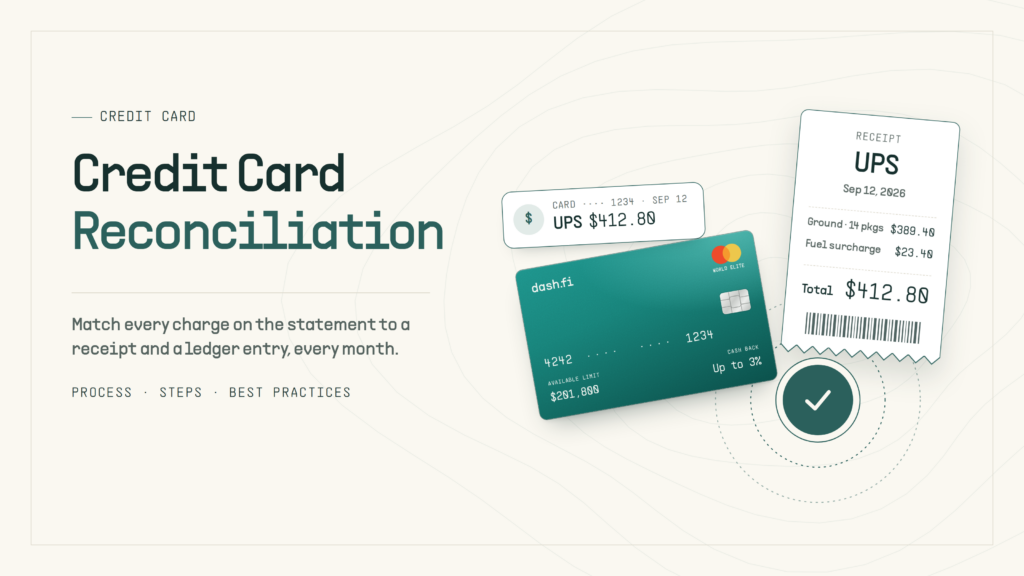
Credit card reconciliation is a bookkeeping practice that involves matching every transaction on the credit card statement against receipts and supporting documentation. This process allows companies to confirm that spending is accurate and has been authorized. And if your company issues cards to multiple employees or departments, reconciliation is the control that keeps card spend from becoming a black box between statement periods.
At its core, credit card reconciliation answers three questions for every transaction:
Did this charge actually happen the way the statement says it did?
Was it authorized and business-related?
Is it recorded correctly in the general ledger?
A company that can answer yes to all three, for every transaction, every month, has a reliable close process and clean books. A company that can’t is exposed to errors and fraud, not to mention financial statements that don’t hold up under audit.
How the Credit Card Reconciliation Process Works
Whether your company has five cards or five hundred, reconciliation follows the same basic sequence. Here’s a glance at what a mid-size company’s reconciliation could look like, where the finance team reconciles company-wide card spend at the end of every month, across a dozen department cards:
| step | what happens | who is typically involved |
|---|---|---|
| 1. Pull the statement | The finance team downloads the billing-cycle statement from the card issuer, covering every cardholder on the account. | Accounts payable / controller |
| 2. Gather supporting documentation | Receipts, invoices, and expense reports are collected for each transaction, usually from a receipt-capture app or email forwarding. | Cardholders, AP |
| 3. Match transactions line by line | Each statement line is matched to a receipt and to the corresponding entry already booked in the accounting system. | AP/bookkeeper |
| 4. Flag discrepancies | Unmatched, duplicate, missing, or unauthorized charges are set aside for follow-up rather than posted as-is. | AP/controller |
| 5. Code and categorize | Matched transactions are assigned to the correct GL account, department, and cost center. | AP/department managers |
| 6. Resolve exceptions | Cardholders are contacted for missing receipts or explanations; disputed or fraudulent charges are reported to the issuer. | Cardholders, controller |
| 7. Approve and post | Reviewed and coded transactions are approved and posted to the general ledger. | Controller/finance manager |
| 8. Close and file | The reconciled statement, receipts, and any exception notes are filed together as the audit trail for that period. | Controller |
While this process is identical no matter the number of cards, what will change is the length of time and energy it will take to reconcile multiple cards. A single-cardholder small business can reconcile in an hour. A company running dozens of departmental cards is matching hundreds or thousands of line items every cycle. That’s where manual reconciliation breaks down.
Types of Credit Card Reconciliation
- Single-card reconciliation: One cardholder’s statement matched against that person’s own receipts and expense reports, very common in very small businesses.
- Company-wide (multi-card) reconciliation: All cardholders’ statements consolidated and reconciled together, typically by department or cost center, before posting to a single general ledger.
- Statement-level reconciliation: Confirming that the total on the card statement matches the total recorded in the accounting system, without necessarily verifying every individual line.
- Transaction-level reconciliation: Matching each charge to its receipt and GL entry. A high level of detail is needed to catch duplicate charges, coding errors, and unauthorized spend.
If you’re a finance team issuing cards to multiple employees, you need transaction-level, company-wide reconciliation. Statement-level checks will only catch a math error, but they’ll miss a personal expense buried in an otherwise accurate total.
Challenges Finance Teams Face With the Credit Card Reconciliation Process
The same handful of problems show up in almost every reconciliation cycle, and they tend to compound as the number of cardholders grows.
| problem | why it happens | typical fix |
|---|---|---|
| Missing receipts | Cardholders forget to save or submit documentation, especially for small purchases. | Mobile receipt capture at time of purchase; policy requiring same-week submission. |
| Duplicate charges | A vendor bills twice, a subscription renews unexpectedly, or the same purchase is entered manually and also synced automatically. | Line-by-line matching against both the statement and the accounting system before posting. |
| Unauthorized or out-of-policy charges | Cards are shared, limits are too broad, or spend controls aren’t enforced at the point of sale. | Card-level spend controls and pre-approval workflows rather than after-the-fact review. |
| Coding errors | Transactions are assigned to the wrong GL account or cost center, often under time pressure at month-end. | Standardized coding rules, default categories by merchant type, and a second reviewer. |
| Timing discrepancies | A charge posts on the statement in one period but is recorded in the books in another. | Cutoff procedures that flag late-posting transactions for the correct period. |
It’s worth noting that missing documentation is a specific, standout problem because it carries tax risk beyond reconciliation itself.
The IRS generally expects a company to be able to substantiate a business expense with the amount, date, place, and business purpose, as noted in IRS Publication 463. A reconciliation process that lets undocumented charges slip through is also a tax-documentation gap.
Best Practices for Accurate Credit Card Reconciliation
- Reconcile weekly or even daily. This catches duplicate charges and fraud while they’re still easy to dispute, instead of thirty days later.
- Require receipt capture at the point of purchase. A photo taken immediately after a transaction is far more likely to exist than one requested at month-end.
- Standardize coding rules before the close. Default GL mappings by merchant category cut down on the judgment calls that produce errors.
- Separate the person who spends from the person who approves and reconciles. This is a basic segregation-of-duties control.
- Set spend controls at the card level. Limits, merchant category restrictions, and per-department cards prevent many exceptions from happening in the first place, rather than catching them after the fact.
- Automate the matching wherever the volume justifies it. Manual line-by-line matching is the first step to break down as the number of cardholders you have grows.
Can Credit Card Reconciliation Be Automated?
Yes. The matching step is largely rules-based. An automated accounting platform can compare statement lines to receipts and ledger entries by pulling the card feed directly and matching it against receipts submitted through an app. It can then apply your code rules automatically and flag only the exceptions that actually need human oversight. This is modern expense management.
And the benefits scale with cardholder count:
- Time savings: automated matching removes the majority of line items that would otherwise need manual review.
- Fewer errors: consistent, rules-based coding reduces the miscoding that creeps in under month-end time pressure.
- Faster close: with most transactions pre-matched, the close process shrinks from days to hours.
- Real-time visibility: finance can see spend as it happens rather than waiting for a monthly statement, which shortens the window in which errors or unauthorized charges go unnoticed.
Key Features of Credit Card Reconciliation Software
| feature | why it matters |
|---|---|
| Automated transaction matching | Reduces line-by-line manual review to only the transactions that don’t match automatically. |
| Mobile or email receipt capture | Closes the gap between when a purchase happens and when documentation exists for it. |
| Real-time transaction feed | Surfaces spend as it happens instead of waiting for a monthly statement cycle. |
| Custom coding rules | Applies consistent GL mapping by merchant, department, or cost center automatically. |
| Built-in approval workflows | Routes exceptions and out-of-policy charges to the right approver before they post. |
| Accounting system integration | Avoids double entry by syncing reconciled transactions directly into the general ledger. |
| Audit trail | Keeps receipts, approvals, and exception notes attached to each transaction for later review. |
Where the Corporate Card Itself Fits In
It’s worth taking a moment to understand what a corporate card can and can’t do. A card is not reconciliation software, and having a good card doesn’t replace the matching, coding, and review steps described here. What a well-designed card program can do is make every one of those steps easier by controlling how spend happens in the first place.
Centralized spend management and per-department or per-employee limits mean fewer surprise or unauthorized charges to chase down during reconciliation. Real-time transaction data, rather than a monthly statement, gives finance teams the visibility to catch duplicate or suspicious charges within days instead of weeks. And accounting automation that syncs coded, reconciled spend directly to the general ledger cuts out the double entry that otherwise eats up close time.
Many companies are still working out card policy questions that feed directly into reconciliation cleanliness, like how corporate card limits should be set by role or how to get a corporate credit card set up for a growing team in the first place. The answers to those questions will determine how reconciliation work shows up every month.
A card program with tight controls and real-time data will shrink the number of exceptions finance has to chase.
FAQs
What is the difference between bank reconciliation and credit card reconciliation?
Bank reconciliation matches a company’s cash account to its bank statement, primarily to catch outstanding checks, deposits in transit, and bank errors. Credit card reconciliation matches card transactions to receipts and expense documentation, and it’s more focused on authorization, coding accuracy, and expense policy compliance than on cash timing.
How often should a company reconcile its credit cards?
Monthly reconciliation, tied to the statement cycle, is the minimum most companies use for closing the books. Companies with higher transaction volume or multiple cardholders increasingly reconcile weekly or continuously through automated matching to catch errors and fraud sooner.
What happens if credit card statements don’t reconcile?
An unreconciled difference means one of four things: either a transaction wasn’t recorded, it was recorded twice, it was recorded for the wrong amount, or it wasn’t authorized in the first place. Each of these needs to be traced to its cause and corrected before the books are closed for the period, rather than adjusted away with a plug entry.
Do small businesses need a formal reconciliation process?
Yes, even with a single card. Formal reconciliation is what allows a business to substantiate its expense records for tax purposes and to catch errors or fraud before they compound. The process is simpler with one cardholder, but skipping it creates the same downstream risks at a smaller scale.