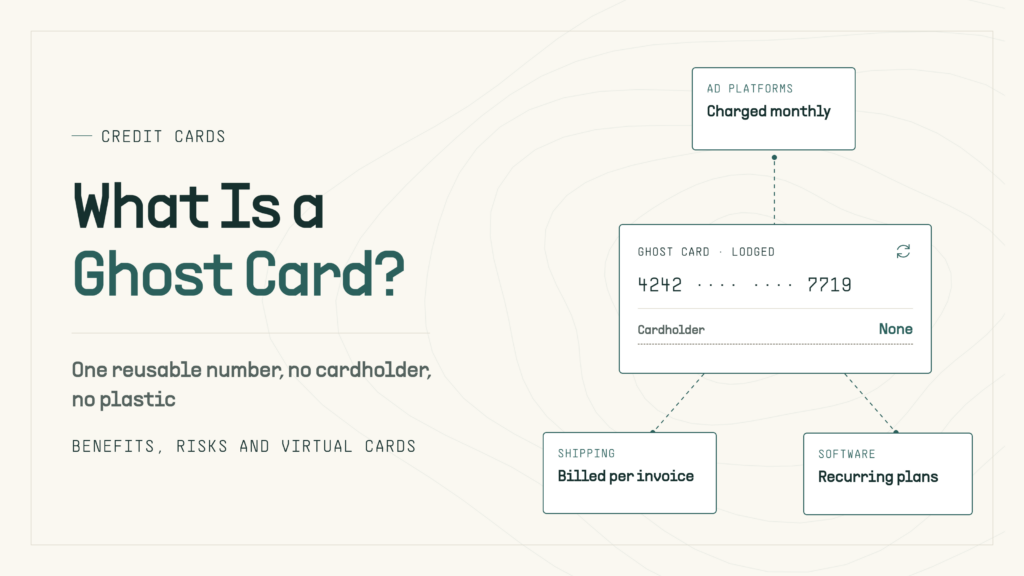
A ghost card is a company credit card number that’s assigned to a department or vendor. It can also be specifically assigned to an expense category. But it’s never assigned to an individual employee. There’s no physical card and no named cardholder. The same number is then reused for recurring purchases from that vendor or in that expense category. And every charge rolls up to one corporate account for payment and reconciliation.
Ghost cards are also often referred to as lodged cards, lodge cards, central travel accounts, and shared cards, depending on the industry. They’re common in corporate travel, procurement, and accounts payable.
They also fit e-commerce finance stacks well, where the same handful of vendors, like ad platforms or shipping carriers, bill you every month.
Key Takeaways
- A ghost card is a card number tied to a department, vendor, or spend category, not a person.
- Ghost cards are reusable. Many virtual cards are single-use or expire after a set window.
- The main benefit is centralized, cleaner reconciliation for recurring spend.
- The main risk is that a static number shared by many people is harder to secure and audit.
- Merchant locks, spend limits, and regular number rotation reduce most ghost card risk.
Understanding Ghost Cards
The “ghost” in a ghost card refers to what’s missing: the physical card and a cardholder’s name. The account is real, and the card works like any other commercial card for card-not-present payments.
It has:
- A 16-digit card number
- An expiration date
- A CVV or security code
- A billing address tied to the company account
Charges post to your company’s commercial card account, not to an employee’s personal credit. Your business is liable for the balance, and your finance team manages the number from a central card platform or through the issuing bank.
How Do Ghost Cards Work?
- You create a ghost card number. The finance department generates it through the card issuer or a spend management platform, under your main corporate account.
- You assign it a purpose. Each ghost card is tied to one department (marketing), one vendor (a shipping carrier or travel agency), or one category (software subscriptions).
- You set controls. Admins define the credit limit, allowed merchants or merchant category codes (MCCs), and any date range.
- You share or lodge the number. Authorized employees receive the credentials, or finance stores (“lodges”) the number directly with the vendor, which charges it for approved orders.
- Transactions post to the ghost card. Each charge carries that card’s identifier, so spend lands in the right cost center without manual coding.
- You reconcile and pay one statement. Charges from every ghost card roll up to a single balance, broken out by card.
Graphic Opportunity: Simple six-step workflow diagram showing corporate account > ghost card number > department/vendor > transaction > single consolidated statement.
How Are Ghost Cards Used in Business?
Most ghost card programs follow one of three setups:
Department Ghost Cards
Each team gets one card number: marketing uses one for event costs and creative tools, and operations uses another for supplies. Anyone on the team with access can make purchases, which is useful when buyers rotate.
Vendor-Lodged Ghost Cards
One number is allocated to each supplier, which is stored in that supplier’s billing system. The vendor charges the card whenever you place an order. This model started with corporate travel, where airlines and hotels could bill a central travel account instead of individual travelers.
Expense-Category or Project Ghost Cards
One number is allocated to each spend type or initiative, like recurring SaaS or a product launch. The card closes or goes dormant when the project ends.
| Use case | Typical setup | Why a ghost card fits |
|---|---|---|
| Corporate travel | Lodged with a travel management company | Travelers never handle a card; bookings are billed centrally |
| Ad platforms (Google, Meta) | Vendor-lodged, one per ad account | Ongoing billing with clean per-channel spend reporting |
| Shipping carriers (UPS, FedEx) | Vendor-lodged | Frequent invoices are charged to one number on file |
| Software subscriptions | Category card | Recurring charges tracked in one place |
| Office and facilities supplies | Department card | Many small purchases by rotating staff |
For e-commerce brands, the vendor-lodged model mirrors how spend actually flows: a few vendors bill large, recurring amounts. Giving each vendor its own number makes it easier to see spend by channel or carrier and to compare the cash back you earn on ad spend against what each channel delivers.
What’s the Difference Between a Ghost Card and a Virtual Card?
It’s easy to confuse these terms because they’re not that different. A ghost card is a type of virtual card. The practical difference comes down to lifespan and who uses the card. A ghost card is one persistent number shared by a team or stored with a vendor, often for years. A virtual card is usually generated for a single employee or one vendor. It’s often single-use or set to expire within days or weeks.
Some providers call any card without plastic a “virtual card.” When you compare providers, ask whether their virtual cards are single-use, multi-use, or merchant-locked.
| Feature | Ghost card | Virtual card |
|---|---|---|
| Assigned to | Department, vendor, or category | Individual employee, single vendor, or single purchase |
| Card credentials | One static number reused for months or years | Unique number generated on demand; often single-use or short-lived |
| Who uses it | Multiple employees or one vendor | Usually, one employee or one merchant |
| Controls | Account- or card-level limits; merchant locks if the issuer supports them | Per-card limits, merchant locks, and expiration dates by default |
| Transaction limits | Usually a monthly or cycle limit shared by all users | Can be capped per transaction, per card, or set to an exact invoice amount |
| Security | Higher exposure; the number is known to many people and stored at vendors | Lower exposure; a stolen number is often expired or locked to one merchant |
| Accountability | Charges tied to a department, not a person | Charges tied to a specific cardholder or purchase |
| Replacement impact | New number must be updated with every user and vendor | Replacing one card affects one user or vendor |
| Common use cases | Travel accounts, recurring vendor billing, department purchasing | One-off purchases, free trials, contractor spend, per-ad-account billing |
Graphic opportunity: Side-by-side visual comparison of ghost card vs. virtual card lifespan (one reused number vs. many short-lived numbers).
When a Ghost Card Is a Better Fit
- You pay the same trusted vendors every month
- Several people buy on behalf of one department
- You manage a centralized travel program
When a Virtual Card Is a Better Fit
- You’re paying a new or one-time vendor
- You’re signing up for a free trial that converts to a paid plan
- You need to know exactly which person made each purchase
Is a Ghost Card the Same as a Corporate Card?
A ghost card is one form of a corporate card, but it’s not the standard form. A typical corporate credit card is issued to a named employee who’s accountable for each charge. A ghost card has no named holder. Both draw on the same company account and count toward your overall corporate credit limit.
| Feature | Employee corporate card | Ghost card |
|---|---|---|
| Cardholder | Named employee | None (department, vendor, or category) |
| Physical card | Usually | No |
| Accountability | Individual | Department or vendor |
| Best for | Travel, meals, and individual discretionary spend | Recurring vendor and team spend |
Benefits of Ghost Cards
- Centralized reconciliation. Charges map to a cost center automatically, cutting manual coding at month-end.
- No reimbursements. Employees don’t front costs on personal cards and file expense reports.
- Fewer cards to issue. One number can serve a whole team, which helps when staff rotate.
- Protection for the main account. If a ghost card number is compromised, you cancel that number without freezing the whole account.
- Continuity when people leave. The card isn’t tied to an employee, so vendor billing doesn’t break when someone quits.
- Rewards still apply. Ghost card spend typically counts toward your account’s corporate card rewards, subject to program terms.
Risks and Limitations of Ghost Cards
- Wider exposure. Every person who knows the number and every vendor that stores it is a potential leak point.
- Weak individual accountability. The statement shows the department, not who made the purchase.
- Harder fraud detection. On a busy shared card, one out-of-place charge is easy to miss.
- Disruptive replacement. A compromised number means updating every vendor that holds it. For ad accounts and carriers, a declined payment can pause campaigns or hold shipments.
- Limited controls on older programs. Some legacy bank ghost card programs offer only account-level limits, without merchant locks or real-time alerts.
- Card-not-present only. Most ghost cards can’t be used for in-person purchases.
Are Ghost Cards Safe?
Ghost cards are as safe as the controls you have in place around them. The number is protected by the same network rules as any commercial card, and merchants that store it are expected to follow the PCI Data Security Standard. If you have weak points, they’ll be internal, like how many people have access to the number and how many vendors keep it on file.
This point matters because payment fraud is common. According to the Association for Financial Professionals’ 2026 Payments Fraud and Control Survey, 76% of U.S. organizations experienced attempted or actual payments fraud in 2025. A static, shared card number is exactly the kind of credential that ends up in a forwarded email or a shared spreadsheet.
The Ghost Card Exposure Check
Before you issue a ghost card, score its exposure on the following four factors:
| Factor | Lower risk | Higher risk |
|---|---|---|
| People who can see the full number | 1–3 | 10 or more |
| Vendors storing the number | One | Several |
| Spend pattern | Predictable, similar amount each cycle | Variable or ad hoc |
| Time to replace the number | Under a day, one vendor to update | Days, with multiple vendors and integrations |
If you notice that two or more factors land in the higher-risk column, you’re likely better off choosing a vendor-specific virtual card, where you’ll get the same reconciliation benefits with less exposure.
Graphic opportunity: Turn the Exposure Check into a scorecard graphic (green/red columns) that readers can screenshot.
Best Practices for Managing Ghost Cards
- Lock each card to one vendor or MCC group whenever your issuer allows it.
- Set limits that match expected spend plus a buffer, not the full account limit.
- Restrict who can view full credentials. Keep them in your card platform, not in email or shared docs.
- Require receipts or purchase notes so reconciliation shows who bought what.
- Route larger purchases through approvals using spend management controls that mirror your org chart.
- Turn on real-time transaction alerts for the finance owner of each card.
- Rotate numbers on a set schedule and immediately after anyone with access leaves.
- Review activity monthly against budgets and vendor contracts.
How to Decide Whether a Ghost Card Fits Your Business
Start with these questions:
- Vendor stability: Do you pay the same vendors every month?
- Team structure: Do multiple people buy for the same department?
- Accounting needs: Do you need spend coded by department, channel, or carrier automatically?
- Control options: Does your card provider support merchant locks, per-card limits, and alerts?
- Accountability tolerance: Can you accept department-level rather than person-level tracking?
If you answer yes to most of these questions, a ghost card will likely simplify your recurring spend. If your provider offers unlimited virtual cards with per-card controls, you can often get the same structure (one number per vendor or channel) without the shared-access tradeoff.
Dash.fi, for example, lets you create a separate virtual card for each ad account, channel, or vendor, each with its own spend controls.
Frequently Asked Questions
Can a ghost card be used for in-store purchases?
Not usually, no. Ghost cards are built for online, phone, and invoice payments. Some providers let you add a card to a mobile wallet, but in-person use isn’t the typical purpose.
Who is liable for ghost card charges?
The company. Ghost cards draw on the corporate account, so charges don’t affect any individual employee’s personal credit.
Does a ghost card have its own credit limit?
It can. Most programs let you set a sub-limit for each ghost card within the account’s overall limit.
Is a ghost card the same as a purchasing card?
Not exactly. A purchasing card (p-card) is typically issued to an individual employee for procurement. Some p-card programs also offer ghost accounts assigned to departments or suppliers.
How often should you replace a ghost card number?
There’s no universal rule. Replace it right away if someone with access leaves, a vendor reports a breach, or you spot unfamiliar charges. For low-risk cards, an annual rotation is a reasonable baseline.