


Meta is pushing its highest-spending advertisers off credit card payments and onto monthly invoicing or direct debit.
While we don’t know exactly why Meta has made this drastic change to its ads payment policy, the most obvious reason is money. Every card transaction costs Meta a processing fee of anywhere from 1.5-3.5%, and at its scale, moving high-spenders to bank payments saves them a fortune.
Except the early data suggests it’s backfiring, and that Meta may be the one paying for it.
In formal objection letters, a group of 20 advertisers that collectively spend $32 million a month on Meta told the company they would cut their ad spend by 25% to 35% if forced off credit cards. Not a single one said the change would have zero impact on their spend.
13 client accounts we track, running $11.5 million a month in Meta spend between them, have been completely moved off their cards, the largest of them spending $5.5 million in a single month.
Sure, this saves Meta roughly 2.35% in processing fees. But these advertisers aren’t threatening to trim just 2.35% of their budgets. They’re talking about cutting a quarter to a third of their entire spend. An advertiser only has to pull back 2.4% of spend to erase the fee savings Meta earned by moving them. They’re threatening more than ten times that.
This is what the credit card ban is really costing advertisers, and why it may end up costing Meta even more.
The math isn’t adding up for Meta
First, let’s look at what Meta saves. The company booked roughly $200 billion in ad revenue in 2025.
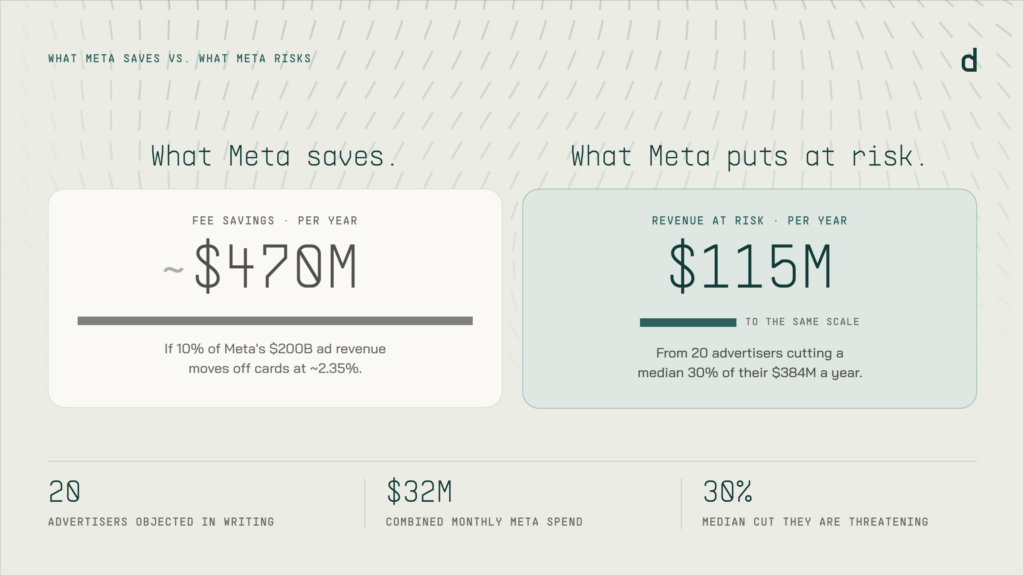
While we don’t know exactly how much of that $200 billion was run on credit cards, if just 10% switched to monthly invoicing, at a typical card-processing cost of around 2.35%, Meta would save close to half a billion dollars each year. If as much as 50% was on credit cards and made the switch, Meta would save nearly $2.5 billion every year.
Either way, it’s an understandable amount of revenue to want back in your pockets.
But let’s look at the other side of this coin.
The 20 advertisers who objected in writing spend a combined $32 million a month (about $384 million a year) with Meta. If they follow through on a median 30% cut, that’s roughly $115 million a year in Meta revenue gone, from just 20 companies. Scale that across the thousands of high-spend accounts Meta is migrating, and the fee savings start to pale in comparison to the revenue at risk.
And they’re not the only ones. Camp Snap CEO Brian Waldman also told MarketWatch that he may pull back his Meta ad spending and look at other channels in its place. David Suk, CEO of Baby’s Brew, expressed the same sentiment, saying his team is looking at other avenues to market the brand as a result of these changes.
Meta is clearly betting these advertisers can’t afford to follow through, and that its reach is too valuable to walk away from. Nick Miller, a growth strategist and co-author of Beyond ROAS who works closely with DTC finance teams, says, “For a DTC brand, it’s very rare not to advertise on Meta. It’s one or the other, Meta or Google, and you play by their rules.”
What Meta actually changed, and who it hits
Meta started sending notices in March 2026 to some of its highest-spend advertisers, warning that credit card billing would end and they’d have to switch to bank-based payment by a set date, or have their ads switched off. Advertisers got two options:
- Monthly invoicing against an assigned credit line
- Direct debit pulled straight from a bank account
A Meta spokesperson explained, “Like other companies in the industry, we are updating and streamlining our billing experience for a very small percentage of advertisers.” They added that the company was “dedicated to making the transition as smooth as possible.”
Meta hasn’t disclosed the spend threshold that decides who’s affected, though reporting and online speculation point to accounts spending roughly $50,000 a month and up. The rollout has also been abrupt. Among the 20 advertisers we tracked, the median gap between getting notice and the deadline was about a month, and 18 of the 20 were handed the exact same date: June 8, 2026.
“I first heard the warning shot at the very beginning of the year,” says Madison Fiore, CRO and partner at Accelerated Growth Studio, a performance agency that spends around $100 million a year on ads across roughly 30 direct-to-consumer brands. “Then I had one of our clients forced to do it about four months ago. And in the last 60 days, it’s become way more prevalent.”
Meta isn’t the first. Google pushed its high-spend advertisers off cards back in 2024. Two of the largest ad platforms on earth have now decided their biggest customers should pay from a bank, not a card, and we can’t help but wonder if other major platforms like TikTok and Amazon will follow suit.
Why advertisers are willing to walk
A 25–35% spend cut might sound drastic until you understand how businesses are actually using their credit cards. For many business owners, their credit card is a financing strategy, not just a payment method.
Take it away, and the costs are tangible.
The rewards: free money, gone
The loss of credit card rewards like miles and cashback is the single biggest cost because it is directly impacting a business’s finances.
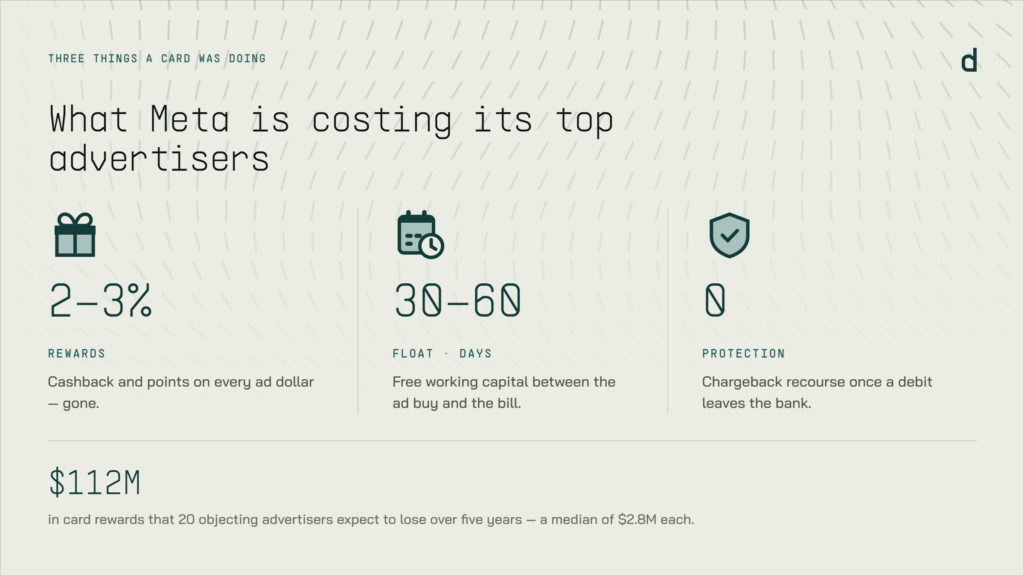
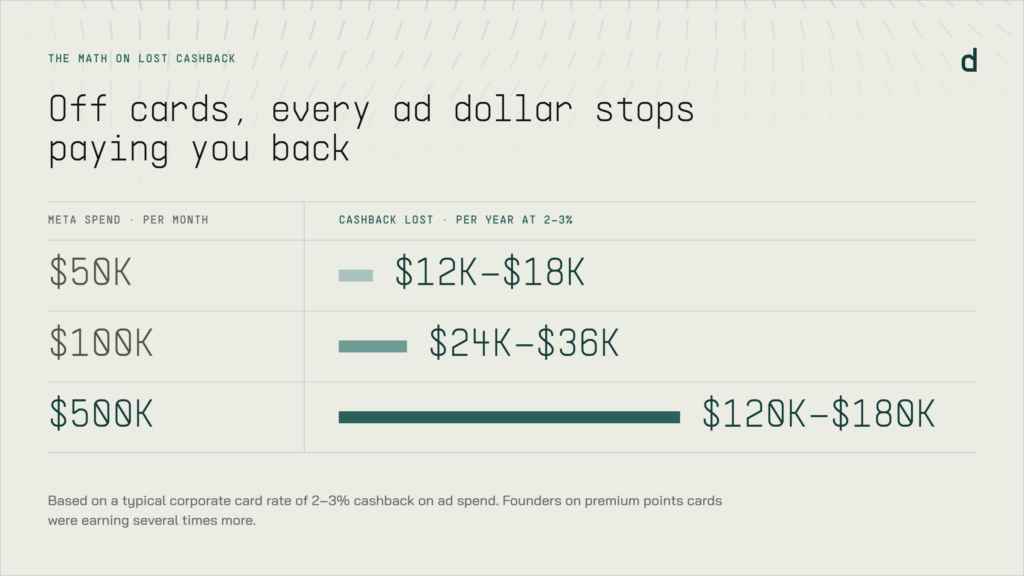
At a typical corporate card rate of 2% to 3% cashback, an advertiser spending $50,000 a month on Meta was earning $12,000 to $18,000 a year in rewards alone. As one X user put it, that’s “free money.”
The heaviest spenders earned far more. “Founders on Amex were getting 4x points on Meta spend—millions of credit card points a year,” Fiore says, “and using that for travel, hotels, all the stuff a founder has to do that usually costs the company money.”
He gives an example: a founder flies to New York to meet a buyer. “It’s $800 for the flight, plus the hotel, but it ends up being $0 on points. That just turned from a zero-cash expense into a three- or four-thousand-dollar cash expense. And that’s a big number for a small DTC brand.”
Business owners also use their credit card rewards to earn additional money to put right back into their businesses. One Reddit user said, “This is gonna affect a ton of small business owners who use credit cards for ad buys and earn rewards to help fund their business.”
Let’s look at the scale of this. The 20 advertisers who sent objection letters to Meta told the company they expected to lose roughly $112 million in card rewards over the next five years, a median of about $2.8 million each. These businesses stand to lose millions simply because Meta decided to switch up how they’re allowed to pay for their ads.
The float: losing a cash-flow cushion that used to fund more growth
The loss of cashback is huge. But the inability to pay for Meta ads with credit cards also impacts how a business manages its cash flow.
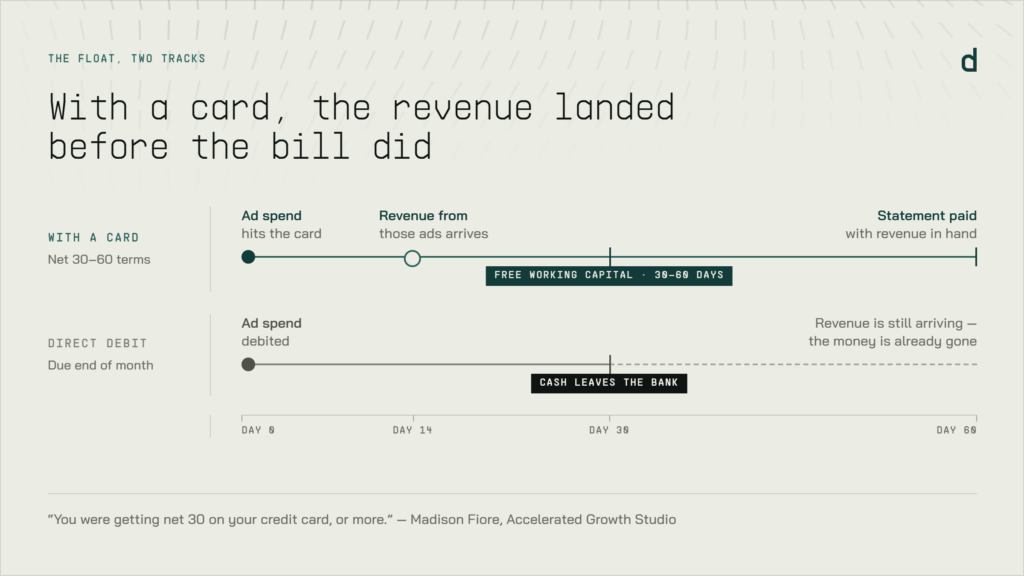
“For everybody who cares about cash flow, you were getting net 30 on your credit card, or more, depending on your statement cycle,” Fiore says. “Plus you were getting all your points. Plus you get the protection.”
Most corporate cards carry net 30 to 60 day terms, giving companies an extra month or two before ad spend comes due. This means they could go big on ads in the meantime, then use the revenue generated by sales from the ads to pay it back, giving businesses additional capital without needing investors.
For Miller, that vanished window is his main issue, and it hit at the worst possible time. His brand, Raw Generation, which currently runs around $300,000 a month on Meta, had just watched its results climb and was ready to scale.
“We’re ready to spend more,” he says. “If we knew we could triple our ad spend profitably right now, with a credit card it wouldn’t matter. We could just increase the spend and factor the interest into next month’s cash flow. But now we have to wait 60 days to get the cash back from sales. So if we triple our spend, that puts us at a million dollars a month, and we’d have to find that cash somewhere else, or get alternative funding, which is complicated.”
By taking away the ability to use credit cards and requiring monthly invoicing or direct debit, ad payments are now due at the end of each month, straight from the business bank account, leaving little to no wiggle room for financing.
One Reddit user explained how this is a huge pain for their agency, saying, “We had this happen with Google last year and it completely messed up our cash flow for like 3 months while we figured out new processes. The worst part is trying to explain to clients why we suddenly need different payment terms when nothing actually changed.”
Fiore thinks many brands haven’t fully felt it yet: “They’re still in that transition. But it’s another annoying thing you have to manage. It’s easy to set up a credit card and set it and forget it. Invoicing has to go through an AP process, and a lot of these businesses don’t have a great AP process.”
The protection: it’s harder to fight fraud from a bank account
Credit cards also have a third job: providing purchase protection. As Fiore notes, “I use credit cards for protection more than convenience.”
This is because credit cards make it easy to dispute a charge and instantly get your money back. When you’re going through a bank account, it gets that much harder to protect yourself against fraudulent charges.
One Reddit user complained, “This is Meta becoming even more scammer friendly. So if my account gets hacked again, I can’t even dispute fraudulent charges with my bank anymore.”
And for some, it breaks how the business is even organized
Sometimes, credit card payments are simply the best form of organization and accounting for the brand. Kristen Pechacek, President of MassageLuXe, shared on LinkedIn how this is impacting her franchise locations.
She explains, “Today each of our locations pays for their own ads with their own credit card, which keeps everything clean from an accounting perspective and is what franchisees prefer. Under Meta’s invoicing structure the credit line sits at the Business Manager level, which makes separating payments by location much harder and removes the credit card option.”
Her company now faces creating 100+ Business Managers, one for each location, in order to organize its Meta ad spending by branch.
Why Meta is doing it anyway
If the move risks so much revenue, why do it? A few reasons.
The first is the fee savings already covered. At Meta’s scale, these do add up to genuine savings, even if they look small against the revenue at risk.
The second is platform integrity. Chris Pollard of Ads Uploader writes, “Tying payments to verified business entities and bank accounts rather than disposable credit cards raises the bar for bad actors. Credit lines require business verification documents, and bank-based settlement exposes real account information. This makes it harder to run the ‘add a card, launch ads, get banned, repeat’ playbook that has plagued the platform. Meta’s lawsuits in early 2026 against deceptive advertisers suggest this fits into a broader cleanup effort.”
And the third, bluntly, is leverage: Meta can do this because advertisers can’t easily leave. As Suk told MarketWatch, Meta “is the 800-pound gorilla in the room.”
Miller puts it more frankly: “Companies like Meta and Google are so big that they can get away with being the opposite of customer-centric. They know you’ll use them regardless.” Redditors seem to agree, with one saying, “Apparently if you spend a lot with them they punish you by removing payment options. Great customer service.”
Miller suspects the move came down to a cold internal calculation, and one he wishes he’d witnessed. “I’d have loved to be a fly on the wall,” he says, guessing the conversation went a little something like this: “A whole bunch of advertisers are going to be upset, and we expect some to cut their ad spend, but overall, what are they going to do? We think it’ll work out in our favor.”
Fiore sees it as a preview of something broader. “The consumer has gotten so lucky with the vendor just eating 3% as a transaction fee,” he says. “Eventually the consumer is going to have to eat that, or they’ll make you pay with cash some other way.”
In his read, Meta, just like Google two years ago, is just an early, visible instance of merchants pushing card fees back onto whoever’s paying.
What advertisers are doing next
While many advertisers are planning to cut back on their overall spend, they’re not planning to quit Meta altogether, and they’re also not planning to simply eat the loss. They’re looking for a workaround that still gives them the perks they’ve built their businesses around.
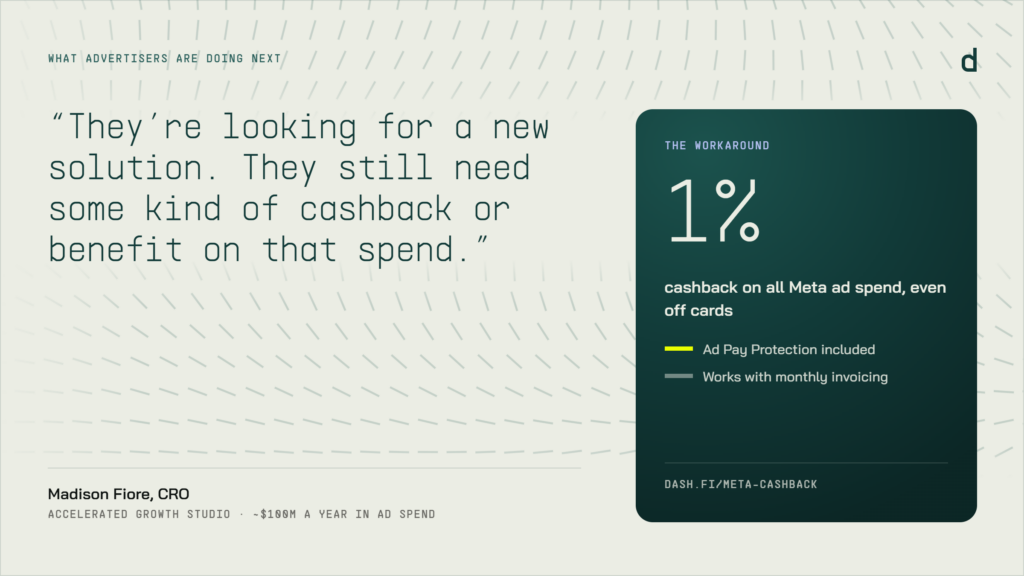
Fiore explains, “They’re looking for a new solution. They still need some kind of cashback or benefit on that spend.”
Miller’s team is weighing the same fix. “Some kind of funding that works like a credit card, that actually fronts the cash so you can pay the invoices, but with the same convenience and benefits of a card,” he says. “That’s something our CFO would be very interested in.”
That’s what Dash.fi built for. With Meta Cashback, advertisers who’ve been forced off cards can still earn 1% cashback on all Meta ad spend, with ad-pay protection included.
The direction seems clear: first Google, then Meta. And if you ask Fiore whether Amazon and TikTok follow, his answer is immediate: “Yes. But it’s also going to slowly become the norm across way more businesses, not just advertising.” He sees it as one early move in a decade-long unwinding of the rewards and float card users have enjoyed.
The only step now is for brands to consider where they’ll go next. Looking for other cashback alternatives, like Dash.fi’s Meta Cashback, as well as keeping their financial strategy adaptable are going to be key, especially if other advertising platforms follow suit.