

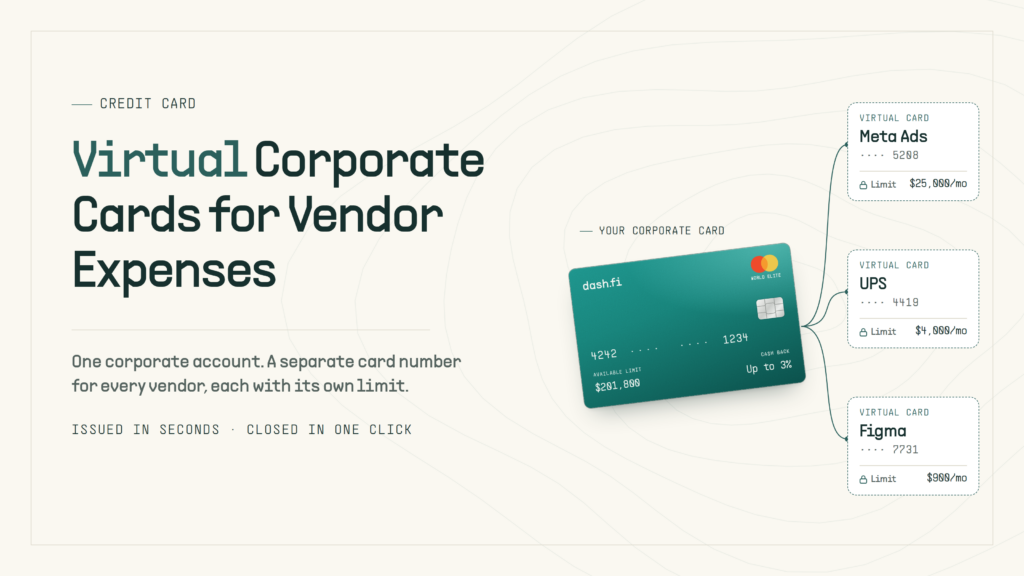
A virtual corporate credit card is a digitally generated card number with an expiration date and security code that’s issued against a company’s existing corporate card account. At its most basic, it’s a standard credit card without the physical, plastic credit card.
Many finance teams generate virtual cards on demand through their card provider’s platform, which can often be done in seconds. The cards can be restricted to a specific vendor, spending limit, or expiration date when it’s generated.
You may hear these cards referred to as “virtual cards” or “virtual business credit cards,” but functionally, they’re the same thing: a card number that exists only in digital form that’s tied to a business’s underlying account.
In general, businesses use virtual corporate cards so they can avoid adding more physical cards to the business while still:
- Paying vendors
- Managing subscriptions
- Controlling recurring or one-off operational spend
How Do Virtual Corporate Cards Work?
Finance teams request a virtual card from their bank, and the issuing platform will generate a unique card number tied to the company’s master account.
Before it’s used, the card can be configured for:
- Spend limit: a maximum dollar amount, set either as a single-transaction cap or a recurring monthly limit
- Merchant lock: restrict the card to a single vendor or a merchant category code (MCC), so the card only works with that specific supplier or type of purchase
- Expiration: single-use cards that close automatically after one transaction, or standing cards for recurring billing
- User or project assignment: tied to a department, project, or individual employee for tracking and reconciliation
When the cardholder uses the card for a purchase, the virtual card number is processed just like a physical card number would be. Card networks apply tokenization and network-level security standards to the transaction. This means that the number a vendor sees and stores is a substitute credential rather than the company’s core account details.
If that number is compromised, the business can shut it off without affecting any other card on the account.
How Do I Get a Virtual Corporate Credit Card?
Businesses typically get virtual cards by opening an account with a corporate card provider or fintech platform, like Dash.fi’s corporate card. Once approved, an administrator can generate individual cards instantly from the platform dashboard.
You won’t need to go through a separate application process for each card.
Traditional banks may offer virtual card add-ons to an existing business credit line, but the process to issue those cards is usually slower and less configurable than fintech-first platforms built around virtual-card-first workflows.
Virtual Cards vs. Physical Corporate Cards vs. Traditional Business Credit Cards
It’s easy to confuse the three different card types, but they actually solve different problems. A traditional business card is a general-purpose account, and it usually has one or two physical cards attached. A physical corporate card is typically one of several cards issued under a broader corporate card program. It’s meant for in-person or recurring physical purchases. A virtual corporate card is a card number generated on demand from that same program, built specifically for vendor payments, subscriptions, and other card-not-present spend.
| Feature | Virtual Corporate Card | Physical Corporate Card | Traditional Business Credit Card |
|---|---|---|---|
| Form factor | Digital-only number, no plastic | Physical plastic card issued to an employee | Physical plastic card, often tied to a personal guarantee |
| Issuance speed | Instant, generated in seconds from a dashboard | Days to weeks for manufacturing and shipping | Days to weeks, subject to underwriting |
| Best for | Vendor payments, subscriptions, one-off purchases | In-person or recurring physical purchases (travel, fuel, supplies) | General-purpose spend on a single shared account |
| Spend controls | Per-card limits, merchant locks, single-use options | Card-level limits set at issuance; harder to adjust per purchase | Typically one limit for the whole card, less granular |
| Issuing scale | Unlimited cards can be generated per vendor or project | Limited by physical card issuance and mailing | Usually one or a small number of cards per account |
| Fraud exposure | Narrow: a compromised number can be shut off without affecting other cards | Broader: a lost or skimmed card exposes the whole card | Broadest: a compromised number often means reissuing the primary card |
Common Use Cases for Virtual Corporate Cards
Because virtual cards can be created instantly and locked to a specific vendor or purpose, businesses use them for spend categories that are harder to control with a single shared card number:
- Vendor payments: paying suppliers, contractors, and service providers with a card locked to that vendor and a defined monthly limit
- Subscriptions and SaaS: assigning one card per software tool so a canceled subscription can’t quietly keep billing the company
- Marketing and ad spend: issuing cards per platform or campaign to isolate and track spend
- Freelancer and contractor payments: funding a project-specific card instead of sharing a general-purpose account number
- Travel and one-time purchases: generating a single-use card for a specific booking or purchase, then letting it expire automatically
- Recurring operational expenses: utilities, hosting, and other fixed monthly costs, each tracked on its own card for easier reconciliation
Can I Use Virtual Cards for Subscription and Vendor Payments?
You can. It’s one of the most common uses of virtual corporate cards because each card can be locked to a single vendor and given a defined monthly limit. So finance teams can assign a dedicated virtual card to each recurring vendor or subscription.
If a vendor relationship ends, or you don’t need the subscription anymore, you can simply close that specific card without disrupting any other vendor payment or subscription running on the account.
Key Features Finance Teams Should Evaluate
Each virtual card program will have its own level of control, so when evaluating a provider, finance teams should look at the following:
Spend Limits and Controls
The ability to set a hard dollar limit per card, per transaction, or per month, and to adjust or revoke that limit at any time without canceling the underlying account.
Vendor-Specific Cards
The ability to issue a card locked to a single vendor or merchant category, so spend can’t drift to unapproved purchases. This is also the foundation of most vendor management workflows, since each vendor’s payment activity lives on its own card.
Security
Check card-level controls like expiration dates, single-use settings, and the ability to freeze or close a card instantly, and determine how they combine with network tokenization that keeps the underlying account number out of a vendor’s system entirely.
Approval Workflows
Built-in approval workflows let finance teams require sign-off before a new virtual card is issued or before spend above a certain threshold clears, without manual back-and-forth over email or Slack.
Expense Tracking and Categorization
Because each virtual card is tied to a specific vendor, project, or employee, transactions arrive pre-categorized, which cuts down on manual coding at month-end and supports the documentation businesses need for IRS recordkeeping guidance on business expenses. Strong expense management tooling turns that transaction-level detail into reconciled books automatically.
Integrations
Native connections to accounting software and ERPs, so card transactions sync to the general ledger without a manual export-and-import step.
Rewards
Some providers attach cash back or rewards to virtual card spend, which can meaningfully offset costs for businesses running high volumes of vendor and subscription payments through virtual cards.
Fees
Annual fees, per-card fees, foreign transaction fees, and any fees tied to specific card features (such as instant issuance or single-use cards) all factor into the total cost of a program, especially for businesses issuing a high volume of cards.
Benefits of Using Virtual Corporate Cards
The primary benefit of virtual cards is visibility: instead of one shared card number that generates a single transaction feed, each vendor, project, or subscription gets its own card number. This means it gets its own transaction history, so finance teams gain several practical advantages:
- Real-time visibility into which vendor, department, or project is driving spend, without waiting for a month-end statement
- Tighter control over company-wide spending, since limits and merchant locks are set at the card level rather than enforced after the fact
- Faster reconciliation, because transactions are already segmented by vendor or purpose when they hit the books
- Reduced exposure to fraud or billing errors, since a single compromised card can be closed without affecting any other vendor relationship
Risks and Limitations of Virtual Cards
Still, virtual cards aren’t fit for every transaction, and they do come with limitations worth planning around:
- Merchant acceptance: some vendors, particularly smaller or in-person businesses, may not accept card-not-present virtual card numbers
- Platform dependency: issuing and managing cards relies on the provider’s platform being available; an outage can delay a time-sensitive payment
- Card sprawl: issuing a card per vendor or project can create a large number of active cards if unused ones aren’t closed regularly
How Do Chargebacks and Disputes Work for Virtual Card Numbers?
Disputes on a virtual card follow the same process as a physical card: the cardholder will file a dispute with the issuer, and the issuer will investigate with the merchant’s bank under standard network rules.
The advantage you get with a virtual card is that you can close a single card the second you notice a problem, like with a subscription that keeps billing after it’s been cancelled. You can stop future charges outright rather than relying on a dispute to reverse them after the fact.
Do Virtual Cards Impact My Business Credit Score?
Virtual cards don’t carry a separate credit card profile. Because they’re tied to the credit line of the corporate card program, whether they impact your business credit score depends on the provider. Some will report utilization to business credit bureaus, while charge-card-style programs that require full monthly payment may not.
You can confirm reporting practices directly with the issuer of your virtual card.
How Do I Choose Between a Physical and Virtual Corporate Card?
The two aren’t mutually exclusive, and most businesses actually use both, matching each to the type of purchase:
- Choose virtual for vendor payments, subscriptions, recurring bills, and any purchase made online or over the phone
- Choose physical for in-person purchases, travel, and situations where an employee needs to present a card directly to a merchant
- Consider volume and risk exposure: businesses issuing cards to many vendors benefit from the speed of virtual cards, and a compromised virtual card limits exposure to a single vendor relationship rather than the whole account
Best Practices for Managing Virtual Corporate Cards
- Set spend limits and merchant locks at issuance rather than adjusting after a transaction has already occurred
- Close single-vendor cards promptly when a vendor relationship or subscription ends
- Review active cards on a regular cadence to catch unused cards before they become a security or reconciliation gap
FAQs
What features should I look for when choosing a virtual corporate card provider?
Prioritize granular spend controls, vendor-level card issuance, strong approval workflows, and accounting integrations. For more details, see the features covered in the section above.
What should I use virtual cards for?
Vendor payments, subscriptions, recurring operational costs, and any other card-not-present purchase where isolating spend by vendor or project adds value.
Are virtual cards free to use?
Costs will vary by provider: some bundle virtual card issuance into a broader corporate card program at no per-card fee, while others charge issuance or transaction fees. Be sure to confirm the fee structure directly with the provider.
How many virtual cards can a business issue?
Most providers don’t cap the number of virtual cards a business can generate, since each one draws against the same underlying credit line rather than requiring separate underwriting. In practice, the limiting factor is operational: you want enough cards to isolate spend by vendor or project, without so many that unused cards go unmanaged.
Do virtual corporate cards work for international vendors?
Yes, in most cases. A virtual card runs on the same card network (Visa or Mastercard) as its physical counterpart, so it works anywhere that network is accepted. Foreign transaction fees, if any, are set by the underlying card program rather than by the fact that the card is virtual.
Can a virtual card be reloaded or reused after it expires?
It depends on how the card was configured. Single-use virtual cards close permanently after one transaction, but standing cards set up for recurring billing or ongoing vendor payments continue to work until the business closes them or the expiration date set at issuance is reached.