Ecommerce returns management is the process of handling a product after a customer sends it back:
- Issuing a return label
- Receiving and inspecting the item
- Restocking or liquidating it
- Processing the refund or exchange
And after Black Friday and Cyber Monday (BFCM), it’s also a cash flow problem.
Your holiday orders book as Q4 revenue. The returns and the refunds that come with them land in December and January. Every one of those returns carries its own label, carrier surcharges, handling labor, and often a billing error nobody catches. In 2025, retailers expected to see 17% of their holiday sales coming back, according to the National Retail Federation (NRF) and Happy Returns.
In this guide, we’ll break down what a return is really costing you and why January refunds put pressure on your cash flow. We’ll also look at how to recover part of that cost through cash back, invoice auditing, and flexible payment terms.
What Does an Ecommerce Return Really Cost?
Most brands track the refund. Fewer track the full cost stack behind it. Industry estimates put the cost of processing a single return at 20% to 65% of the item’s original value, depending on your category, policy, and how efficient your reverse logistics are.
Online orders also come back more often than in-store purchases. NRF and Happy Returns estimated that 19.3% of online sales would be returned in 2025, compared with 15.8% of total retail sales.
About 9% of all returns were fraudulent.
The return cost stack
| Cost component | what it covers | typical cost |
|---|---|---|
| Return label postage | Carrier charge to move the item back to you | About $5–$8 for a USPS Ground Advantage return label; UPS and FedEx vary by contract, zone, and weight |
| Carrier return label fee | Per-label accessorial on carrier return services | $1.15 per UPS electronic or print return label in 2026 |
| Surcharges | Fuel, Additional Handling, demand (peak) surcharges, and DIM weight adjustments | Fuel is a percentage on top of the rate and most surcharges; demand fees run into mid-January |
| Original outbound shipping | The free shipping you paid for on the original order | Not recovered when you refund |
| Processing labor | Receiving, inspection, grading, restocking | Scales with volume and spikes in January |
| Repackaging and refurbishment | New bags, boxes, tags, and cleaning | Per unit |
| Payment processing fees | Card fees on the original sale | Many processors don’t return the original fee when you refund |
| Value loss | Markdowns, liquidation, write-offs | Only about 48% of returned items resell at full price |
| Fraud | Empty boxes, wardrobing, counterfeit swaps | About 9% of returns |
Worked example: one $80 return in January
Here’s an illustrative cost for one $80 apparel item returned on a prepaid UPS label in early January:
| line item | cost |
|---|---|
| Return label postage (contract rate) | $8.50 |
| UPS return label fee | $1.15 |
| Receiving, inspection, and restock labor | $4.00 |
| Repackaging | $1.50 |
| Unrecovered card processing fee (2.9% + $0.30) | $2.62 |
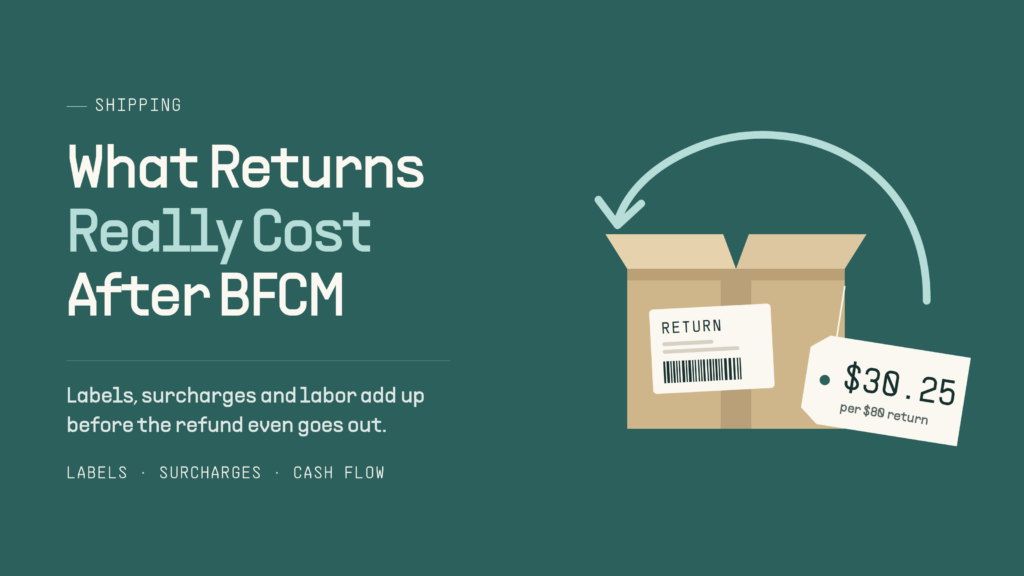
| Expected markdown loss (52% chance it resells below full price × hypothetical 30% markdown) | $12.48 |
| Total cost of the return | $30.25 (38% of item value) |
And this is before the outbound shipping you already absorbed and before any billing error on the label itself. Multiply this figure across a season’s worth of returns, and you’ve got a line item your Q4 margin model probably didn’t include.
Why Return Shipping Costs More After BFCM
Prepaid return labels vs. pay-on-use labels
How you issue return labels decides what you pay for them.
| Prepaid (charged at creation) | Pay-on-use (scan-based) | |
|---|---|---|
| When you’re billed | When the label is created | Only when the carrier scans the package |
| Best for | On-demand labels after a customer requests a return | In-box labels or labels generated in bulk |
| Cost of an unused label | Full postage unless you void it | $0 |
| Watch out for | Paying for labels that never ship | Per-piece fees on some carrier services |
If you drop a prepaid label in every holiday box and pay at creation, you’re paying for every order, not every return.
Peak surcharges don’t end on December 25
UPS and FedEx demand surcharges run well past the holidays. For 2026, UPS demand fees end January 16, 2027, and FedEx’s end January 17, 2027. Your post-holiday returns ship inside that late-peak window. (See the full 2026 peak season surcharge schedule.)
| Late-peak demand fee | UPS (Dec. 27 – Jan. 16) | FedEx (Dec. 28 – Jan. 17) |
|---|---|---|
| Additional Handling | $8.75 | $8.80 |
| Large Package / Oversize | $96.25 | $95.75 |
Fuel surcharges apply on top of demand fees, so the effective cost is higher than the published number. Returns are also where packaging goes sideways. A customer who reships a small item in an oversized box can trigger Additional Handling or a dimensional weight adjustment that the original shipment never triggered.
Billing errors pile up when nobody’s looking
Peak volume is the time when invoice errors multiply and review time disappears. Common return-season errors include:
- Demand surcharges billed outside the published window
- Additional Handling charged on packages that don’t meet the criteria
- DIM weight adjustments based on incorrect measurements
- Charges for voided or unused labels
- Contract discounts not applied to return services
Shippers typically recover 1% to 5% of total shipping spend through invoice auditing alone. Carriers set firm deadlines for billing disputes. FedEx, for example, requires invoice adjustment requests for overcharges within 180 days of the shipment date, so January’s errors come with a deadline. Parcel audit software checks every line, so you don’t have to.
Why January Refunds Put Pressure on Cash Flow
The revenue arrives in November and December. The refunds go out in January. Returns peak in the first business days of January, which UPS has called National Returns Day.
If a brand with $1.5 million in holiday sales experiences a 17% return rate, it could face approximately $255,000 in refunds, with a substantial portion potentially affecting cash flow in December and January.
That’s before return shipping and processing costs.
| January outflow | Why it lands now |
|---|---|
| Customer refunds | Holiday returns peak in the first weeks of the year |
| Return shipping and surcharges | Late-peak demand fees run until mid-January |
| Q4 card and ad spend statements | BFCM ad spend comes due |
| Inventory payables | Net terms on Q4 inventory purchases mature |
| Carrier rate increases | UPS and FedEx general rate increases typically take effect in late December or early January |
Meanwhile, if January is usually one of your slowest sales months, you’re paying for last quarter’s growth with this quarter’s cash.
How to Absorb Return Costs: Focus on Revenue Recovery, Not Just Refunds
Cutting back on refunds can hurt conversion: 82% of shoppers say free returns are a key factor when they decide to buy. So the thing to focus on is recovering more of what the return season costs you.
1. Earn cash back on every return label
Return labels are shipping spend. If you pay UPS and FedEx on a card that earns rewards, every return label sends money back to you. With the Dash.fi card, you get 3% back on all UPS and FedEx spend or 50% of the savings the Shipping Audit finds, whichever is greater. On $50,000 in carrier spend during returns season, 3% is $1,500 back.
2. Audit every peak and returns invoice
Many ecommerce companies lose about 12% of their shipping costs to leakage. The Dash.fi Shipping Audit checks every UPS and FedEx invoice against your contract and flags surcharge overcharges. It will even file the refund claims for you. And these services are free with the Dash.fi card. If you’d rather start manually, here’s how to claim a UPS refund.
3. Use flexible payment terms to bridge January
Putting shipping, ad, and vendor spend on a charge card moves the cash outflow from the day you buy to the statement due date. That float keeps working capital free for refunds and inventory while January sales catch up. Pair it with net terms on inventory and you stop funding December’s returns out of January’s thin receipts.
How to Optimize Your Returns Management Process
- Switch in-box labels to pay-on-use. You stop paying for labels that never ship.
- Lead with exchanges and store credit. An exchange keeps the revenue; a refund doesn’t. Some brands also charge a fee on non-exchange returns. Nearly three-quarters of retailers now charge for at least some returns.
- Track return reasons by SKU. Fit and description problems are cheaper to fix on the product page than in the warehouse.
- Give packing instructions. Ask customers to reuse the original box to avoid Additional Handling and DIM weight charges.
- Set a firm holiday return window. Then model the refund liability so January doesn’t surprise you.
- Negotiate return services at renewal. Return label fees, return service discounts and peak surcharge caps are all on the table. See the most negotiable parts of a UPS or FedEx contract.
How USPS Prepaid Return Labels Work (and How to Send One)
A USPS prepaid return label lets you cover the return postage so the customer ships for free. Most merchants use USPS Ground Advantage Return or Priority Mail Return, generated through a shipping platform or USPS business tools, with scan-based billing, so you’ll pay only when the label is used.
- Pick the service. Ground Advantage Return keeps costs down; Priority Mail Return gets the item back faster.
- Generate the label. Create it in your shipping platform with you as the recipient, and select pay-on-use billing.
- Send it. Email a PDF, send a Label Broker QR code that any Post Office can print, or use USPS Label Delivery Service to mail a printed label for $1.65.
- Track the scan. Trigger the refund or exchange on the first scan or on receipt, depending on your fraud risk.
USPS return labels may remain valid for up to one year, depending on the shipping platform. FedEx return label validity varies by label type and service, with some printed return labels having no expiration date.
Best Ways to Save Money Shipping Returns With UPS
- Use electronic return labels instead of print-and-mail labels, which carry a higher service fee.
- Negotiate the return label fee and return service discounts into your contract.
- Route returns through drop-off networks like UPS Access Points and box-free returns at The UPS Store.
- Prevent Additional Handling on returns with clear packing instructions.
- Audit every invoice and claim refunds inside the dispute window.
Ecommerce Returns Management FAQs
What is ecommerce returns management?
Ecommerce returns management covers everything that happens after a customer sends an online order back: return labels, transportation, receiving, inspection, restocking or liquidation, refunds and exchanges, and the data you collect along the way.
How much does it cost to process an ecommerce return?
Estimates range from 20% to 65% of the item’s original value once you count shipping, labor, repackaging, and value loss. Return volume adds up fast: the NRF’s 2025 Retail Returns Landscape estimated $849.9 billion in U.S. returns for the year.
Do UPS and FedEx peak surcharges apply to returns?
Handling and size demand fees apply to any package that triggers them, including returns, until mid-January. Service-level demand fees depend on the service and delivery type.
How long do you have to dispute a UPS or FedEx billing error?
FedEx requires invoice adjustment requests for overcharges within 180 days of the shipment date. UPS sets its own deadline in the invoice adjustment section of its Tariff/Terms and Conditions of Service. Check your contract for the exact window on each error type.
Recover More From Returns Season
Return season doesn’t have to eat your Q1. The Dash.fi Shipping Audit catches surcharge and billing errors on every UPS and FedEx invoice and files the claims for you. It’s free with the Dash.fi card, and you get 3% back on your shipping spend or 50% of the savings we find, whichever is greater.