

If you’re regularly shipping products that are lightweight but require bulky packaging, like pillows, duvets, pool floats, or stuffed animals, you’ve likely noticed your shipping bills climbing, even though your package weight is not. The reason for this shift is dimensional weight, the pricing method most carriers use to charge you based on the space your package occupies rather than its actual weight.
Once you figure out how these charges work and why carriers have adopted them, you can figure out how to minimize their impact on your profit margins.
What Is Dimensional Weight?
Dimensional weight is the price metric UPS, FedEx, and USPS use to determine the billable weight of a package. You may also hear it referred to as DIM weight or volumetric weight. Carriers then decide whether to use the actual weight of the package or the DIM weight, and it’s usually the higher of the two.
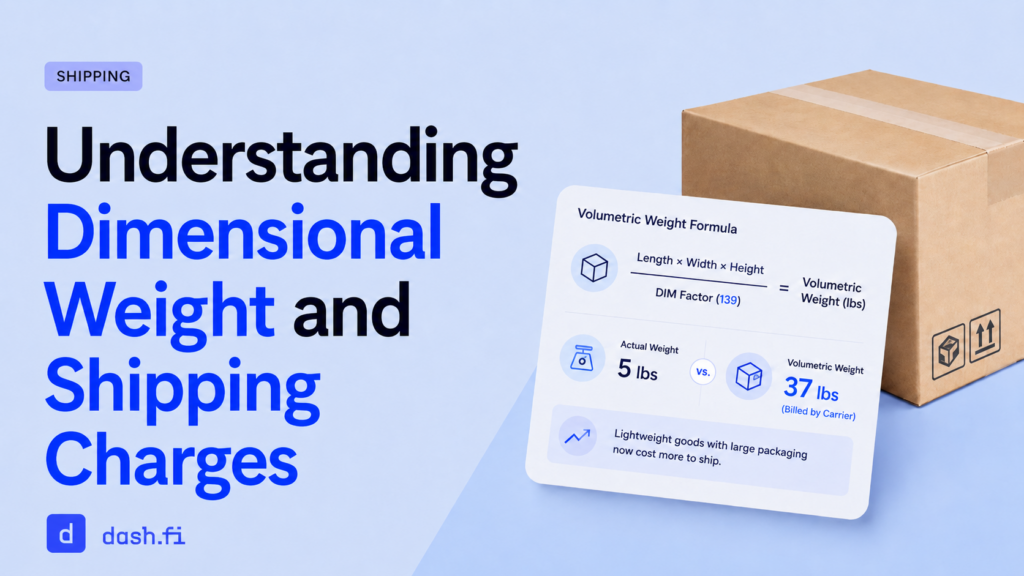
Here’s the standard formula:
Dimensional Weight = (Length × Width × Height) ÷ DIM Factor
The DIM factor is a divisor set by each carrier. For domestic shipments, UPS and FedEx both use 139 (this is cubic inches per pound). So a box measuring 24 x 18 x 12 inches has a cubic volume of 5,184 cubic inches. When you divide that by 139, you get a DIM weight of around 37 pounds. And this is the weight the carrier will use, even if the actual package only weighs 5 pounds.
Dimensional Weight Example (DIM Factor = 139)
| Box Dimensions (in) | Cubic Volume (in³) | DIM Weight (lbs) | Actual Weight (lbs) | Billable Weight |
|---|---|---|---|---|
| 12 × 10 × 8 | 960 | 7 lbs | 3 lbs | 7 lbs (DIM wins) |
| 18 × 14 × 10 | 2,520 | 18 lbs | 10 lbs | 18 lbs (DIM wins) |
| 24 × 18 × 12 | 5,184 | 37 lbs | 40 lbs | 40 lbs (actual wins) |
| 20 × 20 × 16 | 6,400 | 46 lbs | 8 lbs | 46 lbs (DIM wins) |
Is There a Difference Between Dimensional Weight and Volumetric Weight?
No. When it comes to how carriers charge you for your packages, the two terms are interchangeable. U.S. parcel carriers use “dimensional weight,” while international and air freight carriers usually say “volumetric weight,” but the formula is the same in both cases.
The divisor, however, may change based on your carrier and shipping lane. International freight typically applies a factor of 5,000 cubic centimeters per kilogram, while domestic U.S. carriers use the 139 cubic inches per pound factor.
It’s important to confirm which divisor is being used for your specific lane before you calculate your expected charges.
Why Are Carriers Shifting to Dimensional Weight Pricing?
It makes sense if you think about it: trucks and aircraft only have so much room in terms of volume for shipping, usually a bigger factor than weight. A truck or plane filled with lightweight but bulky boxes will often fill up faster than medium-sized, heavier boxes, but they’ll generate much less revenue if the pricing is based only on weight.
UPS and FedEx expanded their DIM pricing to all of their domestic ground packages in 2015, which changed the pricing and cost models for e-commerce businesses at a fundamental level. Before that shift, DIM pricing applied mainly to express and air shipments, but the ground expansion meant that virtually every brand using oversized packaging started paying a premium that had previously been invisible.
The categories that hit the hardest and fastest were the ones shipping the products with the lowest density: home goods, seasonal decor, apparel with rigid boxes, and subscription brands with fill rates that varied widely and inconsistently.
These sellers saw a huge spike in their pricing, but their carrier service and their own selling and shipping behaviors never changed. Great for the carrier, not so much for the shipper.
How Does Dimensional Weight Impact Your E-commerce Business?
Of course, DIM pricing isn’t distributed evenly amongst all shippers. Brands in certain product categories tend to pay more on a consistent basis because of the nature of what they sell and regularly ship.
| Product Category | Why DIM Pricing Hurts | Typical DIM vs. Actual Weight Gap |
|---|---|---|
| Home goods & decor | Large boxes, low density (pillows, vases, frames) | High: often 3x to 5x actual weight |
| Apparel & footwear | Shoe boxes + shipping boxes = excess air | Moderate: 1.5x to 3x actual weight |
| Electronics accessories | Standard box sizes don’t match the product size | High: cables in oversized packaging |
| Subscription boxes | Curated variety = inconsistent fill rates | Variable: depends on curation |
Brands with higher DIM weights often don’t catch on to the full scope of their pricing model until they run a shipping audit. As a result, many are losing a significant percentage of their shipping spend to oversized packaging when they don’t have to. Simply implementing an initiative to package more efficiently could drop those prices dramatically.
How to Reduce Your Dimensional Weight Charges
If you can reduce your DIM weight, you solve the packaging efficiency problem. The goal is to minimize as much void space between your product and the walls of the packaging box as possible, while still maintaining protection.
Here’s where you can focus:
Audit Your Box Sizes
Pull your top 20 SKUs by shipping volume and measure the average void space per box. Calculate the DIM weight being charged versus what a properly fitted box would be charged. Even a modest reduction, say 2 inches per side, can cut your DIM weight by a lot, which can compound fast across thousands of shipments per month.
Standardize Your Box Sizes
Many businesses are still using far more box sizes than they need to, which can leave your staff to default to the “next size up” when the right box isn’t easy to find. Instead, pick 4 to 6 well-chosen box sizes and keep them readily available to your staff, so you reduce oversized packaging and simplify the picking and packing workflow.
Use Mailer Packaging
Poly mailers and padded mailers are designed to cut your void space. When you use these for soft goods, apparel, and lightweight accessories, which typically produce a far lower DIM weight than even a modestly sized rigid box, you’ll end up spending a lot less per unit.
Negotiate Your DIM Factor
Remember that you’re not stuck with your rate. If you ship a significant parcel volume, you can often negotiate your DIM factor, having your carrier adjust the divisor in your shipping contract. If you can negotiate from a DIM factor of 139 to 166 on a 24 x 18 x 12 box, your DIM weight will drop from 37 lbs to 31 lbs. That’s a 16% reduction per package, and you haven’t even started standardizing your boxes yet.
What Is the Fastest Way to Find DIM Savings Opportunities?
The fastest path to saving starts with a systematic parcel data analysis, where you pull 90 days of carrier invoices and identify every single shipment where the dimensional weight exceeded the actual weight. Calculate the DIM premium per shipment by finding the difference between the billed weight and the actual weight and then multiplying that number by your per-pound rate for that service tier.
Now, group your results by SKU or product category to find where the most DIM overage is concentrated, and then model the savings from right-sizing your top offending boxes.
Next, review your contract terms. If you’ve never negotiated your DIM factor, it’s probably sitting at the default 139. Just negotiating that single number can be worth more than any packaging change.
If you’re shipping hundreds of packages every week, you should perform a formal shipping audit to benchmark your actual figures across all your shipping cost categories, not just dimensional weight. This audit will show you where you have the most opportunity for saving money across your full carrier spend.
How to Leverage Packaging Efficiency for Profit
If you’re a brand shipping 10,000 orders every month, and your average DIM weight overage is 3 lbs, at a per-pound rate of $0.50, you’re paying $15,000 every month in extra charges you shouldn’t be paying.
Just by right-sizing your packages, you can cut those overages in half and save $90,000 every year. And when your volume spikes during peak season? Those savings, or losses, go even higher.
When you start treating packaging as a cost lever, not just an issue of branding and protection, you start to build a structural shipping cost advantage into your bottom line. You can start to optimize your shipping by combining regular packaging audits with regular reviews of your DIM weight shipping profiles today, and benefit from immediate savings and ongoing returns.
3PL Relationships Can Complicate DIM Optimization
One thing that’s important to remember is that if you’re using a third-party logistics provider, optimizing your DIM weight can start to get more complicated. Most 3PLs stock box sizes specifically for operational convenience across all their clients, not for your specific SKU mix. This means that your lightweight, compact product might consistently be shipping in a box two sizes too large simply because that’s what’s available at the pick station, and you’ll pay a premium every time.
The other problem is visibility: your carrier invoices will go to the 3PL first, and you’ll only see them later, as an abstracted fulfillment fee. So you won’t get the shipment-level data you need for an audit, like actual dimensions or billed weight. You can’t fix a problem you can’t see.
Here’s what you can do:
- Request a raw carrier invoice from your 3PL, with dimensions and billed weight at each shipment level.
- Ask about getting custom boxes for your high-volume counts.
- Review your contract for any packaging discretion clauses and negotiate for your top SKUs.
You may ultimately want to reconsider using a 3PL if their defaults are driving your DIM weight up and not protecting your margins, and you can’t negotiate those weights back down.
Frequently Asked Questions
Does dimensional weight apply to USPS?
Yes. USPS applies dimensional weight to Priority Mail and Priority Mail Express packages that exceed one cubic foot (1,728 cubic inches). They don’t apply this same pricing to packages below that threshold, making USPS an attractive option for lightweight, modestly sized packages where cubic volume stays under the limit.
Can I avoid dimensional weight charges with flat rate shipping?
Sometimes. USPS Flat Rate boxes aren’t subject to DIM pricing. You’ll pay the flat rate regardless of weight or dimensions, as long as the item fits. The problem is that the flat rate isn’t always the cheapest, especially for heavier packages. Comparing flat rate costs against zone-based DIM pricing for your specific package profiles is the only reliable way to figure out if it’s the better option per shipment.
How often do carriers change their DIM factors?
In general, carriers will announce their rate changes in the fall for implementation the following January. FedEx and UPS both publish annual rate change notices that include any modifications to their DIM pricing methodology. Be sure to watch for these announcements and model their impact on your specific shipping profile to stay on top of your annual cost planning.
Is dimensional weight the same as freight class?
No. Dimensional weight applies to small parcel shipments via UPS, FedEx, and USPS. Freight class is a separate classification system for LTL (less-than-truckload) freight, determined by the NMFTA, and based on density, stowability, handling requirements, and liability. The two systems don’t overlap.
The Bottom Line
In the end, dealing with dimensional weight pricing means volume matters more than actual weight, and it usually matters a lot more. This means that if you’re a brand shipping products that are lightweight but bulky, your DIM premium may be quietly inflating your costs well beyond weight-based pricing, and you often won’t see any clear sign on your carrier invoices that something is off.
To fix this issue, you need to be able to see it and understand it. When you know how much of your spend is driven by DIM weight and which products are most exposed, you can come up with a strategy for packaging your products more efficiently for shipping.
To get started today, you can sign up for the dash.fi corporate card, and you’ll get a free shipping audit as a built-in feature. It’s the fastest way to quantify your DIM weight exposure and find out exactly where, and how much, your savings are.