A peak season surcharge is a temporary per-package fee that UPS and FedEx add to shipments during the holiday rush, on top of your base rate and every other surcharge you already pay. For 2026, both carriers raised these fees again, started charging them in late September, and stretched them into mid-January 2027.
If you ship e-commerce orders, the headline $0.75 or $0.80 per residential package is the smallest number in this article. The real exposure comes from how the fees stack, how volume tiers work, and how early bulky packages get hit.
Here’s the full 2026 schedule, side by side, and what you can do about it.
What Is a Peak Season Surcharge (PSS)?
A peak season surcharge (PSS) is a time-bound fee that carriers apply when they know that demand will increase. This usually takes place between Black Friday and Christmas. UPS and FedEx officially call these “demand surcharges.” Shippers, 3PLs, and the trade press usually call them peak season surcharges or holiday surcharges, but in reality, they’re one and the same.
Three things define a PSS:
- It’s temporary. It only applies inside published date windows, and it disappears afterward.
- It’s per package. Two boxes to the same address pay the fee twice.
- It’s additive. It sits on top of your base rate, residential surcharge, accessorials, and fuel. It doesn’t replace any of them.
Why Do Carriers Charge Peak Season Surcharges?
Holiday volume forces carriers to add temporary capacity:
- Seasonal drivers
- Rented trucks and aircraft
- Extra sort shifts
- Overtime
Peak surcharges shift part of that cost to the shippers who are creating that surge. FedEx frames them as a way to cover elevated volume and capacity constraints while protecting service reliability.
They also work as a pricing lever.
The fees are steepest on the packages that are hardest to move (oversized, non-conveyable, or residential at scale), which nudges shippers toward cleaner, more predictable volume. And because fuel surcharges apply to demand surcharges, the carrier collects a percentage on top of the fee itself.
When Do 2026 Peak Season Surcharges Start and End?
Both carriers run two start dates and three pricing windows. Size and handling fees start first. Service-level fees on residential ground and air start four weeks later. All of them peak between Thanksgiving week and Christmas, then drop back to the opening rate until mid-January.
| Window | UPS | FedEx |
|---|---|---|
| Handling/size fees begin | Sept. 27, 2026 | Sept. 28, 2026 |
| Service-level fees begin | Oct. 25, 2026 | Oct. 26, 2026 |
| Highest rates (peak of peak) | Nov. 22 – Dec. 26, 2026 | Nov. 23 – Dec. 27, 2026 |
| Surcharges end | Jan. 16, 2027 | Jan. 17, 2027 |
Two practical takeaways: if you ship bulky items, you’ve been in peak pricing since the last week of September. And your post-holiday returns and gift-card redemption orders ship inside the late-peak window, so they carry surcharges, too.
What Are the UPS Peak Surcharges for 2026?
UPS published its 2026 demand surcharge schedule on August 26. All amounts below are per package, for U.S. domestic shipments.
UPS service-level demand surcharges (under 20,000 packages per week)
| Service | Oct. 25 – Nov. 21 | Nov. 22 – Dec. 26 | Dec. 27 – Jan. 16 | 2025 peak |
|---|---|---|---|---|
| Ground Residential | $0.50 | $0.75 | $0.50 | $0.60 |
| Ground Saver | $0.50 | $0.75 | $0.50 | $0.60 |
| Next Day Air and all other Air | $1.35 | $2.50 | $1.35 | $2.05 |
UPS handling and size demand surcharges
| Surcharge | Sept. 27 – Nov. 21 | Nov. 22 – Dec. 26 | Dec. 27 – Jan. 16 | 2025 peak |
|---|---|---|---|---|
| Additional Handling | $8.75 | $11.90 | $8.75 | $10.80 |
| Large Package | $96.25 | $117.50 | $96.25 | $107.00 |
| Over Maximum Limits | $530.00 | $590.00 | $530.00 | $540.00 |
UPS Higher Volume Shipper Tiers
If you were billed for more than 20,000 combined residential and Ground Saver packages in any single week since October 2025, UPS moves you off the flat table and onto a volume-indexed schedule. Each week’s volume is compared with your average weekly volume from roughly May 31 through June 27, 2026.
- Tiers begin once you exceed 105% of baseline.
- Ground Residential and Ground Saver top out at $8.00 per package above 400% of baseline. Residential air tops out at $9.35.
- The tier applies to every package that week, not just the volume above the threshold. At 175% of baseline, every Ground Residential package is charged $2.65.
The handling and size demand fees still apply on top of the higher-volume grid.
What Are the FedEx Peak Surcharges for 2026?
FedEx released its 2026 demand surcharges on July 22, ahead of UPS as usual. All amounts are per package.
FedEx service-level demand surcharges
| Service | Holiday peak (Nov. 23 – Dec. 27) | 2025 peak | Change |
|---|---|---|---|
| Ground Residential / Home Delivery | $0.80 | $0.65 | +23% |
| Ground Economy | $4.05 | $3.55 | +14% |
| Overnight services | $2.55 | $2.10 | +21% |
| 2Day, 2Day A.M., Express Saver | $2.35 | New tier | Split from Overnight |
Outside the peak-of-peak window, the Ground Residential and Home Delivery fee drops to $0.50, and the 2Day/Express Saver fee drops to $1.20.
FedEx handling and size demand surcharges
| Surcharge | Sept. 28 – Nov. 22 | Nov. 23 – Dec. 27 | Dec. 28 – Jan. 17 |
|---|---|---|---|
| Additional Handling | $8.80 | $11.85 | $8.80 |
| Oversize | $95.75 | $117.25 | $95.75 |
| Unauthorized Package (Ground) | $535.00 | $595.00 | $535.00 |
FedEx Demand Residential Delivery Charge
FedEx’s version of a volume tier applies when you exceed 20,000 residential and Ground Economy packages in a calculation week. It’s measured against your average weekly volume from June 1 through June 28, 2026, and runs from $1.70 to $8.00 per package on Ground and Home Delivery and $3.05 to $9.35 on Express.
FedEx also adjusts holiday weeks with fewer operating days by multiplying your volume by five and dividing by four, which can push you into a higher tier even when your raw count looks flat.
UPS vs. FedEx: 2026 Peak Surcharge Side by Side
| Peak-of-peak rate | UPS | FedEx |
|---|---|---|
| Residential ground | $0.75 | $0.80 |
| Economy residential | $0.75 (Ground Saver) | $4.05 (Ground Economy) |
| Overnight air | $2.50 | $2.55 |
| Deferred air (2Day, etc.) | $2.50 | $2.35 |
| Additional Handling | $11.90 | $11.85 |
| Large Package / Oversize | $117.50 | $117.25 |
| Over Max / Unauthorized | $590.00 | $595.00 |
| Volume tier ceiling (ground) | $8.00 | $8.00 |
The two carriers price their peak season surcharges almost identically across the board, except when it comes to economy residential. If you lean heavily on FedEx Ground Economy, your peak-window fee is more than five times what UPS charges for Ground Saver. That gap alone can justify re-running your service mix before Thanksgiving.
What’s Different About 2026 Peak Season Surcharges?
- The cheap fees rose fastest. Flat per-package service fees climbed roughly 22% to 25% year over year. Handling and size fees rose about 6% to 10%.
- FedEx split Express into two tiers. Overnight now prices higher than 2-Day and Express Saver.
- UPS narrowed the Over Maximum Limits to U.S. domestic. International lanes moved to a separate Surge Emergency Fee schedule.
- The fees land on a higher floor. Both carriers took a 5.9% average general rate increase for 2026, and fuel surcharges ran elevated most of the year. Because fuel applies to demand surcharges, a higher fuel percentage inflates every peak fee.
What Does a Peak Season Surcharge Apply To?
Peak surcharges hit three kinds of shipments:
- Residential deliveries on ground and economy services (UPS Ground Residential and Ground Saver; FedEx Ground Residential, Home Delivery, and Ground Economy).
- Air shipments, both residential and commercial, on Next Day, 2Day, and Express Saver services.
- Nonstandard packages that already trigger Additional Handling, Large Package/Oversize, or Over Maximum/Unauthorized charges. These apply to commercial shipments too, not just residential.
Commercial ground packages that don’t trigger a handling or size fee are generally exempt from the flat service-level surcharge. That’s one reason B2B-heavy shippers feel peak season far less than DTC brands.
Peak Season Surcharge vs. General Rate Increase vs. Fuel Surcharge
| Peak season surcharge | General rate increase (GRI) | Fuel surcharge | |
|---|---|---|---|
| What it is | Temporary per-package demand fee | Annual increase to base list rates | Percentage added to transportation and many surcharges |
| When it applies | Late Sept. to mid-Jan. | Once a year, effective late Dec./early Jan. | Year-round, adjusted weekly |
| How it’s priced | Flat dollars per package, or volume tiers | Average % (5.9% for 2026) | % indexed to diesel or jet fuel prices |
| Permanent? | No | Yes | Fluctuates |
| Negotiable? | Sometimes, for larger shippers | Through contract discounts | Through discounts or caps on the % |
The three charges compound. Your GRI raises the base rate, the peak surcharge adds a flat fee, and the fuel percentage applies on top of both. For a full breakdown of the other two, see our guides to UPS and FedEx general rate increases and how fuel surcharges are calculated.
What Is the Difference Between a Demand Surcharge and a Peak Season Surcharge?
In practice, nothing. Demand surcharge is the term UPS and FedEx use in their published schedules. Peak season surcharge is the industry shorthand for the holiday version.
The one distinction worth knowing: carriers can impose demand surcharges outside the holidays. Both UPS and FedEx used them during the 2020 volume surge, and in early 2023, they extended demand surcharges on Additional Handling and large packages “until further notice.”
A peak season surcharge is a demand surcharge with a holiday calendar attached.
How Peak Surcharges Stack: Two Worked Examples
The per-package numbers look small. Here’s what they look like on a real shipment and a real week.
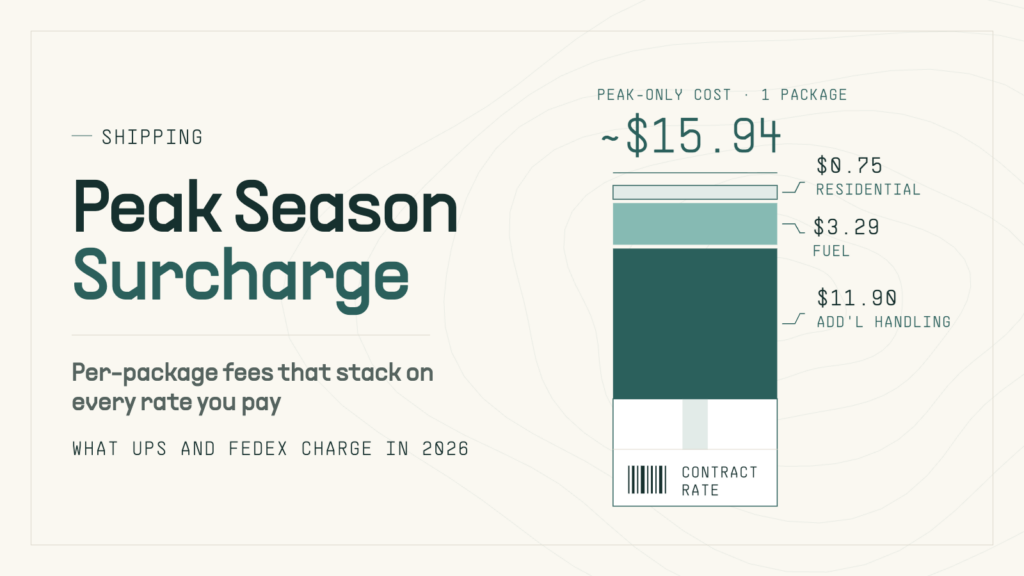
Example 1: One bulky residential package in December
You ship a 24-inch box to a home address via UPS Ground on December 8. It trips Additional Handling.
| Charge | Amount |
|---|---|
| Base rate + standard residential surcharge + standard Additional Handling | Your contract rates |
| Ground Residential demand surcharge | $0.75 |
| Additional Handling demand surcharge | $11.90 |
| Fuel surcharge on the demand fees (illustrative ~26%) | ~$3.29 |
| Peak-only cost on this one package | ~$15.94 |
So you’re facing roughly $16 in charges that didn’t even exist in August, before you count the regular accessorials.
Example 2: A volume spike for a high-volume shipper
Your June baseline is 14,000 UPS Ground Residential packages a week. During Cyber Week, you ship 24,500 (175% of baseline). Because you’ve crossed 20,000 in a week, you’re now on the Higher Volume Shipper table.
- Flat-table cost you might have budgeted: 24,500 × $0.75 = $18,375
- Actual tiered cost: 24,500 × $2.65 = $64,925
That’s a $46,550 difference in one week, triggered by your own growth. This is the number most peak budgets miss.
Can Peak Season Surcharges Be Avoided or Negotiated?
You can’t opt out of the published schedule on the list rates. But you have more control than most shippers realize.
Negotiate them into your contract
Larger shippers regularly negotiate peak terms: a cap on demand surcharges, a waiver on specific services, a higher volume threshold before tiers kick in, or a fixed baseline instead of the June snapshot.
These terms are much easier to win during your annual carrier contract negotiation than in October, when the carrier has all the leverage.
Manage your baseline and your peaks
- Know your June baseline by service. The tier math runs off it.
- Pull promotions forward into early November to flatten the Cyber Week spike.
- Watch the 20,000-package weekly line. One week over it can move you onto the tiered schedule.
Fix the packages that trigger handling fees
The handling and size demand fees are where the real money is, and they’re often a packaging problem. Right-sizing a box can drop it below the Additional Handling threshold and lower its dimensional weight at the same time.
Rebalance your carrier and service mix
The $0.75 vs. $4.05 gap on economy residential is the clearest example. Move your economy volume to the cheaper option for the peak window, or split volume between carriers so neither one sees a spike large enough to trigger tiers.
Audit every peak invoice
Demand surcharges get misapplied: wrong window dates, tiered rates on shippers who don’t qualify, Additional Handling assessed on packages that don’t meet the criteria. At peak volume, nobody on your team has time to check every line. An automated parcel audit catches these and files the refund claims for you.
Your 2026 Peak Season Checklist
- Pull average weekly volume by service for the June baseline window.
- Flag every SKU that triggers Additional Handling, Large Package, or Oversize.
- Model peak-window cost for your actual service mix on both carriers.
- Check whether any week is likely to cross 20,000 residential packages.
- Adjust promotional timing to soften the Cyber Week spike.
- Set up invoice auditing before November 22 so errors get caught in real time.
- Add peak terms to your agenda for your next contract renewal.
Stop Paying for Peak Errors
Peak season is when billing errors pile up fastest and get reviewed least. The Dash.fi Shipping Audit checks every UPS and FedEx invoice against your contract, flags surcharge overcharges, and files the refund claims automatically. It’s free with the Dash.fi card, and you get 3% back on your shipping spend or 50% of the savings we find, whichever is greater.
If you’re weighing options, here’s how Dash.fi compares with Shipware.
For the carriers’ own announcements and ongoing updates, see Supply Chain Dive’s coverage of the 2026 UPS holiday surcharges and the UPS demand surcharge page.
Peak Season Surcharge FAQs
How much is the UPS peak season surcharge in 2026?
UPS Ground Residential and Ground Saver carry $0.50 per package from October 25, rising to $0.75 from November 22 to December 26. UPS Air peaks at $2.50. Higher-volume shippers can pay up to $8.00 on ground and $9.35 on residential air.
How much is the FedEx peak season surcharge in 2026?
FedEx Ground Residential and Home Delivery peak at $0.80 per package from November 23 to December 27. Ground Economy peaks at $4.05, Overnight at $2.55, and 2Day/Express Saver at $2.35.
Does the fuel surcharge apply to peak surcharges?
Yes. UPS confirms demand surcharges are subject to the applicable fuel surcharge, so the effective cost of each peak fee is higher than the published number.