

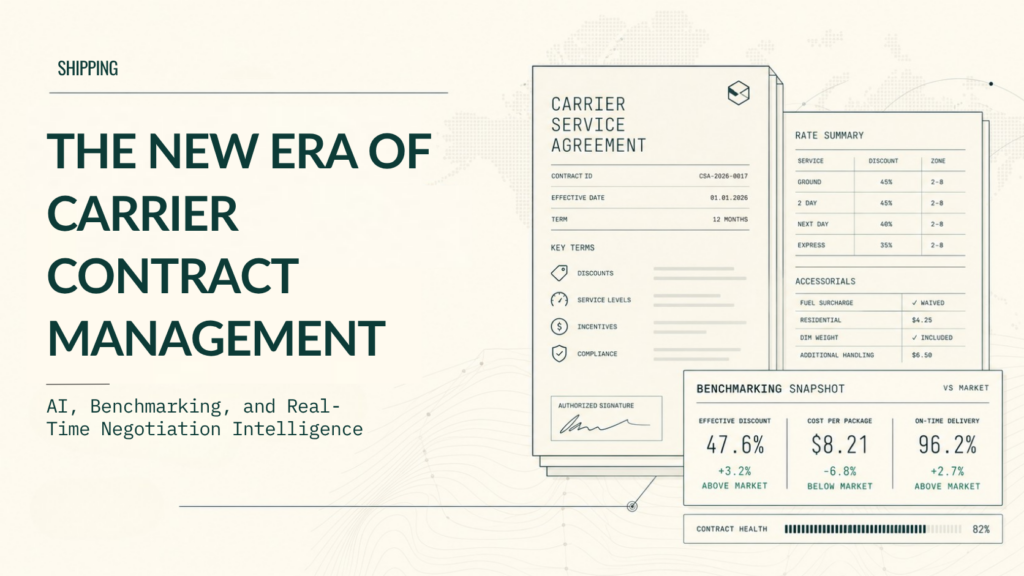
In the past, shippers treated their carrier contracts as a one-time deal: you negotiate, and you sign an agreement that lasts for years. You only revisit it again once it’s time to renew. But that approach no longer works.
Carrier pricing changes several times a year, and your shipping profile shifts as your business grows. The gap between the contracted rate and the effective rate widens between reviews, and the shipper often ends up on the losing end.
Carrier contract management is the process of monitoring and analyzing a shipper’s agreements with its carriers, like FedEx or UPS. This allows the shipper to optimize their contracts using data as leverage. This process covers everything from confirming the negotiated rates are applied correctly to measuring carrier performance against service commitments.
This guide explains how leading shippers are now managing their contracts as a continuous, data-driven function, and how AI and real-time analytics are reshaping the discipline.
What Is Carrier Contract Management?
Carrier contract management is the practice of governing the full lifecycle of a shipping agreement, from negotiation and onboarding through active monitoring and renewal. The goal is to make sure the shipper is actually receiving the rates, discounts, and service levels on the agreement. It also finds opportunities to improve that agreement before renewal.
Complete management will include all of the following functions:
- Rate validation: confirming that negotiated discounts and incentive tiers are applied to every invoice.
- Performance tracking: measuring on-time delivery, damage rates, and service failures against the carrier’s commitments.
- Spend analysis: breaking down costs by service level, zone, weight, and surcharge to understand where the money goes.
- Compliance monitoring: catching billing errors, misapplied surcharges, and incentive thresholds that were missed.
- Renewal planning: building the data record that strengthens leverage in the next negotiation.
Key Components of Carrier Contract Management
Even the most basic program will track base rates and discount tiers as well as accessorial surcharge schedules and minimum volume commitments. From there, it should analyze service-level agreements (SLAs) and incentive earn-back conditions. Every one of these categories is a potential opportunity to recover funds or save them.
Common Types of Carrier Contracts
Every carrier will have a different agreement structure, and that structure should determine how to manage it. The table below outlines the most common structures shippers might see:
| Contract Type | Description | Management Focus |
|---|---|---|
| Standard service agreement | Published list rates with negotiated percentage discounts by service and zone | Verifying that the discounts apply to every line |
| Incentive / tiered contract | Discounts that scale with volume or revenue thresholds | Tracking volume to hit and hold tiers |
| Minimum volume commitment | Reduced rates in exchange for guaranteed shipment volume | Monitoring volume to avoid shortfall penalties |
| Custom / strategic contract | Negotiated terms for high-volume shippers, often with capped or waived accessorials | Auditing caps, waivers, and exceptions |
Why Annual Contract Reviews Are No Longer Enough
Traditionally, shippers review contracts once a year, but that cadence assumes your shipping profile rates remain stable between reviews. They don’t.
Carrier pricing is constantly moving. FedEx and UPS both announced a 5.9% average General Rate Increase for 2026, and that’s the third consecutive year they’ve done so. But that’s not even the real impact.
At any point in the year, shippers can deal with surcharges, accessorial fees, dimensional thresholds, and off-cycle adjustments to fuel surcharges. So the effective rate increase can be as high as 12 percent.
And the shipping profile will drift as well. Order volume grows, package dimensions change, new destinations open up, and service mix shifts. And as each of these elements changes, your contract becomes outdated. A discount that was competitive a few months ago can even become counterproductive.
One common culprit is dimensional weight pricing, where a small change in packaging can quietly inflate billable weight across thousands of shipments, raising the effective cost without a single rate ever changing on paper.
Shippers end up with a gap between the contracted rate and the effective rate that silently grows over the course of a year or longer. An annual review is too far behind the times to do anything about those losses.
Where Carrier Contracts Fail
It’s not always bad negotiation or even bad faith that causes carrier contract value to decline. It’s often a result of a failure to monitor the contract throughout the year.
Here are some of the most common failure points:
- Discount erosion: negotiated discounts that are not applied to every eligible shipment.
- Surcharge and accessorial creep: fees that expand in scope or rate between reviews, often outpacing the headline GRI.
- Missed service refunds: late deliveries and service failures that qualify for credits but are never claimed.
- Unmet incentive tiers: volume thresholds that go unmonitored, so earn-back discounts are forfeited.
- Billing errors: duplicate charges, incorrect weights, and misapplied zones that accumulate at scale.
To catch these failure points, shippers need visibility at the level of every single invoice. Identifying overcharges on the carrier invoice is the foundation of contract management because, without a line-by-line review, none of these failures show up until the contract is already underperforming.
The New Era: AI, Benchmarking, and Real-Time Negotiation Intelligence
Today, three capabilities define the modern approach to carrier contract management. Together, they turn the process from a backward-looking audit into a forward-looking advantage.
AI-Driven Invoice Monitoring
AI systems read every invoice line automatically. They compare each charge against the shipper’s contract in near real time. Instead of sampling a fraction of shipments once a quarter, an AI agent will flag every misapplied discount, late-delivery refund opportunity, and surcharge anomaly as they appear. This turns auditing from a periodic project into an always-on process, and it scales to the dozens of charge types that can appear on a single parcel audit, which is far more than a manual team can review by hand.
Benchmarking Against Market Rates
A contract can only look good or bad in context. Benchmarking compares your effective rates, broken down by service, lane, weight, and zone, against what comparable shippers actually pay. This shows you whether a discount that sounded strong at signing is still competitive today, and it pinpoints the specific services where you’re overpaying. Benchmarking converts a vague sense that rates feel high into a precise, defensible number you can take into a negotiation.
Real-Time Negotiation Intelligence
The most value you can get out of continuous monitoring is leverage. Every validated overcharge, documented service failure, and benchmark gap becomes evidence for the next negotiation. So you’re not walking into a renewal with last year’s numbers. You’re showing up with a live record of carrier performance and a clear model of where the savings sit. Knowing the most negotiable parts of a UPS or FedEx contract matters far more when you can quantify exactly what each concession is worth to your business.
Stronger Carrier Relationships Built on Data
Continuous monitoring doesn’t have to be adversarial. When both sides work from the same verified numbers, carrier relationships can actually improve. A shipper who can point to specific service gaps and benchmark figures is a more credible partner than one who simply asks for a better rate, and carriers increasingly expect that level of preparation. Treating contract performance as a shared, transparent metric makes renewals faster and reduces the friction that comes from disputed invoices, surprise surcharges, and unclaimed credits piling up between reviews.
Carrier Contract Management Software vs. Manual Review
The difference between continuous monitoring and periodic monitoring comes down to the tools you’re using. The table below offers a comparison of the manual approach to dedicated contract management software.
| Capability | Manual Review | Contract Management Software |
|---|---|---|
| Invoice coverage | Sampled and periodic | Every invoice, continuous |
| Error detection | Reactive and partial | Automated and near real-time |
| Benchmarking | Limited or none | Built-in market comparison |
| Refund claims | Often missed deadlines | Filed automatically |
| Negotiation prep | Backward-looking | Live performance record |
Software in this scenario doesn’t replace your judgment in a negotiation. It gets rid of the manual overhead most teams would require just to monitor their contracts periodically and instead offers constant oversight as a matter of routine.
Benefits of Carrier Contract Management
- Lower effective shipping costs through recovered discounts and refunds.
- Stronger carrier relationships built on documented, fact-based conversations rather than guesswork.
- Greater budget predictability as cost drivers become visible and trackable.
- Improved negotiation outcomes backed by hard performance data.
- Reduced administrative burden once monitoring is automated.
Common Challenges in Carrier Contract Management
- Invoice complexity, with dozens of distinct charge types per shipment.
- Data fragmentation across multiple carriers and internal systems.
- Tight refund-claim windows, often as short as 15 days from the invoice date.
- Limited internal bandwidth for line-by-line review.
- Opaque surcharge definitions that change with little clear notice.
Because claim windows are short, the FedEx shipping refund process rewards shippers who can stay on top of invoices constantly, rather than checking on occasional batches. By that time, most eligible credits have already expired.
Best Practices for Continuous Contract Management
- Audit invoices continuously, so you can catch errors inside the refund window.
- Track performance against every SLA in the contract, not just headline on-time rates.
- Benchmark your effective rates against the market at least twice a year.
- Document service failures as they happen to build a record for negotiation leverage.
- Revisit contract terms whenever your shipping profile shifts materially, not only at renewal.
Frequently Asked Questions
How often should you renegotiate carrier contracts?
There’s no fixed schedule, but waiting for a multi-year term to expire usually leaves money on the table. Many shippers revisit terms annually, and any material change in volume, service mix, or destination footprint is a reason to reopen the conversation. Continuous monitoring makes it easier to time a renegotiation for the moment your data is strongest.
How can you enforce SLA compliance when carriers break it?
Enforcement starts with measurement, so track guaranteed delivery windows against actual delivery times on every shipment. Then file refund claims for each qualifying failure within the carrier’s claim window. A documented pattern of missed SLAs also becomes leverage at renewal, where you can push for stronger commitments, service credits, or rate concessions.
What is the difference between common carriers and contract carriers, and does it matter for contract management?
A common carrier offers transportation to the general public at published rates, while a contract carrier serves specific customers under negotiated agreements. For parcel shippers working with UPS and FedEx under negotiated rate agreements, the day-to-day management work is the same: validate rates, monitor performance, and prepare for renewal. The distinction matters more for legal and liability framing than for routine contract oversight.
What are the key components of carrier contract management?
The core components are rate validation, performance and SLA tracking, spend analysis by service and zone, compliance and billing-error monitoring, and renewal planning supported by historical data. Strong programs treat all five as a single continuous loop rather than separate one-time tasks.
Managing Contracts as a Continuous Discipline
Today, carrier contract management has moved from an annual checkpoint to an ongoing process, and shippers who control their costs are the ones monitoring every single invoice. The savings are in both your renewal negotiations and they’re in the lines on your invoices. Tools that audit shipping invoices automatically make that level of continuous oversight achievable without adding labor hours to your team. And you can get real data for every renewal negotiation. Ultimately, contract management becomes a steady source of savings.