

When you’re figuring out the best deal you can get on a carrier contract, you’re most likely thinking of your base rate discount. Your rep may offer you 40% off Ground and 50% off Express, and you figure you got a good deal.
But the real UPS or FedEx rate negotiation comes down to much more than the headline discount. Your contract can contain more than 150 negotiable elements, so focusing on base rates alone will have you ignoring surcharges, fees, and contract clauses that can add up to major costs over the course of a year.
This guide will walk you through the various contract elements that can have the greatest impact on your total shipping spend. You’ll also learn about which fees are most negotiable and the most common mistakes businesses can make when looking over their contract carrier proposals from UPS and FedEX.
Isn’t the Headline Discount the Biggest Deal?
It certainly can be. But it’s important to remember that whatever discount the carrier is giving you is still significantly marked up in their favor, so even if you get a “50% discount,” you’re likely still paying more than you need to.
Meanwhile, the carrier is also charging you accessorial fees and surcharges on top of that base rate, which can compound fast. Indeed, accessorial charges alone can represent 20-40% of your total shipping spend as an ecommerce business. So you think you’re getting a good deal, but then you see fees for residential delivery, address corrections, fuel, delivery area, and additional handling. If you don’t negotiate those fees, the base discount rate won’t make much difference.
The key takeaway here is that the total cost per package is the biggest deal, not the headline discount percentage.
Which Contract Elements Are Most Negotiable?
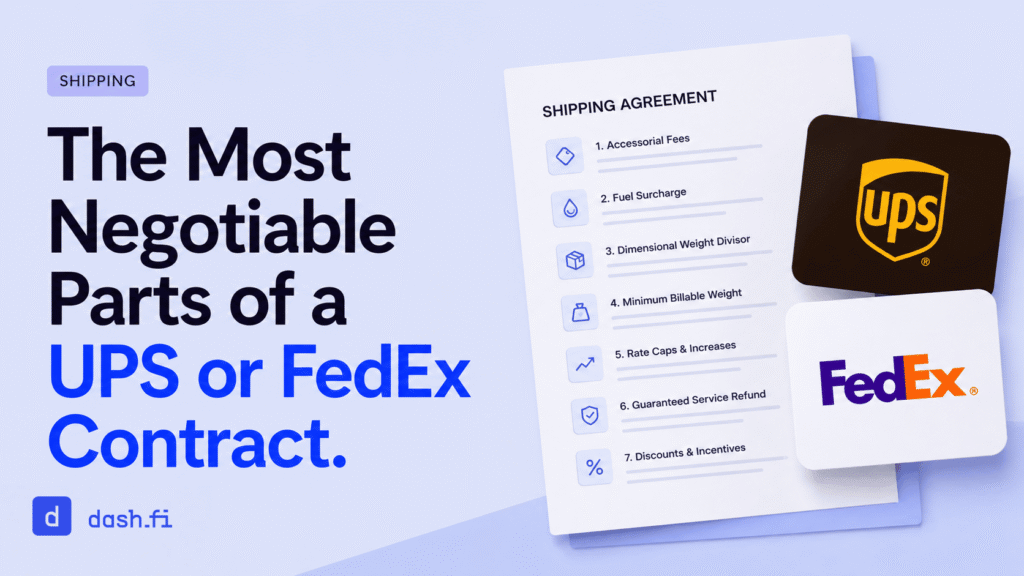
There are probably way more negotiable elements of your carrier contract than you realize. You can typically argue for discounts in all of these areas:
- Accessorial Fees
This is perhaps your single biggest negotiable point, and it’s the one very few businesses pay attention to.
Common accessorials include:
Residential delivery surcharge: Your carrier will apply it to every package delivered to a home address.
Delivery area surcharge: They’ll apply this to ZIP codes that they classify as extended or remote.
Additional handling: This fee can be triggered by any package dimension, weight, or non-standard shape.
Address correction: If the carrier has to correct an incomplete or inaccurate address, this charge will show up on your invoice.
Fuel surcharge: You’ll see this as a percentage of your base rate, and often on top of any other accessorial fees, so it compounds quickly.
What’s negotiable:
- Flat discounts off published accessorial rates
- Caps on specific fees
- Waivers for surcharges your shipping profile triggers most often
In most cases, your carrier will negotiate with you, especially if you can show them the volume of business they’re getting from you and how often specific accessorial fees are being charged.
- Fuel Surcharge Structure
The fuel surcharge often goes overlooked and underestimated in the shipping contract. It can account for up to 10% of your transportation costs, and sometimes more, and it doesn’t just apply to your base rates. The carrier will apply fuel surcharges to many of your accessorial fees as well, which multiplies the impact.
What’s negotiable:
- A cap on how high the fuel surcharge percentage can go
- A fixed or reduced fuel surcharge rate during the contract term
- Exclusion of specific accessorials from the fuel surcharge calculation
Especially during times when fuel prices are rising, asking for fuel surcharge caps can be critical to your bottom line.
- Dimensional Weight Divisor (DIM Divisor)
UPS and FedEx both use dimensional weight pricing, which means they charge based on whichever is greater, actual weight or dimensional (DIM) weight. DIM weight is calculated by dividing a package’s cubic volume by a divisor.
Of course, the default divisor favors the carrier, with a higher divisor benefiting the shipper by lowering the calculated DIM weight for a given package size.
What’s negotiable:
- A higher DIM divisor than the default
- Different divisors for Ground versus Express services
- Adjustments to rounding rules that affect how DIM weight is calculated
If you’re an ecommerce brand shipping lightweight packages in larger boxes, the DIM divisor can be one of the negotiation points with the highest impact on your contract.
- Minimum Billable Weight (MBW)
Carriers will apply a minimum billable weight to certain package categories, like the Large Package Surcharge billed at 90 lbs or the Additional Handling billed at 40 lbs, regardless of the actual weight.
If your packages tend to trigger these charges, those MBW defaults can inflate your invoices by a lot.
What’s negotiable:
You can ask for a lower minimum billable threshold for specific surcharge categories.
- Guaranteed Service Refund (GSR) Waiver
The Guaranteed Service Refund is the shipper’s right to a refund when UPS or FedEx fails to deliver within the contracted service window, and the carrier will often offer you a discounted base rate in exchange for you waiving your right to the GSR.
But it’s not a fair trade. Typical refunds from late deliveries, billing errors, and other discrepancies can add up to a 4% return on your total shipping spend. If you waive your GSR, you get none of that back. The base rate discount won’t come close to matching that potential recovery.
Avoid signing a contract that includes a GSR waiver. If your carrier adds it, treat it as a negotiation tactic, not a standard.
- Rate Caps and Annual Increase Clauses
Many carrier contracts come with a General Rate Increase clause that allows them to hike your rate every year. If you don’t negotiate caps, you can see significant hikes over time, even mid-contract, and new discounts may not offset these hikes.
What’s negotiable:
- An annual cap on the percentage increase the carrier can apply during your contract term
- Caps on specific surcharge categories, looking especially at fuel and peak surcharges
- Advance notice requirements before any mid-year rate adjustments kick in
Rate caps are especially important for businesses that expect to spend more over the next several years.
- Peak Surcharges
Peak surcharges were originally just holiday season fees, but they’ve since become permanent charges that can change throughout the year and vary by package volume, service type, and time of year. For ecommerce brands, these surcharges can add up to large, recurring costs.
What’s negotiable:
- Caps on peak surcharge rates
- Volume thresholds that trigger fees
- Service types these surcharges apply to
Carriers are often more willing to negotiate with you over peak surcharge terms when you can demonstrate consistent volume throughout the year.
- Volume Thresholds and Minimum Commitments
Most carrier contracts include volume commitments that you have to meet in order to retain your discounts, and if you miss those thresholds, you can lose your savings and trigger penalties.
What’s negotiable:
- Conservative commitment thresholds that reflect your actual shipping volume
- Flexibility clauses that allow for variation during different seasons
- Rebates or deferred incentive structures that reward higher volumes but don’t punish shortfalls
Many carriers will also offer rebate programs that give shippers partial credit when they hit specific volumes or spending targets. You can negotiate the threshold amount, rebate percentage, and measurement periods.
Which Fees Have the Greatest Impact on Your Shipping Spend?
While any and all terms of virtually any contract can change, these are the fees most likely to represent the largest share of your total spend after the base rate:
| Fee Category | Typical Share of Total Spend | Key Negotiation Target |
|---|---|---|
| Residential delivery surcharge | 5–10% | Flat discount or waiver for high-volume lanes |
| Fuel surcharge | 5–15% | Cap on percentage; exclusions from accessorial fuel calculation |
| Delivery area surcharge | 3–8% | Discounts for frequently-shipped extended ZIP codes |
| Dimensional weight (DIM) pricing | Variable | Higher divisor; more favorable rounding rules |
| Peak surcharges | 2–6% | Caps and volume-based phase-ins |
| Additional handling | 1–5% | Discounted rate or threshold adjustment |
Of course, the exact impact will vary based on your specific shipping profile: a brand shipping to mostly rural residential addresses will feel DAS most acutely, while a brand with large, lightweight packages will see a large portion of fees coming from DIM pricing.
Common Mistakes Businesses Make During Contract Negotiations
Focusing Only on Base Rate Discounts
Your carrier is going to try to lead your negotiations with discounted base rates because they’re the most obvious and the easiest to evaluate at a superficial level. But focusing only on the base rate without looking at the other accessorials, you’re likely going to pay way more in aggregate than you should.
Not Knowing Their Own Data
If your carrier knows your shipping history better than you do, they have leverage. If you walk into your negotiation without detailed data on your package sizes, weights, zones, service mix, and accessorial triggers, you give your carrier an advantage over you. In contrast, analyzing your own data allows you to start from a productive negotiating position.
Signing a GSR Waiver
Signing the GSR waiver for a marginal rate improvement is rarely a good trade, and it removes accountability from your carrier.
Accepting Volume Commitments Based on Peak-Season Data
Your carrier is going to use your busiest shipping period as the baseline for your volume commitment. When you agree to a Q4 volume when your actual average is 40% lower, you set yourself up to lose your negotiated discounts.
Not Auditing Invoices After Signing
Even the best-negotiated contracts don’t guarantee accurate billing. Carriers make mistakes all the time, and they don’t self-correct. Make sure to perform regular, automated audits of your invoices against contracted rates to confirm that you’re paying what you actually agreed to in your contract.
Starting Too Late
You should be discussing discounts and adjustments half a year to a year before your contract is up. Waiting until the last month can destroy your leverage. Carriers know you’re running out of time, and they’ll negotiate with you based on your desperation.
How to Prepare for FedEx or UPS Contract Negotiation
Before you start negotiating with your carrier, get your leverage. You do this by building a complete picture of your shipping profile:
- Pull 12 months of invoice data: Find your total spend by service type, zone, and fee category.
- Identify your top accessorial fees: Which fees are showing up the most, and what are they costing you?
- Calculate your DIM exposure: What percentage of your packages are billed on DIM weight rather than actual weight?
- Map your delivery area: What share of your volume goes to residential versus commercial addresses?
- Benchmark against market rates: Figure out who your carrier’s competitors are and what they’re offering before you sit down at the negotiating table.
- Figure out what your leverage is: Having relationships with multiple carriers gives you real leverage in a negotiation with any one of them. They’ll compete with each other for your volume, and if you can threaten to move a portion of that volume to a competitor, you have leverage.
FAQs
What is a GSR waiver in a UPS or FedEx contract?
A Guaranteed Service Refund (GSR) waiver takes away your right to file for refunds when your carrier doesn’t deliver on time. And in exchange for the waiver, they’ll offer you a slightly improved base rate discount. In most cases, that refund value you’re losing is more than the value of the rate improvement they’re offering.
Which fees are the most negotiable in a carrier contract?
Accessorial fees (residential, DAS, fuel, additional handling), the DIM weight divisor, fuel surcharge caps, peak surcharge rates, and annual rate increase caps are all negotiable. You can start at the base rate discounts, but those other categories usually make up a larger share of actual savings.
How does the DIM divisor affect shipping costs?
The DIM divisor determines how dimensional weight is calculated. A higher divisor means a lower calculated DIM weight for a given package, which reduces what you’re billed when DIM weight exceeds actual weight.
Can small businesses negotiate with UPS and FedEx?
Yes. While volume is the primary source of leverage, smaller shippers can negotiate by showing up with clean data and demonstrating growth trajectory. Also, don’t be afraid to show your carriers that you have alternatives. Even modest multi-carrier strategies can change the dynamic.
What is a rate cap in a carrier contract?
A rate cap is a negotiated limit on how much the carrier can increase your rates during your contract term. It protects shippers from GRI increases that would otherwise eat away at the value of your negotiated discounts over time.
The Bottom Line
UPS or FedEx contract negotiation is about so much more than just discussing base rate discounts. The many elements that make up your contract are all negotiable, but most businesses don’t even think to haggle over accessorial fees, fuel surcharges, DIM divisors, GSR rights, peak charges, and volume thresholds, so they leave money on the table.
Audit your invoices months ahead of your contract expiration date, and go into a negotiation meeting with complete shipping data, clear benchmarks, and specific targets for every fee category. This level of preparation will get you a contract that actually performs for you.
Ready to get the data you need to negotiate better rates? dash.fi can help. Schedule a demo to see how today.