

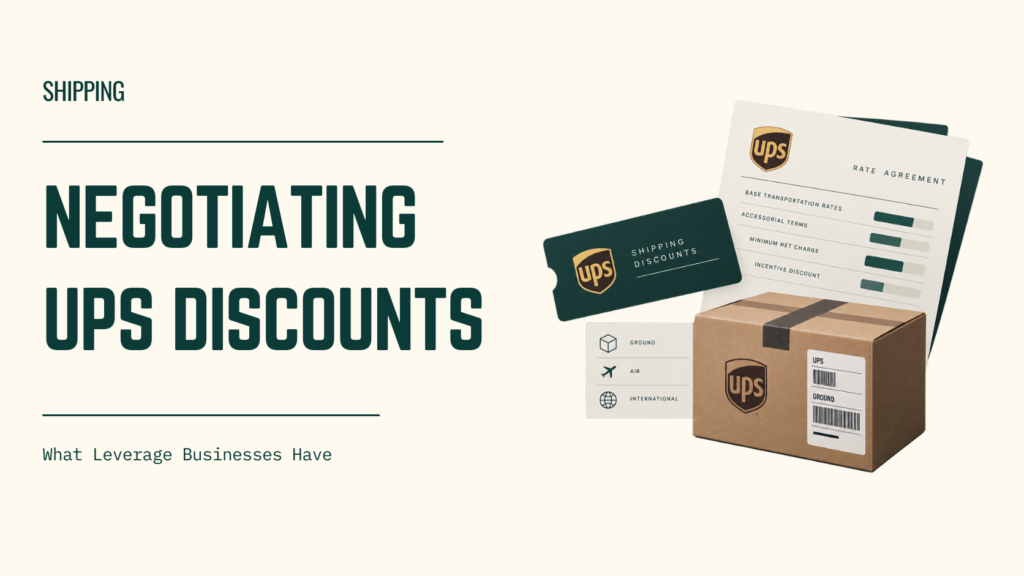
UPS discounts typically consist of multiple parts of a structure, rather than a straightforward percentage. Many businesses may offer something like “1% off of services.” UPS instead negotiates terms that apply to different parts of a shipment, like the base transportation rate and even the physical characteristics of a package.
Any business talking about “our UPS discount” as a single number is usually only describing one piece of a much larger arrangement.
Businesses that understand how that structure and arrangement are built can move past a big headline percentage and use their leverage to gain measurable UPS discounts. This article breaks down how a UPS discount is structured, what UPS evaluates about a business before extending a discount, and what leverage businesses have in that relationship.
What Is the UPS Discount Structure?
When a business signs a UPS agreement, it isn’t accepting a single blanket discount. It’s accepting a set of terms that stack together, and each is negotiated, applied, and monitored differently.
| Discount Component | What It Covers | How It’s Determined |
|---|---|---|
| Base transportation rate discount | Percentage off published rates for a given service | Negotiated per service level, based on volume and shipping mix |
| Guaranteed discount | Applied automatically to every qualifying shipment | Locked in at signing, doesn’t fluctuate month to month |
| Earned or incentive discount | Additional percentage tied to hitting volume or revenue thresholds | Calculated periodically against gross transportation charges |
| Accessorial and surcharge terms | Caps, waivers, or reductions on fees like residential delivery or additional handling | Negotiated separately from the base rate discount |
| Minimum net charge | A floor price per package, regardless of the discount applied | Set independently, and can override a negotiated rate discount |
None of these components move in lockstep.
A business can carry a strong base rate discount on Ground service while paying full freight on surcharges, or hold a favorable minimum net charge while its earned discount tier resets every year.
Each line item on a UPS agreement is its own negotiation, and each behaves differently once the contract is signed.
Rates Are Segmented by Service and Shipment Profile
UPS doesn’t apply a flat discount across every service a business uses. Instead, Ground, Air, and International shipments are typically priced and discounted independently. This means a business can be well-positioned on one service and poorly positioned on another without realizing it.
The characteristics of each shipment factor in just as heavily as the type of shipment. Things like zone and weight can determine which rate table a shipment falls under before any discount is applied.
Dimensional weight in particular can change the billable weight of a package entirely, which means the same negotiated discount percentage can produce very different effective costs depending on how a business packages its products.
Annual base rate changes compound this further: the general rate increase UPS applies each year resets the published rate that every negotiated discount is calculated from, so a static discount percentage doesn’t guarantee a static cost.
What Does UPS Actually Evaluate About a Business
UPS builds its offer around how a business looks from the carrier’s side of the table, not around what the business is asking for.
Several factors shape that view:
| What UPS Looks At | Why It Matters to the Offer |
|---|---|
| Total gross shipping revenue | Determines which incentive tier a business qualifies for across its full portfolio of services |
| Volume consistency | Predictable, steady volume is treated differently than volume that spikes and dips |
| Service mix | Heavier use of Air or Express services is generally more profitable to UPS than Ground-only volume |
| Package density and dimensional profile | Light, bulky packages cost more to move than dense ones, which affects how favorable a dimensional divisor UPS is willing to offer |
| Growth trajectory | A business trending upward may be offered more competitive terms than one with flat or declining volume |
| Documented alternatives | A business that can show it has been quoted by other carriers is evaluated differently than one UPS considers a captive account |
This shift is the most important one for businesses to understand: they look at UPS and ask what discount they can get. In contrast, UPS looks at businesses and calculates what that account is worth to keep, service by service.
The discount that comes out the other end reflects that calculation, not a fixed menu of offers.
Guaranteed Discounts vs. Earned Discounts
These two mechanisms get bundled into the phrase “UPS discount” constantly, but they behave in opposite ways.
Guaranteed discounts are set at the time of signing and applied to every eligible shipment automatically. They don’t depend on hitting a volume target during the contract period, which makes them predictable but also means they don’t grow without a renegotiation.
Earned or incentive discounts work in reverse. They’re tied to actual shipping volume or revenue across a business’s full portfolio of UPS services, and they’re calculated on a rolling or periodic basis. A business that falls short of its volume threshold can lose the earned portion of its discount even though its guaranteed rate stays intact.
This is why a business’s effective discount can shrink from one period to the next without any term in the contract technically changing.
Where the Discount Applies… and Where It Doesn’t
One of the most common misunderstandings in a UPS relationship is assuming a negotiated discount touches the entire invoice. In practice, discounts are usually scoped to specific charge categories, and several major cost drivers sit outside of them entirely unless negotiated separately.
Fuel surcharges are calculated as a percentage of the base rate and adjusted on their own schedule, largely independent of any base rate discount. Residential delivery surcharges are another example. They’re flat or tiered fees added on top of the discounted rate, and they typically require their own negotiated cap or waiver to be affected at all.
A business can hold a meaningful discount on its transportation charges and still see its total invoice climb because surcharges, which sit outside that discount, are increasing on their own.
This is also where UPS’s annual rate increase tends to do the most damage to a business’s assumptions. The headline percentage applies to published base rates, but accessorial and surcharge fees are frequently adjusted by different amounts, on different schedules, which means the “discount” a business believes it’s carrying can erode from angles that have nothing to do with the base rate discount itself.
Why Does Treating It as One Number Create Blind Spots?
A business that describes its arrangement as “we have a 28% discount with UPS” is usually describing one component (often the Ground base rate) and extending that assumption across an invoice that includes Air shipments, residential surcharges, fuel adjustments, and minimum charges that follow entirely different rules.
The result is a business that believes it understands its cost structures while actually holding visibility into only part of it.
This is the same gap that shows up during carrier contract negotiation: a business walks in prepared to discuss one number when the actual agreement is a collection of separately negotiable terms, several of which the business may not have looked at closely since the contract was signed.
The most negotiable parts of a UPS or FedEx contract are rarely the base rate alone. They include the surcharge caps, the dimensional divisor, and the earned discount thresholds that sit around it.
Businesses Can Create Leverage in This Relationship
Leverage with UPS comes primarily from how well a business understands its own shipping profile relative to what it’s being charged for. A business that can show consistent volume, a clear breakdown of its spend by service and surcharge category, and documented evidence of what comparable shippers pay is negotiating from a different position than one that’s simply asking for “a better rate.”
That kind of visibility is also what keeps a negotiated discount intact between renewals. Rate structures, surcharge schedules, and shipment profiles all shift throughout the year, and a business that isn’t tracking how those pieces move against its contract terms often doesn’t notice until the discount it negotiated no longer reflects what it’s actually paying.
The Bottom Line
In the end, a UPS discount isn’t a single lever. It’s a set of components that UPS applies and adjusts independently of one another. Base rates, service levels, shipment characteristics, and surcharges each follow their own rules, and the businesses with the clearest view of how those pieces fit together are the ones with the most accurate picture of what they’re actually paying.
Understanding this structure, not chasing a bigger percentage, is what puts a business in a stronger position the next time its UPS agreement comes up for review.
FAQs
Does UPS offer any discounts or promo codes?
UPS does not typically offer promo codes in the way a retailer would. Discounts are extended through negotiated business agreements based on shipping volume, revenue, and service mix, along with a smaller UPS-published Small Business Rate Guide for lower-volume shippers.
How can I get cheaper shipping rates with UPS?
Businesses typically see lower effective rates by understanding which of the various rate components apply to their shipping profile and addressing the ones with the most exposure.
How can businesses save on UPS shipping rates?
Savings usually come from a combination of sources: base rate discounts, earned incentive tiers tied to volume, negotiated surcharge caps, and accurate application of the correct dimensional divisor. Because these components are negotiated and tracked separately, savings tend to come from addressing each one rather than a single blanket adjustment.
What types of UPS memberships or loyalty programs are available for savings?
UPS doesn’t run a traditional loyalty or points program for shipping rates. Discount structures are handled through negotiated contracts, and smaller shippers may qualify for UPS’s published Small Business Rate Guide, which offers set discounts without a formal negotiation.
Is there a UPS discount for small businesses?
Yes. UPS publishes a Small Business Rate Guide that provides fixed discounts off published rates for businesses that don’t ship enough volume to negotiate a custom contract. It’s a simpler, published structure rather than the tiered, negotiated arrangement larger shippers typically have.