A click farm is an operation that pays groups of low-wage workers with smartphones to click on ads and engage with content they’re not genuinely interested in. And click farm traffic is hard to identify as invalid because it’s coming from real people on real devices.
For ecommerce brands, the timing makes this situation even worse because auctions on Google and Meta get crowded from mid-November through mid-December, so the prices of each click tend to climb right when you push the most budget. A fake click that costs you $1.00 in September can cost $1.20 or more when you’re selling more of your products the week leading up to Thanksgiving and Black Friday, and you’re buying far more of those clicks.
What Is a Click Farm?
A click farm is a form of click fraud. In this case, people, instead of scripts, generate artificial ad interactions at scale. The operators of these farms will run hundreds of physical phones or computers, rotating IP addresses through proxies and VPNs, and assigning workers repetitive tasks:
- Click this ad
- Watch this video
- Like this post
- Fill out this form
You may hear click farms also referred to as device farms, phone farms, and like farms. They’re sold openly online as “traffic” or “engagement” services. Depending on the activity and jurisdiction, their practices may violate advertising platform policies and applicable laws. They can also violate the advertising and community policies of major ad platforms.
Industry standards place click farm activity under invalid traffic (IVT). The Media Rating Council (MRC) splits IVT into two categories:
- General Invalid Traffic (GIVT), which routine list-based filters catch
- Sophisticated Invalid Traffic (SIVT), which takes advanced analytics and human review to identify.
Coordinated human fraud, like a click farm, usually lands in the SIVT bucket because it doesn’t trip the simple filters.
How Do Click Farms Work?
Most click farm operations follow the same basic workflow:
- A buyer places an order. The buyer may be a competitor trying to drain your budget, a shady publisher padding its ad revenue, or a reseller that needs to hit a traffic quota for a client.
- The operator assigns targets. Workers receive a list of keywords to search, ads to click, or posts to engage with.
- Devices disguise their origin. Proxies, residential IP pools, and device ID resets make each interaction look like a new, unique user in the right location.
- Workers mimic real behavior. They scroll, pause, visit a second page, and sometimes submit a form, so session data looks normal.
- Profiles adapt to your targeting. Farms can build or switch profiles to match the audience your ad targets, which lets them slip into narrow Meta audiences.
The result is fraudulent traffic becoming more difficult to detect, potentially resulting in wasted advertising spend.
Are Click Farms the Same as Bots?
No. Both generate invalid traffic, but they behave differently and require different detection methods.
| factor | click farm | Bot traffic |
|---|---|---|
| Who clicks | Real people on real devices | Automated scripts or headless browsers |
| Behavior | Human-like scrolling, pauses, and navigation | Often fast, repetitive, or perfectly timed |
| Devices and IPs | Real phones, often on residential or mobile IPs | Often data center IPs or spoofed user agents |
| Detection difficulty | High; usually classified as SIVT | Varies; simple bots are caught as GIVT |
| Cost to run | Higher per click (labor and hardware) | Lower per click; scales cheaply |
| Typical tell | Clicks and engagement that never convert | Abnormal session patterns and technical fingerprints |
Though the two are different, many modern operations will blend the two, pairing human workers with automation tools. The same fake engagement problem shows up on social, where Instagram bots distort advertising performance using a similar approach.
Why Fake Clicks Cost More in Q4
The cost of a click farm is not fixed. It scales with what you pay per click and how many clicks you buy, and both tend to rise during the holiday season.
Holiday auctions push up click prices
More advertisers bid on the same shoppers between Thanksgiving and Christmas. Triple Whale’s 2024 holiday benchmark, cited by Optmyzr, showed CPCs increasing approximately 22% month over month during the Black Friday period.
On Meta, agency data from GeistM showed CPMs climbing 11% in the second half of November 2025 and another 11% in early December, with CPCs up 10% in the first half of December.
Year-over-year trends fluctuate, of course. Tinuiti reported that Google Search CPCs dipped slightly year over year in Q4 2025, even as clicks grew 13%.
The real comparison to look at for click fraud isn’t this December against last December. It’s your peak weeks against your average weeks.
The holiday fraud multiplier
Four forces stack up in Q4 to make each fake click potentially more damaging than it would be in an ordinary month.
- Price: Invalid clicks that escape platform detection may result in being billed at peak-season CPCs.
- Volume: Bigger budgets buy more clicks, so a steady fraud rate produces more fake clicks in absolute terms.
- Budget pacing: On peak days, fake clicks can exhaust a daily budget early, so your ads stop serving when real buyers are shopping.
- Signal contamination: Invalid engagement can interfere with campaign optimization when those signals are not adequately filtered, potentially affecting targeting and campaign performance during peak shopping periods. If that happens in October, your algorithm walks into Black Friday optimized for the wrong audience.
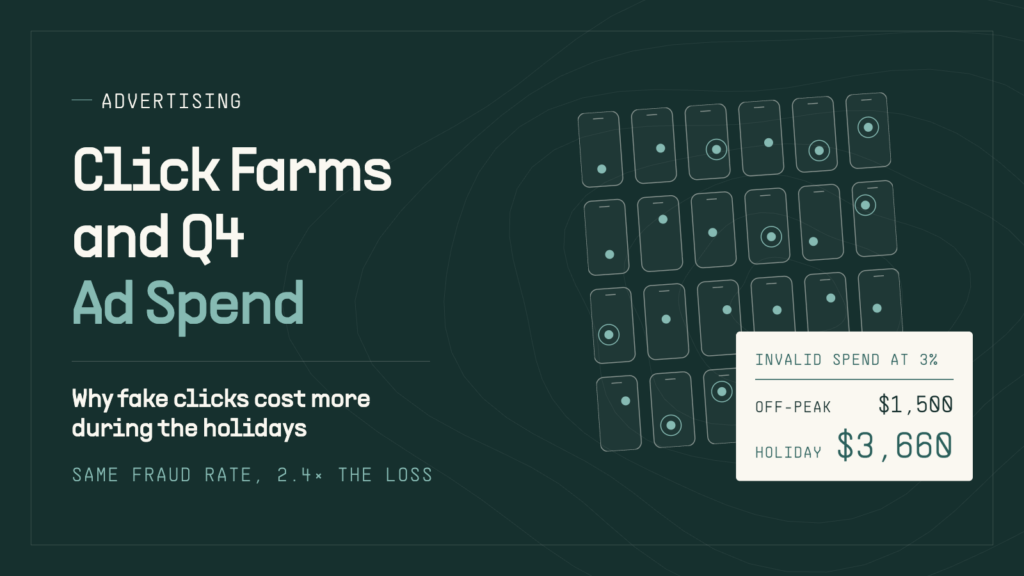
Here’s just one hypothetical example using a constant 3% invalid click rate:
| scenario | clicks | avg. CPC | total spend | invalid spend at 3% |
|---|---|---|---|---|
| Off-peak month | 50,000 | $1.00 | $50,000 | $1,500 |
| Holiday month | 100,000 | $1.22 | $122,000 | $3,660 |
So you see the same fraud rate with the same campaigns, and the dollar loss is about 2.4 times higher. And that figure is leaving out the sales you lose when your budget runs dry and the lift in CPA that follows when the algorithm learns from bad data.
Effects of Click Farms on Ad Campaigns
Click farm traffic does more than merely waste the cost of the click itself.
Over a single holiday season, it can:
- Inflate CPA and lower ROAS as spend rises without matching revenue
- Distort lookalike and Advantage+ audiences that learn from engaged users
- Corrupt your testing, since creative and landing page winners get picked on fake engagement
- Fill your CRM with junk leads when farm workers submit forms
- Trigger an ad death spiral, where the account optimizes toward fake clicks, receives more of them, and CPA keeps climbing
Warning Signs of Click Farm Traffic
You won’t find a single metric that proves click farm activity, but you can spot patterns that warrant further investigation, especially when several of them appear together.
| warning sign | what it can look like |
|---|---|
| High CTR, low conversion rate | An ad set suddenly outperforms on clicks but produces no added revenue |
| Geographic mismatch | Clicks from regions outside your shipping zone, or from cities with no customer history |
| Odd timing | Traffic bursts at hours when your real customers are asleep |
| Shallow engagement at scale | Many sessions with near-identical time on site and page depth |
| Junk form fills | Fake names, disposable emails, or phone numbers that do not connect |
| Engagement without purchases | Rising likes, follows, and comments with no matching lift in sales |
| Device clustering | Many clicks from the same device models or OS versions in a short window |
How to Detect Click Farm Traffic in Google Ads and Meta
Google Ads
- Add the Invalid clicks column to your campaign view to see what Google has already filtered.
- Check the Invalid Activity Credit Report in Report Editor to see credits for invalid traffic that Google caught after billing.
- Compare Google Ads clicks with sessions in your analytics and server logs, matched by GCLID.
- Review search terms, placements, and location reports for spikes outside your normal patterns.
- Submit an investigation through the Click Quality Form if you find traffic that Google missed. Google only reviews activity from the past 60 days.
A broader Google Ads audit can pair this traffic review with a check of your billing and spend.
Meta
- Break down results by placement, region, device, and time of day to isolate unusual clusters.
- Compare link clicks with landing page views. A large gap can point to clicks that never load your site.
- Match FBCLID values in your server logs against reported clicks to find repeated or suspicious IDs.
- Review your billing for invalid activity adjustments, and open a billing dispute through Meta Business Support when you have log evidence.
How a Traffic Audit Helps You Challenge Invalid Spend
Google and Meta filter a large share of invalid traffic before you’re billed for it. According to Google’s invalid traffic policy, the company removes invalid clicks caught before each billing cycle closes and issues credits for invalid activity found later.
Still, sophisticated human fraud is the hardest category to catch automatically, so some of it will land on your invoice.
A traffic audit closes that gap by comparing your ad billing data against click and session data to find spend that platform filters missed. The audit can then package the necessary evidence for each platform to review your claim.
A good audit should:
- Reconcile billed clicks against sessions, conversions, and server logs
- Flag invalid traffic by type, like click farms, bots, and placement fraud
- Quantify the dollars at stake for each campaign and placement
- Simplify the steps needed to file ad credit requests within each platform’s review window
- Turn findings into exclusion lists so the same traffic doesn’t return
The Dash.fi AI ad audit runs this process with Google and Meta. It audits your ad billing and click data, prepares credit requests on your behalf, and builds suppression lists from what it finds. Ecommerce brands can save up to 6% of ad costs, and the audit is free when you pay for ads with the Dash.fi card.
Best Practices to Protect Your Q4 Budget From Click Farms
- Audit in October. Clean your audiences before peak season so the algorithm learns from real buyers going into Black Friday.
- Set tighter location targeting. In Google Ads, use “Presence” instead of “Presence or interest” for location options.
- Add exclusions early. Block known bad placements, IP ranges, and audiences before budgets scale.
- Protect your forms. Use reCAPTCHA, server-side validation, and email confirmation to keep junk leads out of your CRM.
- Watch daily pacing. Investigate any campaign that spends its daily budget unusually early.
- Keep your logs. Store GCLIDs, FBCLIDs, IPs, and timestamps so you have evidence ready to file a claim.
- File claims inside the window. You need to submit holiday traffic from late November to Google by late January. However, it’s always better to review promptly instead of risking missing the window.
For a broader context on holiday ad pricing, Tinuiti’s Cyber Five ad trend analysis breaks down CPM and spend changes across Google, Amazon, and Meta during the busiest week of the year.
Frequently Asked Questions
What is a click farm?
A click farm is an operation that uses groups of real people, often working on many phones or computers, to generate fake ad clicks, likes, follows, and other engagement for pay.
Are click farms illegal?
The legality of click farms depends on the jurisdiction and the nature of the activity. Some practices may violate fraud laws or other regulations, in addition to advertising platform policies.
Are click farms the same as bots?
No. Bots are automated software, while click farms rely on real people using real devices. That human element makes click farm traffic harder to detect, which is why it’s usually classified as sophisticated invalid traffic.
Do Google and Meta charge for click farm clicks?
Google and Meta use systems to detect invalid activity, but some suspicious interactions may still appear in billing data. Depending on the platform and circumstances, advertisers may receive adjustments or request further review. Google accepts investigation requests for activity from the past 60 days.
Why are click farms worse during the holidays?
CPCs and CPMs tend to rise in late November and December, and brands spend more. Each fake click costs more, more fake clicks get bought, and fake engagement can skew the algorithm right before peak sales days.
How do I know if click farms are hitting my campaigns?
Look for high click-through rates with low conversion rates, clicks from outside your target market, traffic at unusual hours, junk form fills, and engagement that does not lead to sales. A traffic audit can confirm suspicions with billing and log data.