
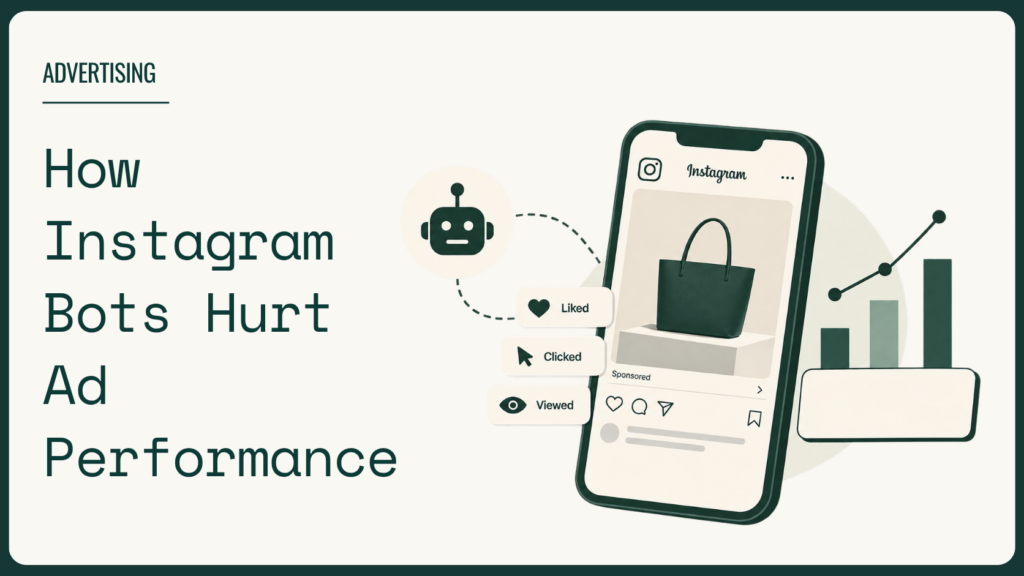
Instagram bots are automated accounts or scripts that mimic human behavior. They follow, like, comment, and even “view” content without a real person behind the activity. Some are built to inflate the creator’s follower count, while others exist specifically to interact with paid ads, generating clicks and engagement that don’t come from a real customer.
For advertisers, the second category is the one that matters because it actively distorts campaign data, wastes ad budget, and makes it harder to tell whether a campaign is actually working.
What Are Instagram Bot Accounts?
An Instagram bot account is a profile controlled by software rather than a person. Bots are typically created in bulk via automated tools or scripts, often with stolen or AI-generated profile photos, minimal bios, and little to no original content.
They’re programmed to perform actions like following accounts and leaving generic comments on a schedule or in response to triggers. And it’s usually all done on a scale no human can match.
Some bot accounts are fully automated from creation to activity, but others are “hijacked” real accounts that were compromised and repurposed to run bot-like behavior. Both count as fake indicators of engagement, and both can interact with paid advertising the same way a real user would, at least on the surface.
What Can Instagram Bots Do?
Because Instagram’s ad platform (run through Meta) uses engagement and click signals to optimize delivery, bot activity doesn’t just create noise. It can actively steer a campaign’s targeting and spend toward more of the same low-quality traffic. This is closely related to the broader problem of automated traffic across the internet, not just social platforms.
Indeed, bots now account for more than half of all web traffic globally.
On the advertising side, they can:
- Click on ads without any intent to purchase, consuming ad spend on cost-per-click campaigns
- Watch video ads to completion, inflating view-through rates and skewing video completion metrics
- Like, comment, or share sponsored posts, making engagement rates look stronger than they are
- Follow business accounts after an ad interaction, distorting follower-growth attribution
- Fill out lead forms or land on landing pages with fake information, polluting a CRM with contacts that will never convert
Types of Instagram Bots
| Bot Type | What It Does | Advertiser Impact |
|---|---|---|
| Follower bots | Follow accounts automatically, usually sold in bulk packages | Inflates audience size without adding real prospects |
| Engagement bots | Like, comment, or view content on a schedule | Falsely signals content or ad relevance |
| Click bots | Click paid ads or links, often via bot farms or scripts | Drains budget on cost-per-click and cost-per-lead campaigns |
| View bots | Generate fake video views | Distorts view-through rate and cost-per-view metrics |
| Spam/comment bots | Post generic or scam comments on posts and ads | Damages brand trust and can bury real customer questions |
| Hijacked account bots | Compromised real accounts repurposed for automated activity | Harder to detect because the account has real history |
Advertisers who have to deal with click and view bots are running into the same kinds of problems we cover in our piece on what bot traffic is and how AI is changing the economics of ad fraud. The tactics may differ by platform, but the underlying economics of inflated, non-human traffic are the same.
How Fake Engagement Distorts Advertising Performance
Here’s where Instagram bots stop being a vanity-metrics problem and start being a budget problem.
Wasted spend. Every bot click or fake view on a paid campaign is billed the same as a real one. On cost-per-click or cost-per-view campaigns, that’s money spent on an audience that was never going to buy anything.
Corrupted optimization signals. Instagram and Meta’s ad algorithms learn from engagement. When bots like, comment, or click at scale, the algorithm reads that activity as a positive signal and starts optimizing delivery toward more of the same audience profile. Of course, this turns out to be the exact profile that produces more bot traffic.
Once an account’s lookalike audiences and targeting have been trained on bad data, unwinding that drift usually takes longer than it took to happen in the first place. Advertisers who’ve spent time on click fraud detection will recognize this pattern: what starts as a data-quality issue becomes a targeting issue, and eventually a rising cost-per-acquisition issue.
Distorted performance measurement. Bot-inflated engagement makes it harder to know which creative, audience, or placement is actually working. A post or ad that appears to be a top performer because of bot likes and comments can pull budget away from creative that’s converting real customers, simply because the reporting doesn’t distinguish real engagement from fake.
Inflated funnel metrics that hide real drop-off. When bots fill out lead forms or click through to landing pages, top-of-funnel numbers look healthy while bottom-of-funnel conversion quietly collapses. That gap can mask a real problem with offer or landing page performance, since the blame gets misattributed to “low intent traffic” instead of fake traffic.
Some of this fake engagement overlaps with more sophisticated forms of invalid traffic, including traffic that’s designed to evade detection.
How to Recognize Instagram Bots
A handful of signals tend to show up consistently across bot accounts and bot-driven engagement:
- No profile photo, or a generic/stock-looking one
- Little to no posted content, or content that looks reposted or stolen
- A follower-to-following ratio that’s heavily skewed, following thousands while having very few followers
- Comments that are generic, off-topic, or emoji-only, and appear on unrelated posts word-for-word
- Usernames with random strings of numbers or letters
- Engagement that spikes instantly after a post goes live, faster than organic reach would allow
- Accounts created very recently with a burst of activity immediately after
On the ad-delivery side, some of these same accounts show up alongside other red flags that advertisers already track for click fraud, like mismatched device or browser signals. We explain this pattern more fully in our piece on what user agent spoofing means for businesses buying digital advertising.
What Are the Major Risks of Instagram Bots for Advertisers?
Beyond wasted ad spend, bot activity carries a few compounding risks:
- Policy violations. Instagram and Meta’s terms explicitly prohibit buying followers, likes, or views, and can suspend or restrict accounts found violating those terms. This is true even if the advertiser didn’t buy the bots directly and simply got targeted by them.
- Brand trust damage. A feed full of spam comments or an obviously bot-inflated following can make a brand look less credible to real customers, not more.
- Legal exposure. Buying fake engagement isn’t just a platform violation; U.S. regulators have made it an enforcement issue.
- Compounding account degradation. As noted above, bot-corrupted data doesn’t stay contained to one campaign. It can influence how the ad account performs going forward.
Are Instagram Bots Legal?
Operating or selling bot accounts occupies a legal gray area, but buying fake engagement for commercial purposes is now explicitly regulated in the United States. The Federal Trade Commission’s final rule on fake reviews and testimonials bars businesses from knowingly buying or selling fake indicators of social media influence, including followers, likes, or views generated by bots or hijacked accounts, when that engagement is used to misrepresent influence for commercial gain.
That means a business that knowingly purchases Instagram followers, likes, or views to look more credible to customers or partners can face real regulatory risks, separate from the consequences seen from just the platform.
Can Instagram Detect Bots?
Instagram does use automated systems to detect and remove large volumes of fake accounts, particularly ones created in bulk or exhibiting obvious behavior patterns.
It’s a constant back-and-forth: as detection improves, bot operators shift tactics to look more like real users, spacing out activity and using more convincing profile details to stay under the radar.
That’s why relying solely on the platform to catch fake engagement isn’t a complete strategy for advertisers. Sophisticated bot traffic is built specifically to blend in, which is the same challenge described in sophisticated invalid traffic and in how bad actors are increasingly relying on pixel stuffing to get credit for ads that were never even seen.
Stop or Remove Instagram Bots Today
You can stop or remove Instagram bots starting right now to limit your exposure and minimize the risk to your business.
Here’s how to get started:
- Audit followers and engagement periodically for the signals listed above, and remove or block suspicious accounts
- Use Instagram’s built-in tools to restrict, limit, or report accounts exhibiting bot behavior
- Apply ad platform exclusion and suppression settings to keep known bad traffic sources out of paid campaigns
- Monitor ad account performance for sudden, unexplained engagement spikes that don’t match typical audience behavior
- Review billing and click data against ad platform reporting to catch discrepancies bot traffic can create
For advertisers spending meaningfully on Meta, manually auditing every campaign for bot-driven clicks and engagement isn’t practical at scale. That’s where Dash.fi’s ad credit recovery audit agent comes in. The system reviews ad billing and click data to identify invalid traffic and then files credit claims on your behalf.
Book a demo to see how we can recover your ad spend.
FAQs
Do Instagram bots affect the Instagram algorithm?
Yes, because the algorithm uses engagement signals to decide what content and ads to show more of, bot-driven likes, comments, and clicks can skew what the algorithm treats as “working,” pulling delivery toward audiences or content that don’t reflect real customer interest.
Can buying followers get an account banned?
It can: Instagram’s terms prohibit buying followers, likes, or views, and accounts found in violation can be restricted or suspended, regardless of whether the fake engagement was purchased intentionally or came from third-party manipulation.
What’s the difference between bot followers and fake engagement on ads?
Follower bots are usually sold to inflate a profile’s audience size. Ad-focused bots and invalid traffic specifically interact with paid campaigns, like clicking, viewing, or filling out forms, which has a more direct impact on ad spend and performance data.
How much of Instagram’s traffic is bots?
Instagram doesn’t publish platform-specific bot traffic figures, but the broader trend is well documented: automated traffic accounted for more than 53% of all web traffic in 2025, up from 51% the year before, according to Imperva‘s 2026 Bad Bot Report. Social platforms aren’t immune to that shift.