
User agent spoofing happens when a user agent string is altered. This change makes it look like the user agent string comes from a different point of origin than it actually does.
Alone, a spoofed user agent isn’t necessarily good or bad.
Developers use the technique to test websites, and privacy-conscious users use it to limit who can track them. But in digital advertising, spoofed user agents are one of the simplest tools hackers use to disguise bots and click farms as real, unique visitors.
For businesses buying ads on Google, Meta, and the open web, understanding user agent spoofing is important. It directly affects how much of an ad budget reaches real customers versus fraudulent or automated traffic.
This guide outlines what a user agent string is, how spoofing works, where it crosses from legitimate to malicious, and what modern fraud detection actually relies on to catch it.
What Is a User Agent String?
A user agent string is a short piece of text that every browser, app, or bot automatically sends with each request to a website or ad server. It identifies the software and the device making the request so the server can return properly formatted content. An example of this formatting could be a mobile-optimized layout for a phone or a desktop layout for a laptop.
Typically, a user agent string bundles several pieces of information into one line:
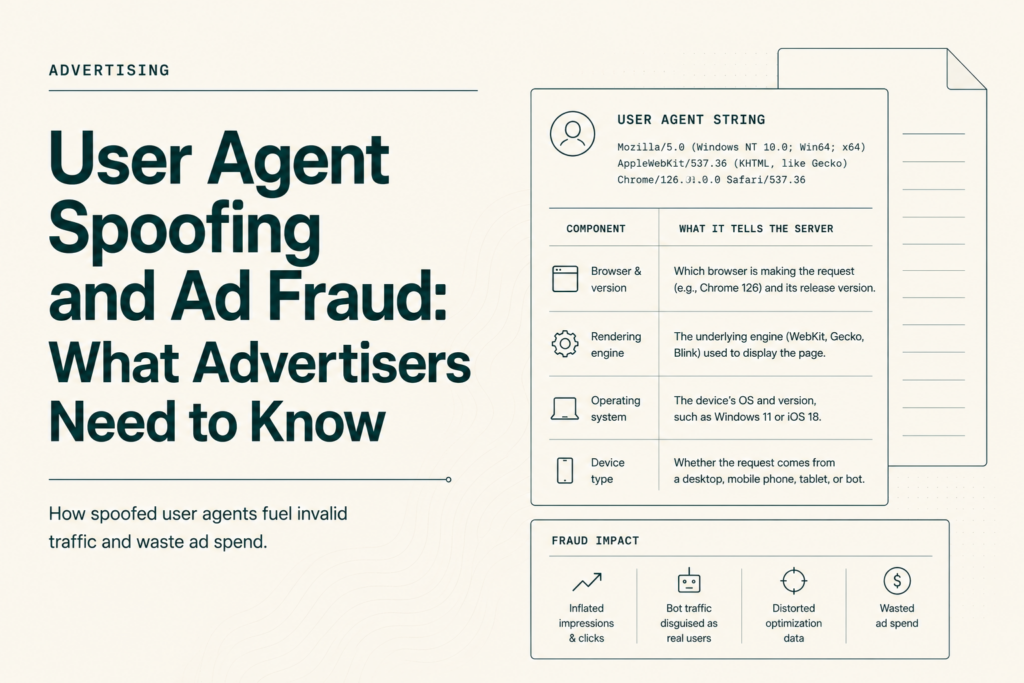
| Component | What It Tells the Server |
|---|---|
| Browser & version | Which browser is making the request (e.g., Chrome 126) and its release version. |
| Rendering engine | The underlying engine (WebKit, Gecko, Blink) used to display the page. |
| Operating system | The device’s OS and version, such as Windows 11 or iOS 18. |
| Device type | Whether the request comes from a desktop, mobile phone, tablet, or bot. |
Ad platforms and analytics tools read this string on every click and conversion event. It’s one of the oldest and most widely used signals in digital advertising. This, of course, is exactly why it’s also one of the first things that fraudsters learn how to fake.
How Does User Agent Spoofing Work?
Hackers don’t need a special device or operating system to spoof a user agent. In fact, browsers like Chrome and Firefox have built-in developer tools that let anyone override the string sent to a site. Browser extensions can make this same change with a single click.
At scale, fraud operators automate the process. They’ll use scripts or bot frameworks that rotate through thousands of different user agent strings so that repeated automated requests each look like they’re coming from a different, legitimate visitor.
This rotation is what sets casual spoofing apart from the version that shows up in ad fraud. A single bot or server can cycle through browser and device combinations fast enough to mimic an entire audience. So the impression and click counts get inflated, and a human never even had to touch a device.
Legitimate vs. Malicious Users
User Agent Spoofing as a Useful Tool
Here are some of the most common, legitimate ways someone might spoof a user agent:
- Web developers testing how a site renders across different browsers and devices without owning each one.
- QA teams reproducing bugs that only appear on specific browser versions.
- Privacy-focused users and researchers reducing the amount of identifying information sent with each request.
- Everyday users working around a site that incorrectly blocks or misformats content for their actual browser.
Malicious User Agent Spoofing
In contrast, this same technique becomes a fraud tool when it’s used to misrepresent traffic at scale.
Malicious spoofing tends to show up in these ways:
- Click farms and bot networks disguise repetitive automated activity as unique human visitors.
- Scrapers and credential-stuffing scripts evade rate limits and blocklists built around known bot signatures.
- Fraud operations fake mobile or high-value device traffic because it commands higher ad rates.
The line between legitimate and malicious spoofing usually comes down to intent and scale. A developer testing cross-browser rendering or a privacy-conscious user limiting fingerprinting is altering one request at a time, for a defensible reason. That’s going to be dramatically different from a bot network rotating thousands of spoofed strings to disguise repeat automated clicks as distinct human visitors.
The malicious version also tends to go hand-in-hand with other evasion tactics. Fraud operators use spoofing to slip past blocklists built around known bot signatures, or to fake high-value device traffic that commands better ad rates. It’s this combination of scale and evasion, not the spoofing alone, that turns a routine technique into a fraud problem.
Why Does User Agent Spoofing Matter for Digital Advertising?
Advertisers pay for impressions and clicks. They’re looking for conversions based on data that assumes each event reflects a real person on a real device. When user agent strings are spoofed, that assumption breaks down.
Google, Meta, and programmatic exchanges all use the user agent as one input for basic bot filtering, targeting, and reporting. This means that a convincing spoofed string can let invalid traffic slip past the first layer of defense and get counted like a genuine interaction.
Which means it gets billed like a genuine interaction.
How Do Spoofed User Agents Contribute to Ad Fraud and Wasted Ad Spend?
Spoofed user agents feed several distinct forms of ad fraud and invalid traffic:
- Inflated impressions and clicks: Bots that rotate spoofed user agents can generate thousands of ad interactions that appear to come from distinct users. This drains your budget on traffic that will never convert.
- Sophisticated invalid traffic (SIVT): Because a spoofed user agent is designed specifically to defeat basic filters, it’s a hallmark of sophisticated invalid traffic, the category of fraud that requires more than routine checks to catch.
- Bot traffic disguised as real audiences: Spoofing works alongside broader bot traffic schemes. So it lets automated sessions pass as the human traffic advertisers are paying to reach.
- Distorted optimization data: Ad platforms optimize delivery based on which “users” engage. When a meaningful share of that engagement is spoofed, campaigns get optimized toward fraudulent patterns instead of real customers.
- Compounding with other fraud tactics: Spoofed user agents are often paired with techniques like pixel stuffing, where fraudulent impressions are logged for ads that were never actually visible on screen.
Across all of these tactics, the end result is the same: advertisers spend real advertising dollars on traffic that never even had the chance to become a customer.
Beyond the User Agent String: How Modern Fraud Detection Works
Because user agent strings are so easy to fake, no credible fraud detection relies on them alone. The Media Rating Council (MRC) and IAB Tech Lab, the industry bodies that set standards for invalid traffic detection and filtration, distinguish between General Invalid Traffic (GIVT) and Sophisticated Invalid Traffic (SIVT), which requires corroborating multiple signals at once.
In practice, the best modern detection systems will layer together several signal categories:
- Network signals: data-center IP ranges, residential proxy patterns, and known botnet activity.
- Device fingerprinting: checking whether the claimed browser, OS, and hardware capabilities are internally consistent. A mismatch between a reported User-Agent header and a device’s actual rendering behavior is a strong fraud signal on its own.
- Behavioral analysis: mouse movement, scroll patterns, and click timing that distinguish genuine human interaction from scripted activity.
- Cross-session corroboration: tracking whether the same underlying device is repeatedly presenting itself as many different “unique” visitors.
When you take this multi-pronged approach, your detection systems will flag spoofed traffic even when the user agent string itself looks completely legitimate.
Advertisers Can Start Reducing Risk Now
Advertisers can take steps today to minimize your risk of being defrauded by a spoofed user agent string:
- Monitor traffic quality metrics, not just volume, so a spike in clicks or impressions triggers a closer look rather than a bigger budget.
- Use fraud detection or ad auditing tools that combine device, network, and behavioral signals instead of relying on user agent or IP checks alone.
- Review placement and publisher-level performance regularly to catch sources with abnormal engagement patterns.
- Build and maintain exclusion lists so confirmed fraud sources stop consuming budget on future campaigns.
- Pursue credit recovery where eligible. Programs like dash.fi’s AI Credit Recovery audit ad billing and invalid traffic data on a business’s behalf and file claims with Google and Meta for spend already lost to fraud.
Ultimately, user agent spoofing sits at a strange intersection: a legitimate, everyday tool for developers and users who value privacy, and a foundational technique behind a meaningful share of digital ad fraud. For businesses buying advertising, the practical takeaway from this is to recognize that the string alone was never enough to confirm real traffic.
Rather than simply distrusting every user agent string, employ effective protection against invalid traffic by combining it with device, network, and behavioral signals. And make sure to round your security out by auditing your ad spend regularly enough that you can catch what earlier layers of detection missed.
If you’re ready to see what this looks like in action, schedule a demo with dash.fi.
Frequently asked questions
Is user agent spoofing illegal?
No. Spoofing a user agent string is a common, legal technique. It’s often used in software testing and privacy protection. It only really becomes a problem when it’s used to commit fraud, like disguising bot traffic as legitimate ad engagement. This can violate platform terms of service and, in some cases, other laws.
How can advertisers tell if traffic involves a spoofed user agent?
Detecting a spoofed user agent usually means comparing the claimed user agent against other signals, like device fingerprint data, network origin, and behavioral patterns, and flagging cases where they don’t line up.
Does blocking known bot user agents stop ad fraud?
It stops some of it. Blocklists catch General Invalid Traffic, like known crawlers and outdated bot signatures. But Sophisticated Invalid Traffic is built specifically to get past these lists by presenting convincing, rotating user agent strings, which is why it requires multi-signal detection rather than user agent filtering alone.