
What Is Bot Traffic?
Bot traffic is any activity on a website that is generated by an automated script or program rather than a real person. This can include simple visits, ad impressions, clicks, and engagement. It becomes a problem for digital advertisers when it interacts with paid media because a bot that’s engaging with an ad is consuming real ad spend but not delivering the way a real customer might.
Of course, not all bot traffic is malicious. Some bots are engine crawlers or ad-verification scanners performing useful, disclosed functions. The traffic that does damage is the kind that hits advertising budgets as invalid traffic, designed to look like genuine user interest but really just consuming ad spend or corrupting performance data.
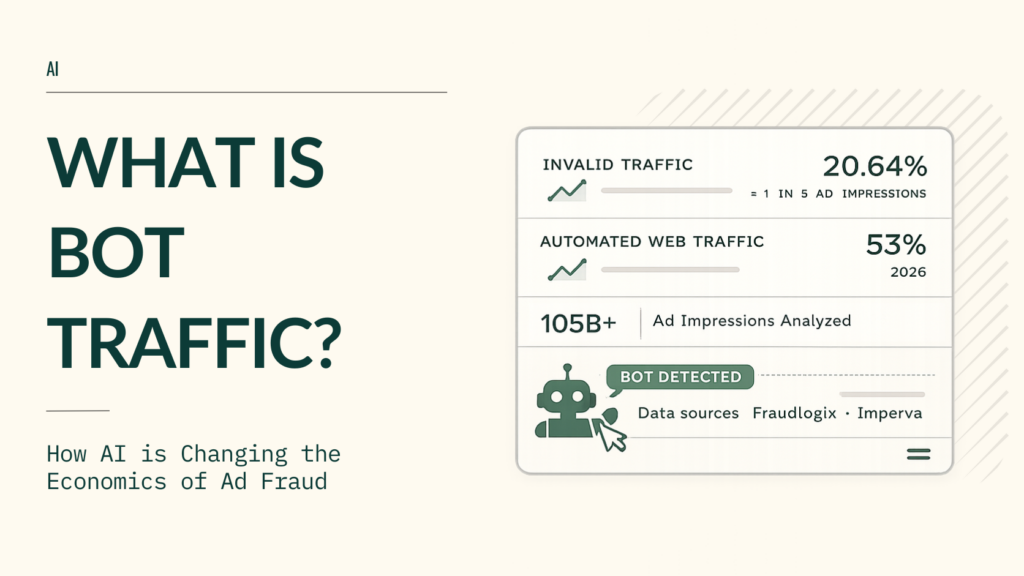
Fraudlogix’s analysis of over 105 billion ad impressions found a global invalid traffic rate of 20.64% across 2025. This means that roughly one in five impressions came from a fraudulent source. Imperva’s 2026 Bad Bot Report goes even further, finding that automated traffic now accounts for more than 53% of all web traffic, up from 51% the year before. This is the first time in history that bots have made up a majority of activity online.
How Does Bot Traffic Work in Digital Advertising?
Bot traffic reaches an ad account the same way a real user would. It just arrives without a real person. The typical bot-driven interaction looks like this:
- A bot operator deploys a script, device farm, or a botnet designed to visit websites or click ads at scale.
- The bot loads a page or clicks an ad, and this triggers a billable event on the advertiser’s account.
- Basic bots will stop here, but sophisticated invalid traffic (SIVT) goes further. It simulates scroll depth, mouse movement, and “reading time” to look like a genuine session.
- The ad platform’s bidding algorithm records the interaction as a signal, whether or not it ever flags the click as invalid.
- If enough bot-driven events look like conversions, the algorithm begins optimizing toward the audiences, placements, and devices that produced them.
It’s that last step that makes bot traffic a data problem as much as a budget problem. Every ad platform’s auction runs on historical performance signals. This is the process that decides whose ads win a placement, and at what price, so when those signals include fake engagement, the auction can’t tell the difference between a real customer and a script.
And your ad spend goes up.
Types of Bot Traffic: Are There Good Bots?
Yes. There are good bots. The clearest way to separate the helpful from the harmful in automation is to look at intent and disclosure. Good bots will identify themselves and perform tasks that benefit the ecosystem. Bad bots hide their identity and perform tasks that benefit only the operator, often at the expense of others.
| Good Bots | Bad bots | |
|---|---|---|
| Purpose | Index pages, monitor uptime, aggregate prices, or verify ad creatives | Generate fake clicks, impressions, form fills, or account sign-ups |
| Examples | Googlebot, Bingbot, uptime monitors, ad-quality scanners | Click bots, scraper bots, credential-stuffing bots, fake-engagement farms |
| Disclosure | Usually identifies itself in the user agent and respects robots.txt | Masks its identity, spoofs headers, or mimics human device fingerprints |
| Effect on ad accounts | Neutral to positive: helps pages get discovered and ads get verified | Drains budget, pollutes conversion data, and distorts optimization signals |
Traffic Bot vs. Bot Traffic
These terms seem similar, and they’re related, but they describe different things.
- A traffic bot is a tool: It’s a piece of software built to generate visits, clicks, or engagement automatically, sometimes sold as a service to inflate view counts or ad impressions.
- Bot traffic is the result: It’s the aggregate of all non-human visits an account receives, whether that’s from a purpose-built traffic bot, a search engine crawler, or a botnet running click fraud.
Every traffic bot produces bot traffic, but not all bot traffic comes from a dedicated traffic bot. Some come from repurposed malware or click farms using real hardware.
Crawler vs. Bot
A crawler is one kind of bot. The two terms get used interchangeably, but a crawler is defined by a narrower job. It systematically requests and indexes pages. Meanwhile, a “bot” can be anything from an automated program, including chatbots, scrapers, and click bots that have nothing to do with indexing.
| Crawler | Bot (General term) | |
|---|---|---|
| Definition | A specific type of bot built to systematically browse and index web pages | Any automated script or program that performs repetitive tasks online |
| Scope | A subset of bots: all crawlers are bots, but not all bots crawl | A broad category that includes crawlers, chatbots, click bots, and scrapers |
| Ad relevance | Rarely a fraud concern; mostly relevant to SEO and content indexing | Directly relevant to ad fraud when the bot clicks, views, or converts on paid ads |
AI and the Economics of Ad Fraud
Bot traffic isn’t new, of course. But the cost of producing convincing bot traffic has collapsed. Generative AI and off-the-shelf automation tools have lowered the technical bar for running a fraud operation, and that shift is changing the economics on both sides of the auction.
Bot traffic is now:
- Cheaper to produce: Bot operators don’t need custom development to mimic human behavior anymore. AI-driven “bots as a service” platforms can generate scroll patterns and click timing. They can even fill out forms that pass basic behavioral checks.
- Harder to detect: Reports on 2026 traffic patterns describe bots that simulate mouse movement, hesitation, and page dwell time closely enough to defeat simple fingerprinting and rule-based filters.
- More profitable per attempt: Because AI-optimized bidding systems learn from every conversion signal, a single successful fraudulent event can redirect future spend toward similar fake traffic. This in turn multiplies the damage of one bot click into an ongoing bias in delivery.
- Faster to scale: What once required a technical team renting server infrastructure can now be coordinated by a small operator using consumer AI tools. So the gap between large fraud rings and low-effort opportunists has shrunk.
The result is a shift in the unit economics of fraud. It’s cost to produce fake clicks is falling, but the payout stays the same. That imbalance is just one reason why invalid traffic rates have continued to be high even as detection tools are improving.
How Does Bot Traffic Hurt Analytics, Performance, and Business in General
What’s worse is that bot traffic doesn’t stay confined to a single wasted click. It compounds across three layers of business:
Analytics
Every bot session inflates pageviews and click-through rates without adding any real audience. This makes top-of-funnel metrics look healthier than they are and can mask a genuine drop in real engagement as the bot volume backfills the numbers reported on the dashboard.
Performance
Automated bidding systems on Google and Meta learn from conversion signals. When bot-driven clicks or fake leads get counted as conversions, the algorithm optimizes toward those same traits as those fake events. This often shows up as a specific placement, device type, or audience segment. Real customer acquisition cost (CAC) then rises as the system chases more of the wrong traffic, and the return on ad spend (ROAS) falls even though the reported metrics may look stable for a period.
Business
Downstream teams absorb the cost that dashboards don’t show. Sales reps chase fake leads with fabricated contact details. Marketing teams misattribute revenue to channels that never produced a real buyer. And budget decisions get made on data that was never clean to begin with.
Identify Bot Traffic
As noted above: bot traffic doesn’t announce itself. But it does tend to leave its fingerprints in campaign and analytics data. When you see these signs, you can be pretty sure bad bot traffic is to blame:
- Sudden spend or click spikes with no corresponding change in real business outcomes
- High click-through rates paired with unusually low conversion rates
- Sessions with near-zero time on page or identical session durations across many visitors
- Traffic clustering around odd hours relative to the target audience’s time zone
- Clicks or impressions originating from data center or cloud-hosting IP ranges rather than residential ISPs
- Repeated conversions from the same device fingerprint or IP block
- A gap between platform-reported “valid” traffic and actual pipeline or revenue outcomes
Just one of these signals alone won’t prove fraud. A real customer might just have a short session or an unusual time stamp. The pattern across multiple signals is your indicator of invalid traffic, especially compared against your normal baseline.
Manage Bot Traffic
Managing bot traffic is an ongoing process because fraud tactics change as detection improves. The best approach is one with a combination of layers:
- Audit your ad billing against tracking data regularly to catch discrepancies between what a platform reports and what actually happened on-site.
- Build and maintain suppression lists, including IP ranges, devices, or placements that have shown fraud signals, and update them as new patterns emerge.
- Use behavioral and network-level detection rather than relying only on the ad platform’s built-in filters. They catch general invalid traffic (GIVT), but they miss more sophisticated fraud.
- Validate leads before they enter a bidding algorithm’s training data, so fake conversions don’t teach the system to chase more of the same.
- File refund and credit claims with ad platforms when overcharges are documented. Neither Google nor Meta issues refunds automatically for everything their filters miss.
You can, of course, handle some of these layers manually with exclusion lists and regular audits. But as your business grows and scales, you’ll need a dedicated layer of monitoring, like what dash.fi’s Ad Agent provides. You’ll get automated traffic audits and ad credit claims filed for you.
Indeed, some ad auditing tools go a step further than fraud detection alone. dash.fi’s card issues up to 3% cash back on Google and Meta ad spend regardless of what its ad audit finds. It also identifies invalid traffic to support refund claims on overcharges.
For advertisers already managing bot traffic exposure, that combination means the audit process that protects a budget from bots can also recover a portion of the spend itself, rather than functioning purely as a defensive cost.
FAQs
What is bot traffic?
Bot traffic is any non-human visit, click, or impression generated by an automated script rather than a real person. This includes both disclosed “good” bots and fraudulent “bad” bots.
Is all bot traffic bad for my ad account?
No. Search engine crawlers and ad-verification bots are automated, but they’re disclosed and generally harmless. The traffic that is bad for your ad account is invalid traffic designed to mimic genuine engagement.
How can I tell if my ad spend is being wasted on bots?
Compare click-through rate against conversion rate, check for traffic from data-center IP ranges, and look for a gap between platform-reported valid traffic and actual pipeline outcomes. When you notice the pattern across several signals, there’s a good chance your ad spend is being wasted on bots.
Can I get a refund for bot traffic on Google or Meta?
Google automatically filters a lot of the invalid traffic it detects, and it issues credits for what it catches after billing. But whatever it misses, you’ll have to file a claim for. Meta’s protection works as a pre-billing filter rather than a refund process, so advertisers generally cannot recover charges for invalid clicks Meta’s systems didn’t already flag.