

What Is Viewbotting?
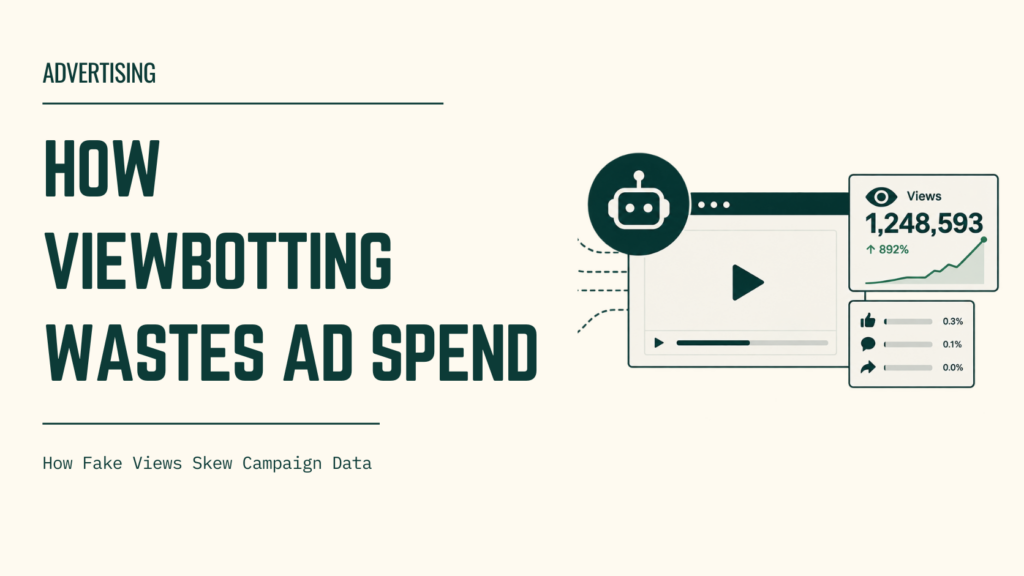
Viewbotting happens when someone artificially inflates the number of views a video or ad receives through the use of:
- Automated scripts
- Bot networks
- Paid click farms
Instead of coming from real, interested audiences, these views are generated by non-human traffic or a low-cost human click farm in order to mimic genuine interest.
This practice started on platforms like YouTube, where higher view counts and concurrent viewer numbers unlock better algorithms for increased sponsorship deals and ad revenue. But now it’s a broader advertising problem: any platform that sells impressions or pays out based on views is a target, and the fake traffic those views generate flows directly into advertiser reporting.
For marketers, viewbotting is a subset of invalid traffic (IVT) and a close cousin of click fraud.
Where click fraud manipulates clicks, viewbotting manipulates the view or impression layer, inflating reach and completion metrics rather than click-through numbers.
How Does Viewbotting Work?
Viewbotting tends to rely on one or more of the following methods:
- Bot networks: Automated scripts running on servers or compromised devices repeatedly load a video or ad, simulating plays without any human watching.
- Device farms: Physical or emulated device farms run hundreds or thousands of virtual sessions in parallel, each registering as a unique “viewer.”
- Click farms: Low-cost human labor, often overseas, is paid to manually watch or load content on real devices, making the traffic harder to distinguish from genuine engagement.
- Residential proxy networks: Bots route traffic through real residential IP addresses to avoid datacenter-traffic detection, a technique closely related to user agent spoofing.
- Session replay tools: More sophisticated operations simulate mouse movement, scroll depth, and watch time to pass basic bot-detection checks.
These tactics overlap heavily with the broader category of bot traffic and, in more advanced forms, with sophisticated invalid traffic (SIVT), which is traffic engineered specifically to evade standard fraud filters.
Types of View Bots
| Type | Description | Typical Target |
|---|---|---|
| Simple script bots | Basic automated requests that load a page or video repeatedly | Low-budget campaigns, small creators |
| Headless browser bots | Simulate a real browser environment, including JavaScript execution | Video ad networks, programmatic display |
| Device farm bots | Run on physical or virtual device banks to appear as distinct users | Mobile app install and video campaigns |
| Click farm labor | Real humans manually generate views on real devices | High-value livestream and CTV inventory |
| Proxy/residential bots | Route through residential IPs to mask datacenter origin | Platforms with strong IP-based filtering |
How Viewbotting Wastes Ad Spend and Skews Campaign Data
Fake views cost advertisers in three distinct ways:
- Direct budget waste. Every impression or view an advertiser pays for that a bot generates is money spent on an audience that can never convert. On CPV (cost-per-view) or CPM campaigns, this waste scales directly with the volume of fraudulent traffic.
- Distorted performance metrics. Viewbotting inflates reach, view counts, and completion rates while leaving actual conversions flat. This makes campaign dashboards look healthier than the underlying business results, which can mask a genuinely underperforming campaign.
- Corrupted optimization signals. Most ad platforms use engagement data to train their delivery algorithms. When bot traffic is logged as a “good” signal, the algorithm optimizes toward more of the same low-quality traffic. This is a compounding problem that keeps degrading account performance and pushing up cost-per-acquisition over time.
This third point is where viewbotting does the most lasting damage. A single fraudulent spike can be absorbed and refunded, but a campaign that has spent weeks training its target on bot-heavy data has a much harder problem to unwind.
The platform’s lookalike and retargeting models were built on the wrong audience.
How Can You Recognize Viewbotting?
There are several patterns that distinguish viewbot traffic from real audience growth:
- Sudden, disproportionate spikes: View counts jump sharply with no corresponding promotion, press mention, or algorithmic push.
- Low engagement relative to view volume: Likes, comments, shares, or click-throughs stay flat or near zero while views climb.
- Near-zero or maxed-out watch time: Bots either drop off immediately or “watch” for an unnaturally exact duration, such as the full length of the video every time.
- Geographic and device anomalies: A disproportionate share of traffic originates from regions outside the target market or from a narrow range of device/browser combinations.
- Repeating IP or session patterns: The same IP ranges, user agents, or session fingerprints appear across large numbers of “unique” viewers, a signal closely tied to user agent spoofing.
- Traffic concentrated in off-hours: Bot traffic often runs on a schedule rather than following the natural time-of-day curve of human audiences.
Of course, there’s no single signal that can prove viewbotting on its own. In general, fraud detection depends on cross-referencing several of these indicators against a traffic-quality baseline.
Viewbotting vs. Legitimate Traffic Spikes
Separating viewbotting from a genuine viral moment can be a tough judgment call.
Here, you can see some of the key differences between the two:
| Signal | Viewbotting | Legitimate Traffic Spike |
|---|---|---|
| Engagement rate | Flat or near zero despite rising views | Rises or holds steady with views |
| Watch time | Unnaturally uniform or near-instant drop-off | Varies naturally across viewers |
| Traffic source | Concentrated IP ranges, proxies, or datacenter origins | Diverse referral sources (social shares, search, press) |
| Geographic distribution | Skewed toward regions outside the target audience | Aligned with or expands naturally from the target audience |
| Conversion activity | No corresponding increase in leads or sales | Some measurable lift in downstream conversions |
| Timing pattern | Constant or scheduled, regardless of time zone | Follows normal peak-usage hours |
How Does Viewbotting Affect Brands?
Advertisers note that the damage viewbotting can wreak rarely stays confined to just that one campaign where it first occurs.
- Wasted budget compounds across channels: If bot traffic isn’t identified and excluded, it can bleed into remarketing lists and lookalike audiences used for future campaigns, spreading the problem beyond the original placement.
- Reporting loses credibility: Marketing teams that present view and reach numbers inflated by bots risk making budget decisions (and defending results to leadership) based on inaccurate data.
- Publisher and platform trust erodes: Advertisers who repeatedly encounter inflated view counts on a given publisher or inventory source may pull spend from that channel entirely. This is part of why platforms invest heavily in click fraud detection and traffic-quality enforcement.
- It compounds with other IVT tactics: Viewbotting rarely operates in isolation. Campaigns hit by fake views are frequently also affected by related schemes like pixel stuffing, where multiple ads are stacked invisibly to claim credit for impressions that were never actually rendered on screen.
Can You Block Viewbotting?
You can’t block viewbotting entirely, but you can reduce your exposure to it by a lot through a confirmation of platform safeguards and measurement discipline. It also helps to maintain regular traffic-quality checks.
Here’s how to get started:
- Use third-party verification: Independent measurement vendors apply fraud filters that platforms’ own reporting may not catch, providing a second layer of validation.
- Set traffic-quality thresholds: Flag placements or publishers where engagement rate, watch time, or conversion rate falls well below account averages, even if raw view counts look strong.
- Apply IP and device exclusion lists: Once a fraudulent source is identified, suppressing it prevents the same traffic from continuing to drain future budget.
- Audit billing against delivery logs: Comparing what was billed against verified, filtered impression data can surface discrepancies worth disputing with the platform.
- Monitor for SIVT patterns specifically: Because sophisticated invalid traffic is built to evade basic filters, campaigns in high-value verticals should periodically audit for the more advanced fraud patterns covered in SIVT, not just obvious bot spikes.
Across the industry, the scale of the problem is significant. The Association of National Advertisers’ Q2 2025 Programmatic Transparency Benchmark found that global advertisers still lose an estimated $26.8 billion in media value annually to programmatic inefficiencies, which includes invalid traffic. These results are in spite of measurable industry progress on cleaning up the supply chain.
Measurement standards published by the Media Rating Council also give advertisers a baseline for what counts as a legitimate, viewable impression. This can be a useful reference point when auditing whether reported views reflect real audience attention.
For advertisers running high-volume Google or Meta campaigns, reviewing billing data against verified click and view activity is one of the most direct ways to catch invalid traffic before it erodes further budget.
Dash.fi’s ad credit recovery tools audit ad billing for exactly this kind of discrepancy and file recovery claims on the advertiser’s behalf.
Book a demo to see how it can work for your business.
FAQs
What is the definition of viewbotting?
Viewbotting is the use of bots, scripts, or paid click-farm labor to artificially inflate the number of views on a video, livestream, or ad, without any real audience behind those views.
How does viewbotting affect brands?
It wastes ad budget on non-human traffic, distorts performance data, and can corrupt the targeting algorithms platforms use to optimize future ad delivery. All of these push up cost-per-acquisition over time.
What are the main types of view bots?
Common categories include simple script bots, headless browser bots, device farm bots, click farm labor, and proxy or residential-IP bots designed to evade detection.
Can you block viewbotting?
It can’t be fully eliminated, but you can reduce exposure through third-party traffic verification, IP and device exclusion lists, billing audits, and monitoring for more sophisticated invalid traffic patterns.