

Carrier invoices can be both dense and filled with inaccuracies, but those errors are hard to catch, specifically because of the complicated nature of the invoices. Often, the credit owed to shippers goes unclaimed because the volume is high and the windows for claims are short.
Parcel audit software automatically reviews your carrier invoices to find issues that can save you money. Most of these systems will work directly with your accounts, including FedEx, UPS, USPS, DHL, and regional carriers.
Parcel audits serve to recover lost funds and help you lower future costs at scale.
This guide covers exactly what parcel audit software does, including all the features that matter to help catch all those errors and save money, including what to do when a carrier rejects a claim. To help further, this includes a neutral comparison of leading tools on the market today and guidance to decide which one might work for your business.
What Is Parcel Audit Software?
Parcel audit software scans carrier invoices to compare each line against contract terms, published tariffs, and shipment records. As it goes, it flags any discrepancies that will qualify for a refund. The more advanced platforms will take this process a step further and normalize data across carriers to reveal where shippers are getting the most out of their contracts.
The core question for these platforms is this: is the shipper receiving what it’s paying for?
Parcel Audit vs. Freight Audit Software
There are two different types of audits that will address different types of shipping. Parcel audit software focuses on small package carriers, where each shipment comes with dozens of accessorial line items. In this case, billing depends on dimensional weight math and money-back guarantees. In contrast, freight audits cover LTL, truckload, ocean, air, and rail, where billing depends on lane rates and documented accessorials. Some platforms will cover both.
Parcel Audit Software vs. Parcel Audit Services
Of course, not every shipper uses a platform, which is parcel audit software. The software performs automatic scans and often files claims for the shipper for a subscription fee. But some shippers prefer to use a parcel audit service, which involves a human team that performs the audits manually and collects a percentage of recovered funds for their efforts. Many vendors do offer both the manual element and the platform. The difference is one of control versus effort.
Why Manual Parcel Invoice Auditing Doesn’t Scale
Because the bottom line is this: manual auditing can be highly effective at lower volumes. The human eye can scan a few invoices a day to catch inefficiencies and discrepancies. But that effort breaks down fast. Exporting invoices, gathering the contract and shipment records, comparing timestamps, weight, dimensions, and surcharges by hand is heavy work. Then add filing each claim before the deadline window, and the work is near impossible, and you’re still going to deal with human error.
You can review a full walkthrough for one carrier in this guide to FedEx parcel audits.
Three structural problems exist that make manual invoicing impractical at scale:
- Carriers structure billing data differently. Invoices arrive in non-standardized formats, where one carrier’s “Notify Fee” is another’s “Call Before Delivery,” so reconciling by hand is slow and inconsistent.
- Spot-checking leaves systematic errors in place. Sampling catches one-off mistakes but misses recurring patterns like a residential surcharge applied to a commercial address every week. Those will only surface across the full dataset.
- Claim windows are tight, and carriers don’t refund proactively. UPS requires Guaranteed Service Refund claims within 15 calendar days of scheduled delivery and never issues them automatically. So by the time a weekly invoice is reconciled by hand, the window may have closed.
| Dimension | Manual auditing | Automated parcel audit software |
|---|---|---|
| Speed | Days to weeks per cycle; often misses the 15-day refund window | Continuous; flags issues within days and files before deadlines |
| Accuracy | Sampling-based and prone to data-entry error | Line-level audit of every shipment against contract and tariff |
| Scalability | Breaks down past a few hundred parcels per month | Handles tens of thousands of shipments per week |
| Cost | Staff hours plus missed claims; about $53.50 per exception | Subscription or contingency fee; recovers far more than manual |
| Insight | Limited to what a reviewer can eyeball | Cross-invoice pattern detection, scorecards, and trend analytics |
And in the end, manual auditing is also costly. The average cost to resolve a single invoice exception is $53.50, and 22% of invoices require manual intervention. That’s a cost inefficiency when you can employ a platform to do the same thing at scale for a fraction of the cost.
What Billing Errors Does Parcel Audit Software Catch?
The software will check every single line against contract and tariff rules.
The most common recoverable issues are the following:
- Duplicate charges: the same shipment billed twice after a glitch, split, or re-invoicing.
- Late deliveries: eligible express packages delivered past the guaranteed window earn a full refund of transportation charges; filing mechanics are in this FedEx shipping refund guide.
- Incorrect service level: billing for a premium service that was not delivered.
- Dimensional weight (DIM) errors: mismeasured dimensions inflate billed weight, and since August 18, 2025, both carriers round every fractional inch up before calculating DIM. The shift to volumetric pricing explains why.
- Wrong zone rate: a shipment rated to the wrong zone, raising the base rate.
- Residential and address-correction surcharges: residential fees on commercial addresses, or correction charges over $20 each for minor formatting issues.
- Contract and discount violations: negotiated discounts that the billing system fails to apply.
- Account-code and fuel-surcharge errors: wrong-account charges, or fuel surcharges on an incorrect base or outdated percentage.
Billing Error Taxonomy
Below, you’ll find a table that maps each error to how it occurs and the path to recovery.
| Error type | How it occurs | Recovery path and timing |
|---|---|---|
| Duplicate charge | Glitch, split shipment, or re-invoicing bills with the same tracking number twice | Dispute with shipment records, within the billing-dispute window |
| Late delivery | Eligible express package delivered past its commitment time | Money-back guarantee refund; UPS requires filing within 15 calendar days of scheduled delivery |
| Incorrect service level | Billed for a higher service than rendered | Rerate the dispute against the service actually provided |
| Dimensional weight | Mismeasured or mis-rounded dimensions inflate the billed weight | Dispute with manifest dimensions as evidence |
| Wrong zone rate | Shipment rated to an incorrect zone | Rerate dispute against the correct zone |
| Residential / address correction | Surcharge on a commercial address or from a minor format issue | Dispute with address validation |
| Contract/discount violation | Negotiated discount was not applied by the billing system | Dispute against the contract rate schedule |
| Fuel / accessorial overcharge | Outdated rate, or a charge applied to an exempt service | Dispute against the published tariff |
There are two important notes here: lost and damaged claims do follow longer, separate windows (UPS allows 60 days domestic and 21 days international). Also, carriers will periodically suspend money-back guarantees during peak seasons, which can change late-delivery eligibility for those dates.
How Much Can Shippers Save?
Audits alone can save shippers anywhere from 1% to 5% of their parcel spend, with direct-to-consumer brands often reaching up to 7%. Late-delivery refunds are the most visible recovery, but they often make up only a small minority, around 1% of spend.
It is important to recognize that carrier accuracy has improved, so while some vendors will still market their services as capable of recovering up to 10%, those numbers are pre-2020. A 2026 analysis found that most invoice lines now match the tariff, and only about 3.5% of volume runs through guaranteed services eligible for refunds. The combined savings landed between 1.8% and 3.5%.
The larger opportunity today is operational. Audit data shows where spend leaks by accessorial category, surcharge, and carrier performance, and that data is leverage for shippers when negotiating their contract renewals.
Indeed, surcharges now make up roughly 40% of DTC parcel spend, up from 28% in 2022.
The Cost of Inaction
The table below illustrates the annual leakage left unclaimed at different spend levels, using a moderate 2% to 6% range. Of course, these figures are just an example, not a guarantee. Your results will depend on the mix of carriers you use, your service levels, and your exposure to surcharges.
| Annual parcel spend | At 2% | At 4% | At 6% |
|---|---|---|---|
| $250,000 | $5,000 | $10,000 | $15,000 |
| $500,000 | $10,000 | $20,000 | $30,000 |
| $1,000,000 | $20,000 | $40,000 | $60,000 |
| $5,000,000 | $100,000 | $200,000 | $300,000 |
Even at the lowest end, the unclaimed amount for a shipper spending $500,000 to $1,000,000 will usually exceed the amount of time it will take a team to chase that money down manually.
Key Features to Look for in Parcel Audit Software
Once you start shopping for parcel audit software, there are a few features that separate a basic refund tool from a full spend-management system:
- Automated invoice ingestion: a direct carrier connection, so every invoice is pulled without manual export.
- Multi-carrier support: FedEx, UPS, USPS, DHL, and regional carriers in one normalized dataset.
- Automated refund detection and filing: the only reliable way to hit a 15-day window at volume.
- Accessorial charge detection: flags residential, additional-handling, address-correction, and peak surcharges.
- Rate validation: checks each line against the negotiated schedule and published tariff.
- Contract compliance monitoring: confirms negotiated discounts and tiers are actually applied.
- Analytics and dashboards: spend by carrier, service, zone, and surcharge, with performance scorecards.
- Configurable alerts: notifications when a surcharge changes or a guarantee is suspended.
- Scenario modeling: projects the impact of rate increases or carrier-mix changes before they hit invoices.
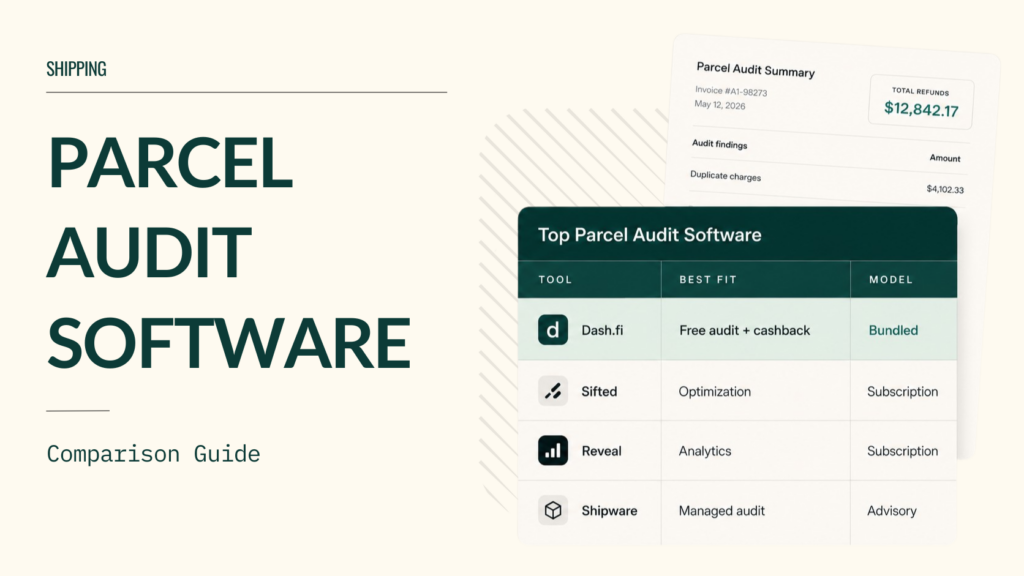
Top Parcel Audit Software Solutions
The market for parcel audit software solutions spans SaaS platforms, contingency recovery services, and bundled offerings. You can also choose from among various pricing models that include subscription, contingency, or free with a bundle.
| Tool | Best for | Pricing model |
|---|---|---|
| Dash.fi | Ecommerce founders wanting a free audit plus cashback | Free, bundled with a corporate card |
| Sifted | Data-driven optimization beyond refunds | Subscription |
| Reveel | Mid-market analytics and negotiation insight | Subscription |
| Shipware | Enterprises wanting managed audit plus negotiation | Subscription plus advisory |
| Lojistic | A free audit entry point | Free platform plus paid services |
| Refund Retriever | Smaller shippers wanting hands-off recovery | Contingency |
| Share a Refund | Automated multi-carrier recovery, no upfront cost | Contingency |
| LateShipment.com | Multi-carrier refunds plus post-purchase tracking | Contingency or tiered |
| TransImpact | Enterprise margin analysis and negotiation | Managed or subscription |
| Intelligent Audit | Enterprise multi-modal (parcel plus freight) | Enterprise or custom |
- Dash.fi: bundles a free parcel audit with its corporate card plus cashback on UPS and FedEx spend, with confidence-adjusted projections; see cards for ecommerce shipping.
- Sifted: audit data plus scenario modeling, contract-compliance checks, and an AI assistant.
- Reveel: machine-learning shipping intelligence; its All Modes product extends into freight.
- Shipware: audit technology paired with an advisory team that negotiates carrier contracts.
- Lojistic: a genuinely free audit within a broader cost-management platform.
- Refund Retriever: hands-off FedEx and UPS refund recovery on contingency.
- Share a Refund: automatic claims across FedEx, UPS, and DHL on a revenue-share basis.
- LateShipment.com: wide carrier coverage plus post-purchase tracking tools.
- TransImpact: parcel spend management with expert-led contract negotiation.
- Intelligent Audit: enterprise parcel-and-freight platform with anomaly detection.
The comparison here is descriptive, not an endorsement. The right fit will be based on your volume, your mix of carriers, and whether your priority is refunds or long-term optimization.
How to Choose the Right Parcel Audit Software
Here’s a breakdown of how to figure out which parcel audit software is right for you, based on your business:
- Define the audit scope: Are you interested in refunds only, or refunds plus optimization and negotiation support?
- Assess volume and carrier mix: Under roughly 10,000 parcels a month, a subscription platform often beats a gainshare service. Above 50,000, a dedicated team can win.
- Evaluate integration: Do you want direct connections to the carrier billing accounts and the TMS or ERP?
- Understand the pricing model: Weigh the subscription model against contingency against free or bundled, and project your net recovery.
- Consider scalability: Will it handle seasonal peaks and new carriers without manual workarounds?
- Check carrier-specific coverage: Every carrier in use, including regional and international, where claim windows differ.
- Assess analytics: Figure out whether reporting supports contract negotiation, not just refund tracking.
How to Use Parcel Audit Data Strategically
Of course, the audit is only the beginning. Once you have that data in hand, you’ll want to use it to support four strategic moves:
- Reduce accessorial fees: With surcharges near 40% of spend, the largest categories show where packaging or routing changes cut cost.
- Review carrier mix and service selection: Audit data reveals which services and lanes overcharge or underperform.
- Build a diversified carrier network: Cross-carrier data supports adding regional carriers to reduce zones and surcharge exposure.
- Negotiate contracts: A documented overcharge profile is leverage at your contract renewal. The most negotiable terms are in this UPS and FedEx contract guide.
What Happens When a Carrier Rejects a Claim?
If a claim is rejected by a carrier, it’s usually because an automated system or lower-level billing queue bounced it. A clear, well-documented dispute can often get that rejection reversed.
To make this happen, follow these three steps:
- Escalate past the automated system. Ask a billing analyst or the account manager to review the claim rather than accepting the automated denial. Clear errors, like a wrong-zone rate or duplicate charge, are corrected on manual review.
- Use audit data as evidence. Attach manifest weights and dimensions, the contract rate schedule, tracking timestamps, or address validation. Disputes framed in exact dollar terms are harder to deny.
- Look for systematic issues. A repeated denial of the same charge type can signal a contract-loading error or a guarantee suspension, and fixing the pattern will resolve many claims at once.
Before moving forward, be sure to confirm a few things: you’re within the claim window (these windows are strict). Also note that some contracts include a money-back-guarantee waiver that forfeits late refunds in exchange for lower rates. Make sure you didn’t agree to this waiver before trying to reclaim funds.
You can find the authoritative terms in the FedEx Money-Back Guarantee and the UPS Service Guarantee.
Frequently Asked Questions
What is parcel audit software?
An automated system that reviews carrier invoices against contract and tariff terms to find billing errors and service failures, then files refund claims and surfaces spend analytics.
How is parcel audit software different from parcel audit services?
Software is a platform that the shipper self-serves. A service is a managed engagement where a provider’s team recovers funds for a percentage. Many vendors offer both.
What is the difference between parcel audit and freight audit software?
A parcel audit covers small-package carriers and depends on dimensional-weight math and money-back guarantees. A freight audit covers LTL, truckload, ocean, air, and rail, and depends on lane rates and accessorials.
How much can a business save with parcel audit software?
Auditing alone typically recovers 1% to 5% of parcel spend, and DTC brands often reach 3% to 7%, with larger long-term savings from contract leverage and network optimization.
What billing errors does parcel audit software catch?
Duplicate charges, late deliveries, incorrect service levels, dimensional-weight errors, wrong zone rates, misapplied surcharges, unapplied discounts, and fuel or accessorial overcharges.
Is parcel audit worth it for small businesses?
Generally yes once monthly shipping passes a few thousand dollars; free or bundled options lower the barrier, and automation captures refunds manual review tends to miss.
How does parcel auditing support carrier contract negotiations?
It produces a documented record of overcharges, surcharge exposure, and carrier performance that serves as evidence and leverage at renewal.
Can parcel audit software handle multiple carriers?
Yes, multi-carrier support normalizes FedEx, UPS, USPS, DHL, and regional carrier data into one view, though claim rules and windows differ by carrier.
Bottom Line
In the end, parcel audit software has shifted from a refund tool into a spend-management tool. Yes, you can still get refunds and recover decent money, but the real, long-term value is a continuous, line-by-line record of how your carriers are billing you. For most shippers past a modest monthly volume, the question is whether to audit manually and miss deadlines or automate and take full advantage of all opportunities available.