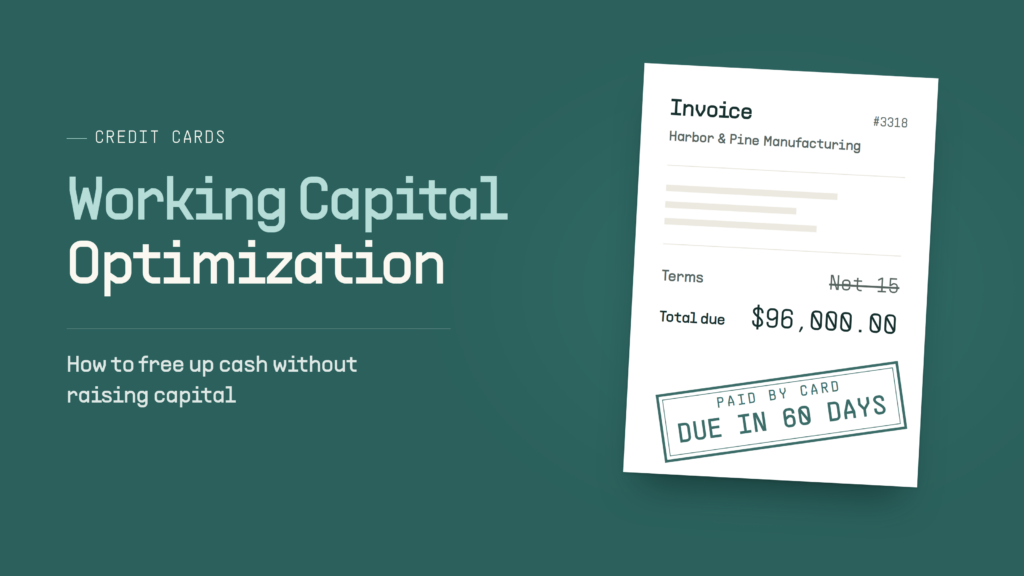
Working capital optimization is the practice of shortening the time your cash spends locked inside day-to-day operations, so more of it is available to run and grow your business. For an e-commerce brand, that means managing three things:
- How long inventory sits before it sells
- How fast sales turn into deposited cash
- How long you take to pay the vendors who supply your product, ads, and shipping
All of this matters because you can be profitable on paper and still be short on cash. The cash that paid for your inventory and that Meta campaign left your account weeks before the sale paid out.
Working capital optimization closes that gap without you having to sell equity or sign a loan.
What Is Working Capital and Why Does It Matter?
Working capital is the difference between your current assets and your current liabilities.
Working capital = current assets − current liabilities
| Side | Line item | What it looks like in e-commerce |
|---|---|---|
| Current assets | Cash | Operating account balances, processor balances awaiting payout |
| Current assets | Inventory | Finished goods in your warehouse, at a 3PL, in transit or at Amazon FBA |
| Current assets | Accounts receivable | Marketplace payouts not yet settled, wholesale and retail invoices |
| Current liabilities | Accounts payable | Supplier and manufacturer invoices, 3PL and freight bills |
| Current liabilities | Card balances | Ad spend, shipping, SaaS and AI tools charged to cards |
| Current liabilities | Accrued expenses | Carrier charges, platform fees, and payroll incurred but not yet billed or paid. |
Positive working capital means short-term resources exceed short-term obligations. Some fast-turning DTC brands run negative working capital on purpose, collecting from customers before paying suppliers.
Types of Working Capital
| Type | Definition | E-commerce example |
|---|---|---|
| Gross working capital | Total current assets | All inventory, cash, and receivables on the balance sheet |
| Net working capital | Current assets minus current liabilities | The figure most lenders and investors look at |
| Permanent (core) working capital | The minimum needed to operate year-round | Baseline safety stock plus a month of operating costs |
| Temporary (seasonal) working capital | Extra capital needed for peaks | The Q4 inventory build and holiday ad budget |
| Negative working capital | Current liabilities exceed current assets | Pre-orders or fast payouts, funding inventory before supplier bills come due |
Seasonal working capital is where most e-commerce cash crunches happen. You buy Q4 inventory in August and September, ramp ad spend in October and November, absorb peak season surcharges on every label, and don’t see the full cash return until December payouts settle.
How Working Capital Optimization Works: The Cash Conversion Cycle
The cash conversion cycle (CCC) measures how many days a dollar stays tied up between paying for inventory and collecting cash from the sale. It’s the core metric for working capital optimization.
CCC = DIO + DSO − DPO
- Days inventory outstanding (DIO): how long inventory sits before it sells
- Days sales outstanding (DSO): how long it takes to collect cash after a sale
- Days payable outstanding (DPO): how long you take to pay suppliers and vendors
A lower CCC means cash comes back to you faster. A negative CCC means customers are effectively funding your operations.
A worked example
Say your brand carries 90 days of inventory, receives Shopify and marketplace payouts in about 5 days, and pays most vendors within 15 days.
90 + 5 − 15 = 80-day cash conversion cycle
Now, say you move ad, shipping, and software spend onto Net 60 terms and push supplier terms out to match, so your DPO rises to 60 days.
90 + 5 − 60 = 35-day cash conversion cycle
If your brand spends roughly $16,400 a day on inventory and operating costs (about $6 million a year), cutting 45 days off the cycle releases around $740,000 in cash. You didn’t sell more, raise prices, or take a loan.
You changed the timing.
Why the e-commerce CCC is different
Most working capital guides assume DSO is the big problem, because B2B customers pay on 30 to 90-day invoices. In DTC e-commerce, DSO is usually just a few days, so the real levers are DIO and DPO.
There’s also a fourth lever that the standard formula ignores: leakage. Overbilled shipping, invalid ad clicks, and unused software seats drain cash without showing up in your CCC at all.
Recovering that money adds to working capital the same way a faster payout does.
| Lever | What it changes | E-commerce examples | Speed to cash |
|---|---|---|---|
| Inventory (DIO) | How long cash sits in stock | SKU-level reorder points, dead-stock liquidation, and smaller POs | Weeks to months |
| Collections (DSO) | How fast sales become cash | Payout schedules, wholesale deposits | Days |
| Payables (DPO) | How long you hold cash before paying | Supplier terms, card terms on vendor spend | Immediate once terms change |
| Leakage recovery | Cash lost to billing errors | Parcel audits, ad credit claims, SaaS cleanup | Ongoing; refunds post as claims are approved |
Strategies to Improve Working Capital
1. Tighten inventory to lower DIO
Inventory is usually the largest single place where your cash sits.
- Set reorder points by SKU velocity, not by category
- Liquidate or bundle slow movers before they become dead stock
- Negotiate lower minimum order quantities, even at a slightly higher unit cost, when it cuts weeks of carrying time
- Split large POs into staggered deliveries so you pay for inventory closer to when it sells
Watch the other side of this lever, too. Running too lean causes stockouts, and stockouts waste ad spend on products you can’t ship. Track your marketing efficiency ratio alongside inventory levels so you can see when cuts start hurting revenue.
2. Speed up incoming cash to lower DSO
- Check marketplace payout settings and move to the fastest schedule available
- Require deposits on wholesale orders instead of full net-30 terms
3. Stretch payment timing to raise DPO
Paying vendors on the due date, not the day an invoice arrives, is the easiest working capital win available. From there, negotiate longer terms with suppliers as your volume grows.
Be careful with early-payment discounts. A common term like 2/10 net 30 (2% off if you pay within 10 days instead of 30) works out to an annualized return of roughly 37%. That’s a strong return if you have idle cash, but a poor trade if paying early means you can’t fund your next inventory order.
4. Move vendor spend onto card terms
Ad platforms charge on billing thresholds, UPS and FedEx invoice weekly, and software renews monthly. Most brands can’t get net terms from Meta but you can change when that spend leaves your bank account by running it through a card with longer payment terms.
A corporate card with flexible terms adds days of DPO across every vendor at once, without a separate negotiation for each. Dash.fi, for example, lets you choose Net 1, Net 15, or Net 60, with up to 60 days to pay at no fee. The tradeoff is between time and rewards: shorter terms earn more cash back, while Net 60 maximizes the time your cash stays in your account.
| Spend category | Net 1 | Net 15 | Net 60 |
|---|---|---|---|
| Shipping (with AI Shipping Audit) | Up to 3% back | Up to 2.5% back | Up to 1% back, 0% fee |
| Everything else, ad spend included | 1.5% back | 1% back | No cash back, 0% fee |
For suppliers that don’t accept cards, bill pay with deferred terms can do the same job. Dash.fi pays the vendor right away, and you repay in 15, 30, or 60 days for a flat fee shown upfront, with nothing due before the end of the term.
5. Recover money lost to billing errors
Billing errors are working capital that you’ve already spent and can get back, without changing suppliers, terms, or inventory plans.
- Shipping: carrier invoices regularly include incorrect dimensional weight charges, misapplied residential and fuel surcharges, duplicate billing, and rates that don’t match your contract. Parcel audit software checks every invoice and files claims before carrier deadlines pass.
- Advertising: invalid traffic from bots and click farms eats into ad budgets, especially in Q4. Google automatically credits some invalid clicks, but recovering the rest usually means spotting it and filing a claim.
- Software and AI tools: duplicate subscriptions, unused seats, and forgotten trials add up quietly. A regular SaaS spend audit finds them.
Dash.fi’s audit agents run these checks automatically on shipping and ad spend paid through the card, with no platform fee and nothing upfront.
Working Capital Optimization vs. Raising Capital
| Factor | Equity raise | Debt or revenue-based financing | Working capital optimization |
|---|---|---|---|
| Ownership | Dilutes founders | No dilution | No dilution |
| Cost | Share of future value | Interest, fees or a cut of revenue | Low; mainly process changes and term fees where used |
| Speed | Months | Weeks | Days to weeks for payables and recovery; longer for inventory |
| Repayment | None, but permanent ownership loss | Fixed schedule or daily revenue share | Normal vendor and card payment cycles |
| Best use | Large, long-term bets | Defined growth projects | Funding ongoing operations and seasonal peaks |
Optimization isn’t going to replace outside capital in every case, but it does mean you raise for growth instead of having to plug a cash gap.
Benefits and Limitations of Working Capital Optimization
Benefits
- More cash available without dilution or new loans
- Better ability to fund seasonal inventory and ad ramps
- Stronger position in supplier and carrier negotiations
Limitations
- Stretching supplier payments too far can damage relationships or cost you priority in production queues
- Cutting inventory too aggressively leads to stockouts and wasted ad spend
- Longer card terms usually mean lower cash back, so you’re trading rewards for time
- Billing recovery depends on clean data and claim deadlines; missed windows mean lost money
These pressures aren’t unique to e-commerce. In the Federal Reserve’s Small Business Credit Survey, rising costs, paying operating expenses, and uneven cash flow were the financial challenges small businesses cited most often, and the 2026 Report on Employer Firms found that rising costs remained the top challenge by a wide margin.
Best Practices for E-commerce Working Capital
- Calculate your CCC monthly. Track DIO, DSO, and DPO separately so you can see which one is moving.
- Build a 13-week cash forecast. Map inventory purchases, ad spend, and carrier invoices against expected payouts.
- Plan the Q4 build early. Line up card terms and supplier terms before you place peak-season POs, not after.
- Audit continuously. Annual reviews miss claim deadlines. Ongoing audits catch errors while they’re still recoverable.
Frequently Asked Questions
What is working capital optimization?
Working capital optimization is the process of reducing the time cash spends tied up in inventory, receivables, and payables. The goal is to have more cash available for operations and growth without raising equity or taking on loans.
What is a good cash conversion cycle for an e-commerce brand?
It depends on your category and supply chain, but shorter is better. Brands with long overseas lead times often run 60 to 120 days, while fast-turning DTC brands with strong payment terms can get close to zero or even negative.
Can a profitable e-commerce brand run out of cash?
Yes. Your P&L books revenue when sales happen, but cash leaves earlier for inventory, ads, and shipping. Fast growth can shrink your bank balance even while profit rises.
Does putting vendor spend on a corporate card count as taking on debt?
Technically it’s a short-term liability, but because you pay it in full each term, it works more like extended vendor terms than a loan.
See how Dash.fi’s Net 60 terms and audit agents can fit your cash cycle.