

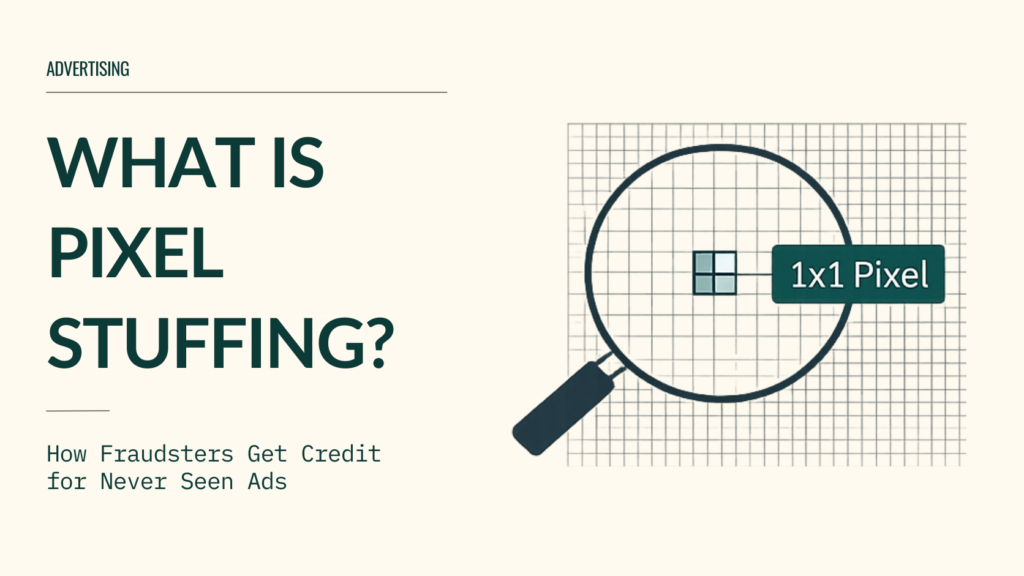
Pixel stuffing is a form of digital fraud that compresses multiple ads into a single pixel frame so humans can’t see or click to engage. What makes this process problematic is that, although users cannot actually interact with the ad, it still registers as a served impression, which means the advertiser is billed for each one.
Pixel stuffing is one of the most common techniques behind invalid traffic (IVT) on the open web. And it disproportionately affects display and programmatic campaigns that run through Google, Meta, and other ad networks.
This guide breaks down how pixel stuffing works and why it quietly damages ad performance and account health. It will also discuss detection and prevention methods and how to recover the money wasted on this fraudulent hack.
What Is a Pixel in Marketing?
In digital advertising, a pixel is a small, often invisible piece of code embedded in a webpage, ad creative, or email that communicates data back to an ad server or analytics platform. The term comes from the earliest version of the technology: a literal 1×1 pixel GIF image, so small it couldn’t be seen, placed on a page purely to trigger a tracking request when the page loaded.
Today, digital advertising relies on a few different types of pixels. Each one serves a different function in the campaign lifecycle:
| Pixel Type | Function |
|---|---|
| Display ad pixel | Renders the actual ad creative in an allotted ad space on a webpage or app. |
| Tracking (conversion) pixel | Fires when a user completes an action, like a purchase or form submission, to attribute that conversion to a campaign. |
| Retargeting pixel | Drops a cookie or identifier when a user visits a site, allowing advertisers to serve that user ads later. |
| Impression pixel | Confirms that an ad was served (not necessarily seen) and logs a billable impression. |
Pixels form the foundation of billing and metrics in digital advertising, which is why pixel fraud is so effective. Fraudsters don’t need to fake a user or a click. They just need to make the pixel fire.
What Is Pixel Stuffing?
With pixel stuffing, a publisher or ad network compresses one or more ads into that 1×1 pixel container on a page. They might also hide those ads behind other content. Then, the ad tag loads, the impression pixel fires, and the advertiser is charged for a “served” ad.
But the ad itself is never rendered at a visible size.
Nothing about the transaction will appear to be broken to a standard service because the impression was technically delivered. It’s just delivered to space that no human eye will ever encounter.
The Media Rating Council (MRC) and IAB Tech Lab classify pixel stuffing as a form of Sophisticated Invalid Traffic (SIVT). This category of fraud requires advanced analytics to detect it because it doesn’t rely on obvious bot activity.
Indeed, Google’s own ad traffic quality documentation similarly groups pixel stuffing with ad stacking and hidden iframes as tactics that make ads technically served but never actually seen.
How Does Pixel Stuffing Work?
Pixel stuffing usually happens on the publisher or supply side of the programmatic ecosystem. And it’s often taking place without the advertiser even realizing it.
The mechanics of this process tend to follow the same pattern:
- A low-quality or fraudulent publisher accepts ad tags from a demand-side platform (DSP) or ad network, just like any legitimate site.
- Instead of rendering the ad at its intended size, the publisher uses CSS or an iframe to shrink the ad container down to 1×1 pixels.
- Multiple ad units, sometimes dozens, are stacked into that same tiny space on a single page load.
- Each ad still fires its impression-tracking pixel as if it had been delivered normally.
- The advertiser is billed for every impression in the stack, even though only one page load occurred and zero ads were visible to the visitor.
Because the fraud happens at the layer of rendering, the standard tools for detecting bots often miss it. Even though the traffic may be legitimate, from a real user, the ad placement might be fraudulent. That’s a tough catch.
Why Does Pixel Stuffing Hurt Advertisers?
Pixel stuffing does more than just waste a few dollars on unseen impressions. It compounds into a larger, more expensive problem for the advertiser’s entire account.
| Impact | What It Looks Like |
|---|---|
| Wasted ad spend | Advertisers pay full price for impressions that were never viewable, with no chance of driving awareness or conversions. |
| Corrupted optimization signals | Ad platforms treat every recorded impression and click as a data point for algorithmic targeting. Fraudulent signals train the algorithm to chase more of the same low-quality inventory, degrading audience quality over time. |
| Inflated, misleading reporting | Impression and reach numbers look strong on paper, but they don’t correspond to real audience exposure, which skews performance analysis and budget decisions. |
| Rising cost per acquisition (CPA) | As accounts optimize toward fraudulent signals, the ratio of real conversions to total spend worsens, pushing CPA higher over time. |
| Brand safety exposure | Ads placed through stuffed pixels often run on low-quality or disreputable sites that the advertiser never approved. |
Optimization is usually the most problematic area of waste, especially in the long term. Once an ad account starts absorbing fraudulent impressions and clicks as “good,” it can enter a downward spiral.
The algorithm looks for more traffic that resembles that same fraudulent pattern, and the quality of that ad account degrades. Finally, the CPA climbs as ad spend increases.
To reverse that spiral, advertisers need more than just a block on one ad placement. Instead, they’ll need to clean up the underlying billing and click data that the account is optimizing against.
How Can You Detect Pixel Stuffing?
Because impressions that come stuffed as pixels are technically “delivered,” they won’t show up as errors on standard ad platform dashboards. For this reason, advertisers need to look at data from several different angles in order to detect pixel stuffing.
Here’s what to watch for:
- Viewability rate anomalies: IAB standards require display ads to be at least 50% in view for a minimum duration to count as viewable. Placements with impression volume but near-zero viewability are a strong indicator of pixel stuffing.
- Impression-to-click and impression-to-conversion ratios: Publishers or placements with impression counts far out of proportion to any downstream engagement are a red flag. Dive deeper.
- Domain and app-level auditing: Cross-referencing where impressions were actually served against the advertiser’s approved inventory list can surface stuffed placements hiding inside broader programmatic buys.
- ads.txt and sellers.json verification: Confirming that a publisher is authorized to sell the inventory it’s serving ads on helps filter out spoofed or low-quality supply paths.
- Third-party and platform-level fraud monitoring: Verification vendors and Google and Meta’s own invalid traffic filters will catch a significant share of pixel stuffing. But the most sophisticated cases will slip through standard filters. So a billing-level analysis is essential.
It is at this layer that advertisers can benefit from a dedicated audit tool. dash.fi’s AI Ad Audit continuously reviews Google and Meta billing and click data against invalid traffic signals. That way, it can catch pixel stuffing and other forms of SIVT even when they pass a platform’s initial filters.
You can also read the article on What a Google Ads Audit Should Actually Uncover to help gain an in-depth understanding of what’s happening behind the scenes.
What Can You Do to Prevent Pixel Stuffing?
Advertisers can’t hope to eliminate pixel stuffing in its entirety on the open web. But you can significantly reduce your exposure and recover money lost to it with a combination of discipline and monitoring.
Here’s what that combination looks like:
- Set minimum viewability thresholds in DSP and campaign settings, and exclude placements that consistently fall below them.
- Favor private marketplace (PMP) deals with vetted, transparent publishers over open exchange buying, which comes with the highest exposure to fraud.
- Require ads.txt and sellers.json authorization for any publisher or app in the buy.
- Monitor impression-to-click and impression-to-conversion ratios by placement on an ongoing basis instead of just at the time of campaign launch.
- Layer in auditing that works on a continuous, billing level. Relying solely on platform-native invalid traffic filters leaves you without precision.
- File for ad credit recovery when you identify fraudulent billing. Google and Meta both offer credit and refund processes for verified invalid traffic, but their claims process is manual and time-consuming to run in-house.
dash.fi’s Ad Credit Recovery and Ad Pay Protection tools are built around this exact workflow: the audit agent identifies invalid traffic, including pixel-stuffed impressions, across Meta and Google billing data. It then files credit requests on the advertiser’s behalf and adds the flagged sources to your suppression lists, so those placements stop draining your budget going forward.
dash.fi cardholders also earn cash back on all Meta and Google ad spend, so advertisers can offset some of the costs of the fraud that doesn’t end up being recoverable.
Pixel Stuffing vs. Cookie Stuffing: What’s the Difference?
Pixel stuffing and cookie stuffing are both classified as sophisticated invalid traffic, and the names do sound similar. But they actually target different parts of the advertising funnel.
| Pixel Stuffing | Cookie Stuffing | |
|---|---|---|
| What it targets | Ad impressions and display billing | Conversion attribution and affiliate commissions |
| How it works | Stacks multiple ads into a 1×1 pixel frame so each fires a billable impression | Drops tracking cookies on a user’s browser without their knowledge or interaction, so any later purchase gets falsely credited to the fraudster |
| Who it harms | Advertisers are paying for display and programmatic impressions | Advertisers and legitimate affiliates in referral or affiliate marketing programs |
| Primary detection method | Viewability and impression-to-engagement ratio analysis | Attribution path and click-to-conversion timing analysis |
In the end, pixel stuffing steals impressions by making unseen ads count as served. Cookie stuffing steals conversion credit by planting attribution data that a user never actually generated. Both will inflate your bill for activity that doesn’t happen the way the data claims it does.
FAQs
What is a pixel in marketing?
A pixel is a small piece of tracking code, often invisible to the user, embedded in a webpage or ad that sends data back to an ad server or analytics platform. Pixels are used to render ads, track conversions, and support retargeting campaigns.
Is pixel stuffing illegal?
Pixel stuffing violates the terms of service of every major ad network, including Google and Meta, and constitutes advertising fraud. Publishers caught engaging in it usually face account suspension and must return any money they earned through the fraud. In cases involving organized fraud networks, it can carry civil or criminal liability under fraud statutes.
Can pixel stuffing happen on Google Ads and Meta campaigns?
Yes. Both platforms run automated invalid traffic filtering and remove a large share of known fraud before advertisers are billed, but pixel stuffing is specifically designed to evade standard detection by appearing as a normally served ad. It shows up most often in display and programmatic placements sourced through third-party publisher networks rather than in on-platform search or feed placements.
How much does pixel stuffing cost advertisers?
There’s no single industry-wide figure, since fraud rates vary widely by industry, ad format, and how the campaign is bought, but invalid traffic as a whole is consistently estimated to consume a meaningful share of global digital ad spend each year. For advertisers running open-exchange programmatic and display campaigns, pixel stuffing is one of several SIVT techniques contributing to that loss.
Does pixel stuffing affect SEO or organic traffic?
No. Pixel stuffing is strictly a paid media and ad billing issue; it affects impression counts and ad spend, not a website’s organic search rankings. However, sites that engage in pixel stuffing as publishers can face other penalties, like being removed from ad networks, which can indirectly affect their traffic.