
When you start looking into a business credit card, one of the first questions you’ll have to consider is whether to go with secured or unsecured. A secured business credit card requires you to put down cash collateral before you can spend. It’s usually a deposit equal to or greater than your credit limit. An unsecured business credit card extends credit based on your business’s creditworthiness, and sometimes your personal creditworthiness. But you won’t have to put down a deposit.
It sounds like a simple difference at face value, but it shapes everything else about the card:
- How much you can spend
- What it costs
- How fast you’re approved
- How much personal risk you’re taking on
Here’s how the two compare and how to figure out which one actually fits your business right now.
What Is a Secured Business Credit Card?
A secured business credit card ties your credit line directly to a cash deposit. You fund an account, and that amount typically becomes your credit limit. The card issuer will then hold the deposit as collateral. That way, if you stop paying, they can use those funds to cover the balance.
Secured cards exist so lenders don’t have to take a risk on you. That makes them accessible to businesses that don’t yet have the credit history or revenue for an unsecured line.
Dash.fi’s own Secured Rewards Program works on a related principle. You pre-fund an account with a cash balance and you unlock a higher cashback rate, because the pre-payment functions as collateral that reduces the issuer’s exposure.
What Is an Unsecured Business Credit Card?
An unsecured business credit card doesn’t require any deposit. The issuer extends a credit limit based on an underwriting review of the business rather than the money you’ve already put up. In most cases, the underwriting also considers the owner’s personal credit history.
This is the card most people picture when they think “business credit card,” and it’s what most competitive rewards programs, ad-spend cards, and corporate charge cards are built on.
Because there’s no collateral cushioning the issuer’s risk, unsecured cards carry stricter approval criteria. Many will also require a personal guarantee (more on that below) and a minimum credit score.
Key Differences at a Glance
| factor | secured business credit card | unsecured business credit card |
|---|---|---|
| Collateral required | Yes, a cash deposit, often equal to the credit limit | No |
| Typical approval bar | Lower, and it’s accessible with limited or damaged credit | Higher, and it depends on credit history, revenue, and cash flow |
| Credit limit | Capped at (or near) the deposit amount | Set by underwriting; can scale with business performance |
| Personal guarantee | Sometimes still required | Often required, though some corporate cards waive it |
| Fees | May include setup or monthly fees on top of the deposit | Varies by issuer; some charge annual fees, others don’t |
| Best for | New businesses, limited credit history, and credit-building | Established businesses with revenue and/or funding history |
| Impact if funded | Ties up cash as collateral | Preserves cash flow because you won’t have funds locked up |
Collateral Requirements: What You’re Actually Putting Up
When you get a secured card, the deposit you make is refundable collateral rather than a fee, like a security deposit on an apartment. You’ll get it back if you close the card or graduate with that issuer to an unsecured product, as long as your account is in good standing.
The catch is liquidity. Your cash is tied up and unavailable for other uses while the card is still open, which matters if you’re a small business watching your cash flow closely.
You won’t have this trade-off with an unsecured card. The business’s credit line isn’t backed by a specific pool of the owner’s cash. So your capital is free for operations, inventory, or ad spend.
Qualification Criteria: What Issuers Will Evaluate
Unsecured card issuers typically look at some combination of:
Time in business and business structure (LLC, corporation, sole proprietorship)
Business revenue and cash flow
Personal credit score of the primary applicant
Existing business credit history
Bank balance or funding status, especially for corporate charge cards
Secured cards trade most of that scrutiny for the deposit itself. Some will still run a light credit check or require basic business documentation, like an EIN, but the bar is meaningfully lower because the issuer’s downside is capped at the deposit amount.
If you’re building a credit file from scratch, the SBA’s guide to establishing business credit walks through the foundational steps, including getting an EIN. It covers what most issuers expect, regardless of which card type you’re applying for. You can apply for an EIN directly through the IRS at no cost.
Credit Limits: How Much Spending Power You Actually Get
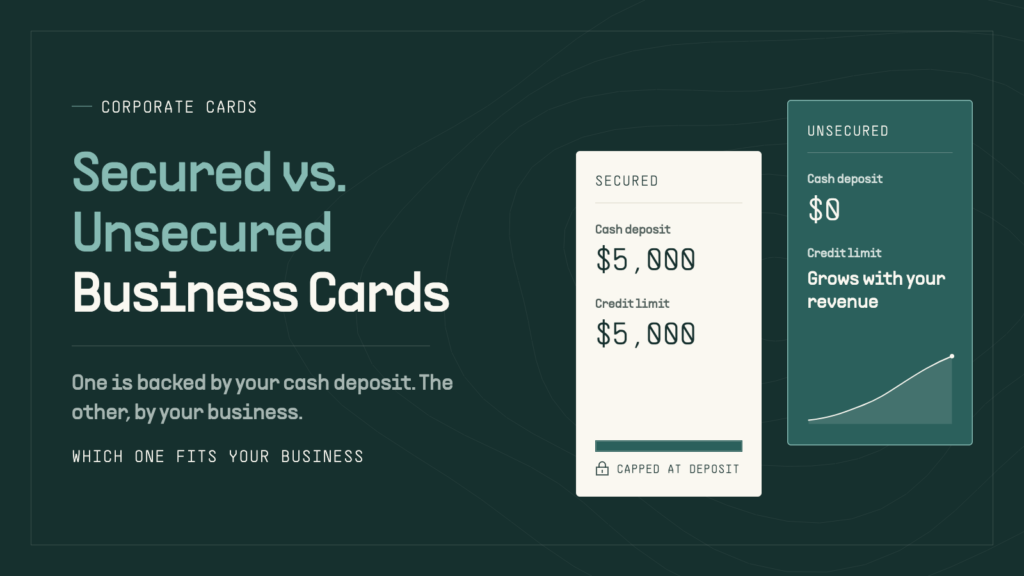
Here’s one of the most obvious differences between the two card types. A secured card’s limit is mechanically tied to the deposit. You put down $5,000, and you get a $5,000 limit (occasionally, issuers offer a small multiple of the deposit, but rarely much more). There’s no path to a materially higher limit without adding more collateral.
Unsecured cards, especially when it comes to corporate charge cards, can scale limits based on business performance rather than a fixed deposit. For businesses with variable or high-volume spend, like heavy digital ad spend, that flexibility matters.
It’s part of why cards positioned for growth-stage businesses lean unsecured, with underwriting based on cash flow and bank balance rather than a locked deposit.
You can compare how differently Divvy, Dash.fi, and other business cards approach credit limits to see the range in practice.
Fees: Where the Real Cost Differences Show Up
Secured cards sometimes carry fees beyond the deposit itself. It might be an annual fee or a monthly maintenance fee. You may even get a setup fee. This is on top of tying up your cash, and it’s typically considered the price of building or repairing a credit profile.
Unsecured cards vary widely, with some charging annual fees in exchange for stronger rewards, while others charge no annual fee but will monetize through optional paid features.
This is why, when you’re shopping for a new business credit card, you want to compare costs across the board:
- Annual fees
- Foreign transaction fees
- Late fees
- How rewards stand to offset costs
Don’t just assume that an unsecured card is automatically cheaper.
Impact on Business and Personal Credit
Both card types can help build a business credit profile if the issuer reports to business credit bureaus. That’s the whole point of a secured card for a credit-building strategy. You’ll note the difference on the personal side.
Secured cards issued to individuals (as opposed to entities) often report to personal credit bureaus, which is useful if you’re rebuilding personal credit alongside business credit. Unsecured business cards vary: some will report only to business bureaus, while others report to both. But virtually all of them can affect your personal credit if they carry a personal guarantee and you fall behind on payments.
The Personal Guarantee Question
A personal guarantee is a separate issue from whether a card is secured or unsecured, though the two get confused often enough to be worth discussing.
A personal guarantee means you, personally, are on the hook for the balance if the business can’t pay. It applies regardless of collateral status.
- Most secured business cards still ask for a personal guarantee, even though the deposit already protects the issuer. It’s an added layer of recourse.
- Most unsecured business cards require one, too, because without collateral or a guarantee, the issuer has no direct claim on repayment.
- A smaller category of unsecured corporate charge cards waives the personal guarantee entirely, underwriting purely on business financials like cash balance, revenue, and spend history rather than the owner’s personal credit. This is typically reserved for businesses with strong revenue or funding, since the issuer is taking on more risk without either collateral or a personal backstop. Dash.fi’s corporate card, for example, requires no personal guarantee, with limits set from business cash flow instead.
If your goal is a business credit card with no personal guarantee required, it’s helpful to know that it’s usually gated by business qualifications like revenue thresholds or funding.
Which Card Fits Your Business?
Choose a secured business credit card if your business has little or no credit history, your personal credit needs rebuilding alongside your business credit, you have cash you can afford to set aside temporarily, and you’re not relying on the card for significant day-to-day spending power.
Choose an unsecured business credit card if your business has an operating history, revenue, or funding that supports underwriting, you need a limit that can grow with your spend rather than staying fixed to a deposit, you’d rather preserve cash flow than tie funds up as collateral, and you’re comparing rewards, cash back, or spend-management features. Most competitive card programs are unsecured.
If avoiding a personal guarantee matters specifically, look at corporate charge cards built for that purpose rather than assuming any unsecured card will skip it. The two aren’t automatically linked. Reviewing how corporate cards like Ramp, Brex, and dash.fi structure personal guarantees is a useful way to see how that plays out across providers before applying.
The Bottom Line
Secured and unsecured business credit cards solve different problems. Secured cards trade cash flow for accessibility. They’re a credit-building tool for businesses that don’t yet qualify for more, with limits capped by the deposit and often still paired with a personal guarantee.
Unsecured cards trade accessibility for scale. They demand more from your business’s financial profile up front, but they can grow with the business and, for a subset of corporate cards, remove the personal guarantee entirely.
The right choice comes down to where your business is right now: if you need to establish credit and have cash to spare, secured makes sense. If your business already has revenue, cash flow, or funding behind it, an unsecured card, and potentially one built specifically to skip the personal guarantee, will usually serve you better.
FAQs
Can an LLC get a secured credit card?
Yes. LLCs can apply for secured business credit cards the same way sole proprietorships and corporations can. The issuer will typically still want an EIN and a business bank account, even though the deposit is what primarily secures the line.
Do secured business credit cards require collateral?
Yes. That’s the defining feature. The collateral is usually a cash deposit held by the issuer, and your credit limit is generally set at or near that deposit amount. Some issuers offer a modest multiple of the deposit, but the limit stays fundamentally tied to how much you’ve put down.
How does an unsecured line of credit differ from a business credit card?
A business line of credit and an unsecured business credit card are both revolving, uncollateralized forms of credit, but they work differently. A line of credit typically lets you draw cash directly, often at a lower interest rate, and may have a longer draw period. An unsecured credit card is built for everyday purchases, usually comes with rewards or cash back, and charges interest only on carried balances rather than on funds drawn. Businesses sometimes use both: a line of credit for larger capital needs and a card for recurring operational spend.
Will a secured business credit card hurt my personal credit if I close it?
Closing any credit account can affect your credit utilization ratio and the average age of your accounts, which may cause a temporary dip. As long as the account is in good standing when closed, though, it shouldn’t cause lasting damage, and the responsible payment history it generated typically stays reflected in your credit history for years.
Can I get a business credit card with no personal guarantee if my business is new?
It’s uncommon. No-personal-guarantee cards are typically reserved for businesses that can demonstrate revenue, cash reserves, or funding sufficient to satisfy underwriting without a personal backstop. Newer businesses are more likely to start with a secured card or an unsecured card that requires a personal guarantee, then transition to a no-PG corporate card as the business’s financial history builds out.