

Net 60 payment terms give a buyer 60 calendar days from the invoice date to pay the full amount owed. For e-commerce brands that buy inventory weeks or months before it sells, the extra 30 days can be the difference between funding your next reorder or ad push from operating cash and putting it on credit.
But there’s a trade-off: every day you hold cash is a day your supplier goes without it.
In this guide, you’ll learn how net 60 works and when to negotiate for it. Then, we’ll talk about how a charge card with net 60 terms extends your timing while your suppliers still get paid on schedule.
What Is Net 60?
Net 60 is a form of trade credit: the supplier ships goods or delivers a service now and lets you pay later, with no interest, as long as you pay within that term. “Net” refers to the total invoice amount after any credits or discounts.
The 60-day clock typically starts on the invoice date, though some contracts start it at delivery or at the end of the month.
For example, an invoice dated March 1 on net 60 terms is due on April 30.
You may see several variations of this example on your purchase orders and invoices:
- Net 60: Full amount due within 60 days.
- 2/10 net 60: Take a 2% discount if you pay within 10 days; otherwise, the full amount is due in 60 days.
- 1/10 net 60: The same as 2/10 net 60, with a 1% early payment discount.
- Net 60 EOM: Payment is due 60 days after the end of the month the invoice was issued, which can stretch effective terms between 60 and 90 days.
What Are Net 30, Net 60, and Net 90 Payment Terms?
Longer terms favor the buyer and shift more of the financing burden onto the supplier.
| Term | Payment due | Where it’s common | What to expect |
|---|---|---|---|
| Net 30 | 30 days after invoice | Default for most B2B suppliers | Typical starting point for new buyer accounts |
| Net 60 | 60 days after invoice | Wholesale, manufacturing, and established buyer relationships | Usually earned through order volume and payment history |
| Net 90 | 90 days after invoice | Large retailers and enterprise buyers with leverage | Suppliers often price the extra time into unit costs |
Why Net Terms Matter for Growing Brands
Payment terms directly shape your cash conversion cycle (CCC), the number of days cash is tied up between paying for inventory and collecting from customers.
CCC = Days Inventory Outstanding + Days Sales Outstanding − Days Payables Outstanding
Every extra day of supplier terms adds a day to “days payables outstanding” and takes a day off the cycle. Consider a brand that holds inventory for 75 days and collects from its checkout platform in about 3 days:
| Scenario | Inventory days | Sales days | Payable days | Cash conversion cycle |
|---|---|---|---|---|
| Net 30 supplier terms | 75 | 3 | 30 | 48 days |
| Net 60 supplier terms | 75 | 3 | 60 | 18 days |
For a brand spending $200,000 a month on inventory, moving from net 30 to net 60 keeps roughly a one-time $200,000 of working capital available for ad spend, payroll, or the next purchase order.
Advantages and Disadvantages of Net 60 Terms
Advantages of Net Terms
- More float for buyers: You can often sell inventory before the invoice comes due.
- No interest: Trade credit costs nothing as long as you pay on time and there’s no early payment discount on the table.
- Less reliance on debt: Longer terms can replace a short-term loan or line of credit for inventory purchases.
- Bigger orders for suppliers: Offering net terms helps suppliers win larger and more frequent purchase orders and keeps buyers loyal.
Disadvantages of Net Terms
- Supplier cash strain: The supplier carries your receivable for two months and may need its own financing to cover the gap.
- Higher prices for buyers: Suppliers may offset longer payment terms with higher unit costs or smaller volume discounts.
- Relationship risk: Pushing a smaller supplier too hard can lead to deprioritized production runs or lost allocation during peak season.
The Hidden Cost: Early Payment Discounts
When a supplier offers an early payment discount, waiting the full 60 days has a real cost that’s easy to calculate:
Annualized cost = Discount % ÷ (100 − Discount %) × 365 ÷ (Net days − Discount days)
| Terms | Extra days of float | Annualized cost of skipping the discount |
|---|---|---|
| 2/10 net 30 | 20 | ~37.2% |
| 1/10 net 30 | 20 | ~18.4% |
| 2/10 net 60 | 50 | ~14.9% |
| 1/10 net 60 | 50 | ~7.4% |
If your cost of capital is below the annualized rate, take the discount. If not, hold the cash for the full term.
When to Negotiate Net 60 With Suppliers
Net 60 is a reasonable ask when you bring the supplier something in return. It tends to work when:
- You have 12 months or more of on-time payments with that supplier
- Your order volume is growing, and you’re a meaningful share of their revenue
- You can commit to larger purchase orders or share a rolling demand forecast
It tends to backfire with small, cash-constrained suppliers who are your only source for a critical SKU, or when you’re a new account.
How to Ask Without Damaging the Relationship
- Lead with data. Share your payment record and order growth.
- Offer something back. A volume commitment or longer forecast window gives the supplier a reason to say yes.
- Phase it in. Moving from net 30 to net 45, then to net 60 after a few clean cycles, lowers the supplier’s risk.
- Never stretch terms on your own. Paying late without agreement will erode trust and put you on the wrong side of any potential negotiation.
Net Payment Terms vs. Credit Cards
| Feature | Supplier net terms | Standard business credit card | Charge card with net 60 terms |
|---|---|---|---|
| Who extends the credit | Supplier | Card issuer | Card issuer |
| When the supplier gets paid | Day 30–90 | At settlement, within days | At settlement, within days |
| Time you have to pay | Set per supplier | Statement cycle plus grace period | Up to 60 days per charge |
| Interest | None if paid on time | Accrues on carried balances | None within term |
| Requires supplier negotiation | Yes | No | No |
| Rewards | None (sometimes early pay discounts) | Varies by card | Varies by card |
The key difference: supplier terms ask the supplier to finance you, while a card shifts that financing to the card issuer. Your supplier gets paid on its normal schedule regardless of when you settle.
For a deeper comparison of card options, see Ramp vs. Brex vs. Dash.
How a Charge Card With Net 60 Terms Extends Payment Timing
A corporate charge card with Net-1 to Net-60 terms separates when your supplier gets paid from when you pay. On Dash.fi, each charge has its own rolling due date instead of a single monthly statement date:
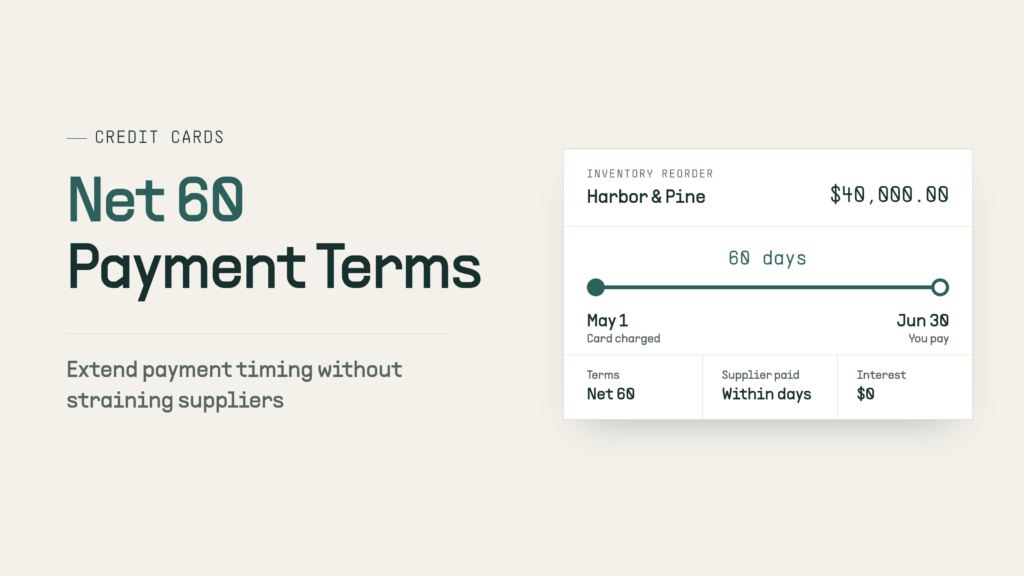
- Your supplier is paid within business days. The card network settles the transaction, so the supplier isn’t waiting for you.
- Each charge gets its own clock. A $40,000 inventory reorder charged on May 1 on net 60 terms is due June 30. A charge on May 2 is due July 1.
- No interest within your term. A 2.99% late fee applies only to balances not settled by their due date.
- Cash back on the spend you’re already making. Dash.fi pays 3% on ad, shipping, and AI spend and 2% on other eligible card spend.
Dash.fi sets your net terms and spend limit during underwriting, and both can change as your spend history grows. Learn how corporate card limits are set and how high-limit business credit cards scale with revenue.
One thing to check: Card payments carry processing fees, usually paid by the supplier, and some suppliers pass that cost on as a surcharge. Be sure to compare any surcharge against the value of 60 extra days of float and the cash back you earn to decide whether paying by card allows you to come out ahead.
Best Practices for Optimizing Working Capital While Meeting Net Terms
- Map every payable’s due date. A simple calendar of supplier and card due dates prevents surprise cash crunches.
- Stack terms where suppliers accept cards. Paying a net 30 invoice by card on its due date, then settling the card on net 60, can extend effective timing to roughly 90 days without asking the supplier to wait longer.
- Run the discount math every time. Take early payment discounts when the annualized rate beats your cost of capital.
- Route spend to the right card category. Pairing payment timing with corporate card rewards turns necessary spend into recurring savings.
For a broader view of how payment timing fits into cash management, Investopedia’s overview of the cash conversion cycle and the SBA’s guide to managing business finances are useful references.
FAQs
What does net 60 mean on an invoice?
Net 60 means the full invoice amount is due within 60 days, usually counted from the invoice date.
Is net 60 better than net 30?
For buyers, yes: more float and a shorter cash conversion cycle. For suppliers, it means waiting longer to get paid.
Do net 60 terms charge interest?
No. Trade credit is interest-free if you pay by the due date, though late fees or a switch to prepayment can apply if you miss it.
Can I get net 60 terms without negotiating with suppliers?
Yes. A charge card with net 60 terms pays suppliers within a few business days and gives you up to 60 days to repay each charge, as long as the supplier accepts cards.