

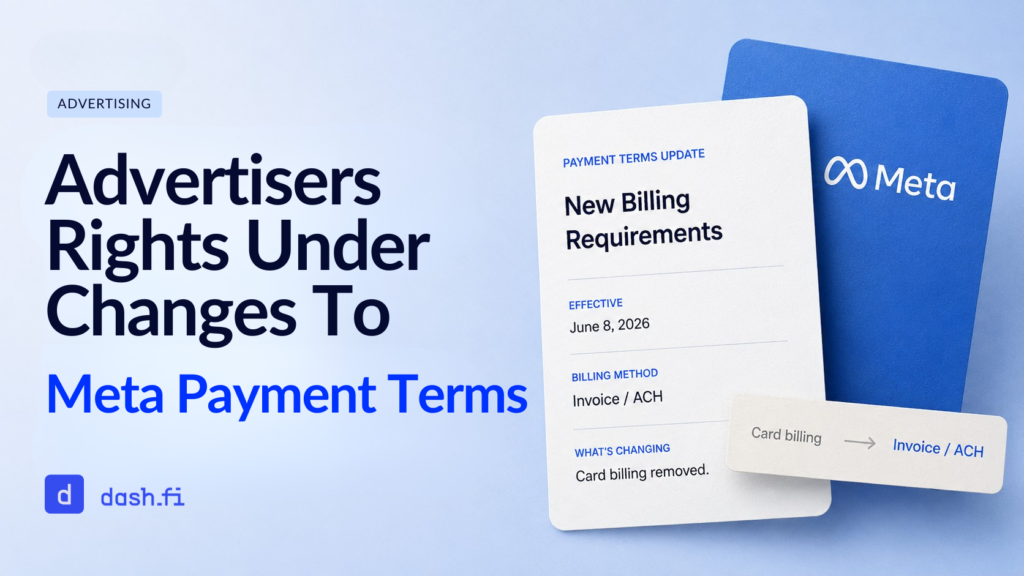
Meta’s pushing advertisers to move off credit card billing, and the consequences are steep. Here’s a breakdown of your rights and how to assert them.
Meta has begun forcing advertisers to transition from credit card billing to invoicing or direct bank transfer, with a deadline of June 8, 2026, much to the chagrin of e-commerce brands and performance marketers. After all, this isn’t a simple administrative change but an overhaul that eliminates cash flow tools and removes credit card rewards on ad spend. Perhaps more significantly, without credit card protections in place, advertisers lose chargeback and dispute rights, their primary defense against billing errors.
When a platform changes payment terms mid-relationship, advertisers usually figure they have no choice but to comply, but that’s not always the case. Advertisers do indeed have legal standing to object, and in some cases, to formally demand that the original terms be preserved.
What Is Meta’s Credit Card Payment Policy Change?
Meta started sending out notifications to advertisers in early 2026 that credit card billing would no longer be an option for Meta ad spend. Instead, they were directed to migrate to invoicing or direct bank transfer by June 8, 2026. The company sent out these notifications without the option for pushback or negotiation and without a commercially extended transition window.
For advertisers who spend heavily on Meta, through Facebook Ads, Instagram Ads, or Advantage+ campaigns, this policy creates several immediate problems:
- Credit card rewards (often 2-3% cashback or points) are eliminated on what may be the company’s largest recurring expense
- The end of chargeback rights through Visa and Mastercard networks, which eliminates the most practical pathway for billing error disputes
- Significant changes to cash flow management take place as ad spend shifts from a monthly credit cycle to invoice or ACH timing
- Operational costs increase as finance teams implement new invoicing infrastructure under compressed timelines
Meta’s new policy applies across advertiser account types, regardless of spend level, account history, or contractual relationship.
Do Advertisers Have Legal Rights When Meta Changes Payment Terms?
A legal basis for pushback does exist, and it hinges on several principles of contract law and commercial fairness.
Unilateral Modification of Material Contract Terms
You have a core commercial right to pay via credit card because it affects your cash flow, costs, and dispute rights. Under contract law, one party generally cannot modify the material terms of an ongoing agreement without the other party’s consent.
Meta’s standard advertising terms do include a provision allowing for modification, but the scope of that provision is a legitimate legal question. Advertisers who have structured their financial operations around credit card billing have reasonable grounds to argue that the modification constitutes a breach of the original terms of service.
Breach of Implied Covenant of Good Faith and Fair Dealing
Every contract carries an implied obligation that neither party will act to undermine the other’s reasonable expectations under the agreement. A forced payment migration with a compressed deadline, imposed without negotiation or alternative accommodation, can reasonably be argued to violate this standard.
This argument is particularly relevant for advertisers who received minimal advance notice and no pathway to seek exemptions or individually negotiated terms.
Elimination of Payment Protections Without Consent
Credit card payment provides legally meaningful protections that invoicing and ACH do not. The chargeback mechanism under Visa and Mastercard network rules gives cardholders the right to dispute charges, seek refunds for services not rendered, and contest unauthorized billing.
Removing this mechanism without advertiser consent and without providing equivalent substitute protections is a legally significant change, not an administrative one. Advertisers who have relied on chargebacks to recover overbilled amounts or contest invalid traffic charges have standing to argue that the removal of this mechanism constitutes harm.
Economic Coercion
Meta’s stated policy is that initiating a chargeback against Meta constitutes a violation of its payment terms and grounds for permanent account disabling. This creates a situation where advertisers are simultaneously being stripped of their chargeback right and threatened with account termination if they attempt to exercise it.
The legal doctrine of economic duress applies where one party compels another’s compliance through threats of material harm to their business. Advertisers facing account suspension or delivery throttling for maintaining a credit card payment may have grounds to argue that their compliance was not voluntary.
Meta’s History of Advertiser Billing Disputes
To understand why credit card payment protections matter, it helps to put Meta’s billing track record into context.
| Case | Allegation | Status | Amount |
|---|---|---|---|
| LLE One v. Facebook (2016–2020) | Deliberate inflation of video ad viewing metrics by 150–900% | Settled | $40 million |
| DZ Reserve v. Meta (2018–Present) | The Potential Reach metric is inflated by up to 400% by counting fake/duplicate accounts | Active — proceeding to trial after the Supreme Court declined Meta’s appeal (Jan 2025) | $7 billion claimed |
| Iron Tribe Fitness v. Meta (2025) | Systematic secret inflation of Facebook advertising prices | Active | Not disclosed |
| Consumer Federation of America v. Meta (April 2026) | Meta knowingly profited from scam ads; internal documents showed over 10% of 2024 revenue (~$16B) from high-risk ad categories | Active | Not disclosed |
The pattern across these cases is directly relevant to the policy change. Credit card chargebacks have historically been the primary mechanism by which individual advertisers could recover overbilled amounts outside of the class action litigation. Forced migration to invoicing takes away that option.
Invalid traffic is a documented industry-wide issue. According to the 2026 Lunio Global Invalid Traffic Report, invalid traffic across Meta placements averages approximately 8.2%, with a conservative floor of 6%. For an advertiser spending $500,000 per year on Meta, that 6% rate represents $30,000 in charges for interactions that were never authorized. And it has historically been the credit card chargeback mechanism that has allowed advertisers to recover those charges. For more, you can refer to dash.fi’s guide to click fraud.
How to Quantify the Financial Impact of Losing Meta Credit Card Billing
Before you fill out any formal objection, make sure to calculate the actual dollar value of what the policy change will cost your business. This informs the decision about whether to act and forms the damages basis if you do.
These are the three categories to quantify:
1. Lost Credit Card Rewards
Most business credit cards offer 2-3% cashback or equivalent points on advertising spend. If you spend $50,000 every month on Meta ads, a 3% reward rate represents $18,000 per year in rewards that will just disappear when you transition your billing to invoicing or ACH. To calculate your total, multiply your historical Meta ad spend by your card’s reward rate, and then project forward over a similar horizon for prospective damages. dash.fi clients should confirm their applicable cashback rate with their account manager before calculating.
2. Unauthorized Charges for Invalid Traffic
Invalid traffic includes bot-generated clicks, zero-bounce traffic, invalid impressions, and out-of-geo clicks. Advertisers authorized Meta to charge only for valid, human-generated engagement within specific targeting, which means charges outside of those parameters can be characterized as unauthorized. Using the 6% industry benchmark, you can multiply your total Meta ad spend by 0.06 for a conservative estimate. A third-party audit from dash.fi will yield a more precise account-specific figure.
3. Revenue Loss from Forced Spend Reduction
Advertisers whose operations are structured around credit card billing may need to reduce their Meta ad spend after migrating to invoicing. You may be using business cards for float, rewards, and cash flow management, and now you’ll likely see a 25-35% reduction in credits. Multiply that reduction by your ROAS to estimate the resulting revenue loss.
For example, if you project $2,000,000 in spend x a 30% reduction, that’s $600,000 less in spend x ROAS of 4.0, which is $2,400,000 in lost revenue.
Adding these three figures will give you a total damages number that can ground any formal objection in specific, calculable terms.
What a Formal Demand Looks Like
Advertisers who object to Meta’s forced migration can submit a formal legal demand letter to Meta directly. This is a documented assertion of rights that puts Meta on notice and creates a record of the dispute. A well-constructed demand letter for this situation typically includes:
- A clear statement of your existing payment arrangement and account history with Meta
- Your legal basis for objecting to the change. This could be unilateral modification of material terms, breach of good faith, elimination of payment protections, and economic coercion.
- A quantified damages calculation covering lost rewards, unauthorized traffic charges, and your projection of the impact on your revenue.
- A primary demand: this could be an immediate and permanent stop to the forced migration for your account.
- An alternative minimum demand: this could be a 90-day extension of the transition deadline (through September 8, 2026) with no adverse account action during that period.
- A reservation of all legal rights, including the right to pursue RICO claims, FTC complaints, and state attorney general filings if Meta does not comply.
Note: In cases involving patterns of fraudulent billing or systematic misrepresentation, the kind alleged in several of the active lawsuits above, RICO (the Racketeer Influenced and Corrupt Organizations Act) allows private plaintiffs to pursue claims against enterprises engaged in a pattern of racketeering activity, with the potential for treble damages.
You should deliver the demand via email with a certified delivery request, directed to the advertiser’s Meta Business Account Manager, and ask Meta to respond within 10 business days.
Dash.fi has developed a formal demand letter template for advertisers affected by this policy change, which we built around the legal arguments above and designed to be completed with your actual account data before you submit it. Dash.fi account managers can help you extract the relevant billing data from your Meta Ads Manager and coordinate the process for you.
What Advertisers Should Do Right Now
In the end, whether or not you file a formal demand, you should take these steps immediately if you are affected by Meta’s policy changes:
- Document your billing history. Pull your Meta Ads Manager billing data for the past four to five years. Set the date range to capture full historical spend. This is the foundation of any calculation you’ll make for damages.
- Calculate your invalid traffic exposures. If you don’t have a third-party IVT audit, use the 6% benchmark to estimate what you’ve potentially been charged for undelivered or invalid interactions. Consider running an audit with dash.fi to get an account-specific figure.
- Assess your credit card rewards loss. Determine what rewards rate your current business card gives you on ad spend, and multiply that by your historical and projected Meta spend. If you’re a dash.fi cardholder, confirm your applicable cashback rate with your account manager.
- Consult with an attorney before you send a demand letter. Our demand letter template is a legal document, but we strongly encourage advertisers to have qualified counsel review it before you submit it, especially if the total damages figure is significant.
Frequently Asked Questions
Can Meta legally force me to change my payment method?
Meta’s terms of service include modification provisions, but whether they extend to eliminating a payment method, removing chargeback rights, and altering core commercial terms is a legitimate legal dispute. You have grounds to object and demand that the original terms be preserved or that a commercially reasonable transition period be granted.
What happens if I ignore the June 8, 2026, deadline?
Meta has indicated non-compliant accounts may face payment holds or service disruption. Submitting a formal demand letter and requesting a 90-day extension creates a documented record that your non-compliance is a legal objection, not an oversight.
Is a demand letter the same as suing Meta?
No. A demand letter is a formal written notice of dispute, not a lawsuit. It puts Meta on notice of your legal position and creates a record. It may prompt negotiation or an extension, and while it is typically a precursor to litigation, it is not litigation itself.
What if Meta ignores the demand letter?
The advertiser retains all rights to pursue legal remedies, including breach of contract claims, state consumer protection complaints, FTC filings, and participation in class action proceedings. The demand letter creates the documented record needed to support those actions.
Does Dash.fi handle the legal process for me?
dash.fi is not a law firm, and the demand letter template does not constitute legal advice. dash.fi’s account management team can assist with data extraction and damages calculation. Advertisers should engage qualified legal counsel for review and strategy. See also: How Dash.fi helps advertisers recover ad spend and Understanding Meta billing and invalid traffic.
How does this connect to Dash.fi’s credit card and cashback product?
dash.fi offers a business credit card that earns 3% cashback on Meta and Google ad spend. The forced migration to invoicing directly eliminates this benefit for affected advertisers. Separately, dash.fi’s click fraud agent identifies invalid traffic charges and files ad credit requests on advertisers’ behalf—the same category of charges that the demand letter framework covers as unauthorized billing. See how dash.fi’s ad refund process works.
Additional Resources
For background on advertiser protections under credit card networks, see the Visa Chargeback Guide for Merchants. For industry data on invalid traffic benchmarks, see the Lunio 2026 Global Invalid Traffic Report.
*This article is provided for informational and educational purposes only and does not constitute legal advice. Advertisers should consult qualified legal counsel before submitting any formal demand letter or pursuing legal action.