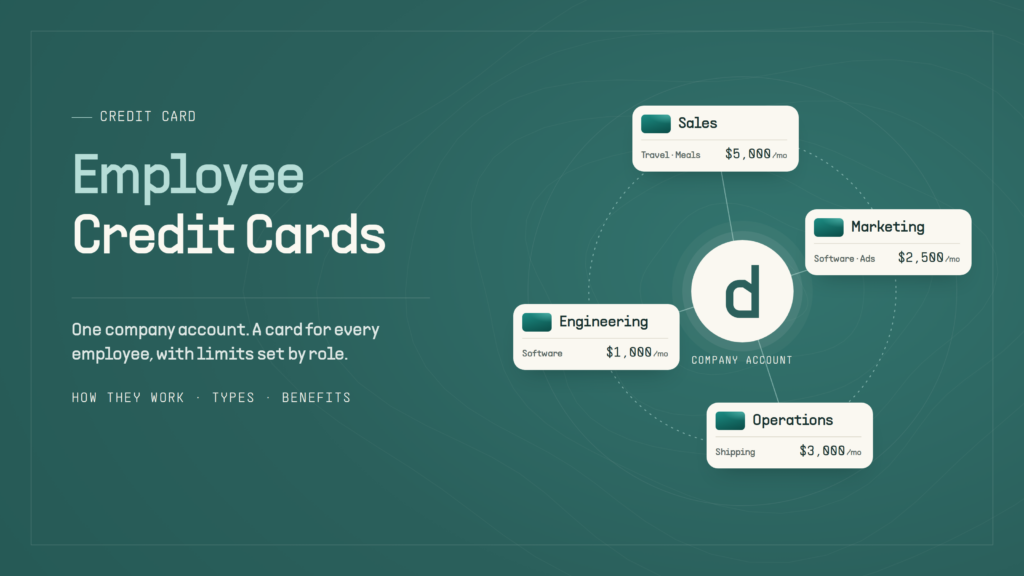
What Is an Employee Credit Card?
An employee credit card is a payment card issued in an employee’s name but backed by the company’s account. So the employee can make purchases on the business’s behalf without using personal funds. The company sets the spending rules and monitors the transactions and, in the end, is responsible for the balance.
Employee cards exist to solve a specific problem: reimbursement is slow, and giving every employee a company credit card number creates risk without controls. Modern employee cards address this by pairing spending authority with:
- Real-time limits
- Category restrictions
- Automatic transaction records
How Employee Credit Cards Work
The level of control for each card will vary, but the mechanics are pretty much the same for all issuers:
Issuance
A finance admin or account owner requests a card for an employee through the issuer’s platform app. Most modern issuers can generate a virtual card instantly and ship a physical card within days.
Spending Limits
Businesses set limits per card, ranging from a fixed monthly cap to a per-transaction ceiling or category restriction (software only, travel only, etc.). These limits can typically be adjusted in real time as budgets change. You can read more about how limit structures work, see our article on Corporate Card Limits Explained.
Monitoring
Every purchase posts to a central dashboard in real time, giving finance teams visibility into who spent what, where, and on which category, without having to wait for a monthly statement or an expense report.
Repayment Responsibility
With true corporate and employee cards, the company, not the individual employee, is responsible for paying the balance. The card company will usually debit the business’s bank account each billing cycle automatically, so there’s no reimbursement cycle at all.
Types of Employee Credit Cards
Every employee card will work slightly differently. The right type for your business will depend on the size of your company and your company’s credit profile. You’ll also want to consider how much control finance wants over the spend.
| card type | who’s liable | best for | credit check |
|---|---|---|---|
| Traditional corporate card | Company (no personal guarantee) | Larger, established businesses issuing many employee cards | Based on the company’s financials, not the employee’s personal credit |
| Business credit card | Often, the business owner, via a personal guarantee | Small businesses and startups without an extensive credit history | Usually requires the owner’s personal credit |
| Prepaid card | No credit extended; spending capped at loaded balance | Contractors, events, or one-time budgets | None |
| Virtual card | Same as the parent account (corporate or business) | Online purchases, subscriptions, single-vendor spend | Tied to the parent account |
Small Business Employee Cards
Small businesses without the revenue or credit history for a true corporate card typically start with a business credit card that carries a personal guarantee from the owner, then add employee cards as authorized users under the same account.
This gives a growing team spending access without the company needing to qualify for corporate card underwriting. It’s worth exploring our article on The Best Business Credit Cards for E-Commerce for a closer look at how this works in practice.
Corporate Credit Cards vs. Small Business Credit Cards
The core distinction is liability.
A corporate card is underwritten against the business itself, so employees using it carry no personal risk, and the account doesn’t touch their personal credit report.
A small business card is underwritten against the owner’s personal credit, and any employee added as an authorized user is spending against that owner’s personal guarantee.
| corporate credit card | small business credit card | |
|---|---|---|
| Underwriting basis | Company revenue and financials | Owner’s personal credit |
| Personal guarantee | Typically none | Usually required |
| Employee liability | None | None directly, but tied to the owner’s guarantee |
| Typical issuer | Fintechs and banks serving mid-size to large companies | Banks and fintechs serving startups and small businesses |
Benefits of Employee Credit Cards for Business
- Faster spending: employees can purchase what they need without waiting for a reimbursement check to clear.
- Cash back and rewards: many issuers return a percentage of spend, which adds up quickly across a full team of cardholders. See The Best Corporate Credit Card Rewards for how rewards structures compare.
- Real-time visibility: finance teams see spend as it happens instead of reconstructing it weeks later.
- Simplified expense reporting: transactions are already categorized and tied to a cardholder, which cuts down on manual data entry and chasing employees for receipts.
- Built-in controls: limits, category locks, and instant card freezes reduce the risk that comes with handing out spending authority.
- Business credit building: consistent, on-time payments on a corporate or business card can strengthen the company’s own credit profile over time.
Some newer corporate card platforms take this a step further by auditing the spend itself or flagging billing errors on shipping invoices or invalid clicks on ad spend. That way, the card isn’t just a payment method but a source of recovered cash.
Uncapped cash back on categories like ad spend and shipping is worth comparing directly in each issuer’s rewards program, particularly for companies with meaningful shipping or advertising spend.
Risks and Limitations
- Misuse risk: without clear category limits, employees can make purchases outside the intended budget.
- Personal credit exposure: on small business cards with a personal guarantee, missed payments can affect the owner’s personal credit, while the employee who’s doing the spending on the card is not personally liable.
- Administrative overhead: someone still needs to review transactions, reconcile spend against budgets, and deactivate cards when employees leave.
- Overspending across many cards: distributing spending authority widely without limits or alerts can make budget overruns harder to catch early.
Eligibility Considerations
Your eligibility will depend on whether the business is applying for a corporate card or a small business card.
- Corporate cards: typically require a minimum revenue threshold and a business bank account. In some cases, you’ll need to show a set amount of time in operation. Approval is based on the company’s financial profile, not any individual employee’s credit.
- Small business cards: usually require the primary applicant, typically the owner, to pass a personal credit check, since the card carries a personal guarantee.
- For a step-by-step breakdown of what issuers look for, see How to Get a Corporate Credit Card.
Once the business qualifies, individual employees generally won’t undergo a separate credit check to receive their own card. The account admin grants access to the employee based on the employee’s role and need.
Should You Issue Physical Cards, Virtual Cards, or Both?
The answer to this question will typically come down to what the spend is for.
- Physical cards make sense for employees with recurring in-person spend like travel, client meals, or on-site purchases.
- Virtual cards make sense for online subscriptions, single-vendor spend, or one-off purchases where a unique card number per vendor limits exposure if credentials are ever compromised.
- Many companies issue both: a physical card for travel-heavy roles and virtual cards for software and vendor spend across the rest of the team.
Do Employee Credit Cards Affect Personal Credit Scores?
Not usually. True corporate cards are underwritten against the business, not the individual, and account activity won’t show up on a personal credit report. The exception is a small business card carrying a personal guarantee. In that case, seriously delinquent activity can eventually be reported to personal credit bureaus, but this would be the guarantor’s liability, not the employee’s.
NerdWallet breaks down business card reporting practices to explain in detail how this can vary by issuer.
How Employee Credit Cards Simplify Expense Reporting and Receipt Management
Because every transaction is already tied to a specific cardholder, category, and date, employee cards remove most of the manual work of traditional expense reporting. Instead of employees submitting receipts after the fact, many platforms let cardholders attach a receipt directly to the transaction at the time of purchase. Finance can then match that receipt automatically to the correct budget line.
This automation matters for tax purposes, too. The IRS generally expects documentation showing the amount, date, place, and business purpose of an expense. So a system that captures this at the point of sale is far more reliable than one that requires reconstruction weeks later.
Best Practices for Choosing and Managing Employee Credit Cards
- Write a spending policy before issuing cards. Define which categories are approved, what requires pre-approval, and what documentation is expected.
- Set limits by role, across the entire company. A sales rep with travel needs and a marketer paying for software subscriptions don’t need the same limit.
- Require receipts and a business purpose at the time of purchase, rather than at the end of the month.
- Reconcile spend on a regular cadence, weekly or biweekly, rather than waiting for the statement close.
- Deactivate cards immediately when an employee changes roles or leaves the company.
- Use virtual cards for single-vendor or trial subscriptions to limit exposure if a vendor is breached.
FAQs
What is an employee credit card?
A payment card issued to an employee under a company’s account, allowing them to make approved business purchases without using personal funds. The company, not the employee, is responsible for the balance.
How do employee credit cards work?
A finance admin issues a card with a defined spending limit, transactions post to a central dashboard in real time, and the business pays the balance directly, typically through an automatic bank debit.
Who is eligible for an employee credit card?
Eligibility is going to depend on the business qualifying for a corporate or small business card account. Once approved, individual employees are typically added by an admin based on role, without a separate personal credit check.
Do employee credit cards affect an employee’s personal credit score?
Not with a true corporate card, since it’s underwritten against the company. A small business card with a personal guarantee can affect the guarantor’s personal credit if the account becomes seriously delinquent.
What’s the difference between employee credit cards and corporate cards?
“Employee credit card” describes any card issued to a staff member for business spending. A corporate card is one specific type of employee card, underwritten against the company with no personal guarantee, as opposed to a small business card, which carries the owner’s personal guarantee.