
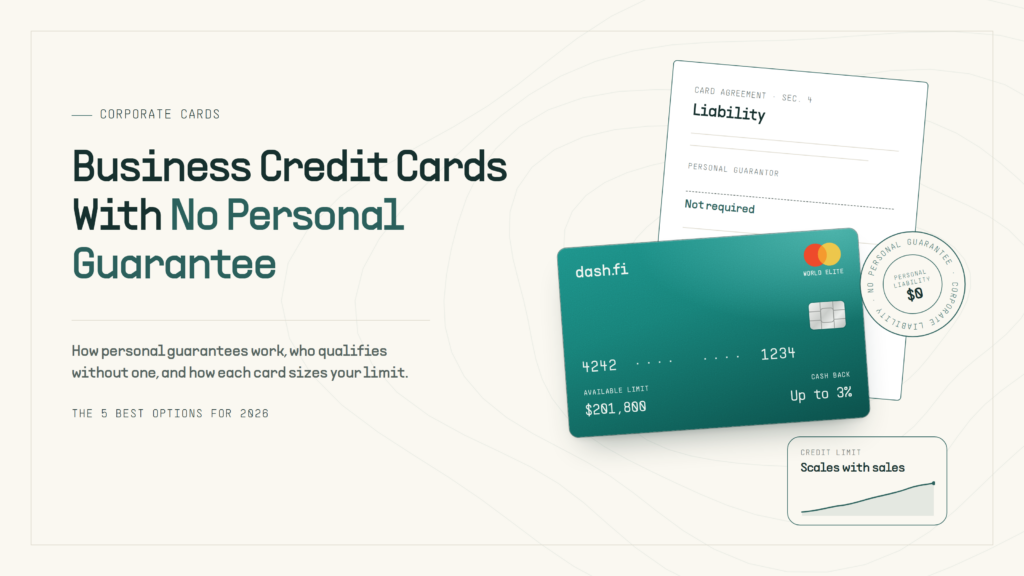
A business credit card with no personal guarantee is a card your company alone is responsible for repaying. If the business can’t pay, for any reason, the issuer cannot come after your personal savings or house. And it won’t usually affect your personal credit score.
Most traditional small business cards require a personal guarantee, but a growing group of corporate cards and fintech charge cards don’t. They underwrite the business instead of you.
Here’s how personal guarantees work, who qualifies without one, and the five best options for 2026.
Key Takeaways
- A personal guarantee makes you personally liable for business card debt, even if your company is an LLC or corporation.
- Approval for a card with no personal guarantee depends on your business’s cash, revenue, or live sales data rather than your personal FICO score.
- You’ll almost always need a registered LLC or corporation. Sole proprietors rarely qualify.
What Is a Personal Guarantee on a Business Credit Card?
A personal guarantee is a clause in a business card agreement that makes the owner or authorized signer personally responsible for the card’s debt if the business defaults. It sidesteps the liability protection your LLC or corporation would normally give you.
In short, your entity can close its doors, and the issuer can still come after you.
Personal guarantees come in two forms:
- Unlimited guarantee: You’re on the hook for the full balance, plus interest and fees.
- Limited guarantee: Your personal liability is capped at a set dollar amount or percentage.
In practice, your liability can mean you’re sent to collections and that you’ll receive negative marks on your personal credit report. It can even include lawsuits targeting your personal assets.
Do You Need a Personal Guarantee for a Business Credit Card?
Not always. Whether you sign one depends on the type of card you apply for and how the issuer underwrites it.
| Card type | Personal guarantee? | How approval works | Typical fit |
|---|---|---|---|
| Traditional small business credit card | Almost always | Owner’s personal credit score and income | Sole proprietors, very new businesses |
| Traditional corporate card (bank or Amex programs) | Usually not; corporate or combined liability | Company financials and business credit, often $4M+ in revenue | Established mid-market companies |
| Fintech corporate or charge card | No | Cash balance, revenue, or connected sales data | Startups and growth-stage LLCs and corporations |
Sole proprietors are the exception: you and the business are the same legal entity, so personal liability is built in. Always form an LLC or corporation if you want to be approved for a business credit card with no personal guarantee.
How No-Personal-Guarantee Cards Decide Your Limit
Every card on this list skips the personal guarantee, but they size your credit line differently. The underwriting model sets your ceiling, which often matters more than the rewards rate.
| Underwriting model | What it measures | Limit behavior | Example |
|---|---|---|---|
| Cash-based | Balances you hold with the provider | Moves up and down with your bank balance | Mercury IO |
| Performance-based | Live revenue, sales, and payment history from connected platforms | Scales with sales volume, not cash on hand | Dash.fi |
| Financials-based | Revenue, cash position, and business credit history | Set at approval, reviewed periodically | Rho, Amex Corporate |
Here’s why that distinction matters: picture a brand with $150K in the bank and $800K a month in Shopify sales heading into Q4. A cash-based card caps that brand near its bank balance right when ad spend needs to triple. A performance-based card reads the sales data and extends the line to match. (More on this in our guide to corporate card limits.)
5 Best Business Credit Cards With No Personal Guarantee of 2026
| Card | Best for | Rewards | Repayment terms | Annual fee |
|---|---|---|---|---|
| Dash.fi Corporate Card | Ecommerce brands with heavy ad, shipping, and AI spend | Up to 3% on ads, shipping, and AI; 2% on other eligible spend | Net-1, Net-7, Net-15 (Net-30 to Net-60 coming soon) | None |
| Rho Corporate Card | Companies that want banking and cards together | Up to 2% for Rho Platinum members on daily terms | Daily to monthly options | None |
| Mercury IO | Early-stage startups | 1.5% flat on all spend | Daily; 30-day once balances reach $15K | None |
| BILL Divvy Corporate Card | Budget and spend controls | Points; higher rates with more frequent payment | Weekly, semi-monthly, or monthly | None |
| American Express Corporate Card Program | Established companies with $4M+ revenue | Membership Rewards eligibility varies by card | Charge card, pay in full | Varies by card |
1. Dash.fi Corporate Card: Best for Ecommerce Brands With Heavy Ad and Shipping Spend
The Dash.fi Corporate Card is built for brands whose biggest costs are Google, Meta, UPS, FedEx, and AI tools. It pays its top cash back rate on those categories and includes free audit agents that recover money you’ve already overpaid.
- Up to 3% cash back on ad spend, shipping, and AI spend, and 2% on all other eligible card spend. Rewards pay out to your personal account.
- Rolling credit terms: Each charge settles on its own clock instead of one monthly statement date. Net-1, Net-7, and Net-15 are live.
- Performance-based underwriting: Connect Shopify, Amazon, or PayPal and your limit updates with real sales data. Approved limits can run 10 to 20 times higher than what a traditional card sets at signup.
- Free audit agents: Dash.fi automatically audits Google and Meta billing for invalid traffic and files ad credit claims, flags shipping overcharges like late fees and dimensional weight errors, and tracks LLM token waste.
- Unlimited virtual cards with per-card controls, plus expense management and bill pay with no platform fee.
Good to know: The rewards structure pays off most when ads and shipping make up a large share of your spend. Net-30, Net-45, and Net-60 terms are listed as coming soon, not live.
2. Rho Corporate Card: Best for Companies That Want Banking and Cards in One Place
Rho pairs a corporate charge card with business checking, treasury, and AP automation. It doesn’t require a personal guarantee or a personal credit check.
- Up to 2% cash back for Rho Platinum members on daily terms. Platinum requires running payroll and revenue through Rho and holding at least half of company assets there.
- Physical and virtual cards, spend controls, and sync with NetSuite, QuickBooks Online, and Sage Intacct.
Good to know: The top rate requires moving most of your banking to Rho. Certain categories, including utilities and non-US transactions, are excluded from cash back. See our full Rho vs. Dash.fi comparison.
3. Mercury IO: Best for Early-Stage Startups
Mercury IO is a charge card attached to Mercury’s business bank account, available to eligible customers with no separate application.
- 1.5% flat cash back on all spend, including international purchases.
- No personal guarantee and no personal credit check.
- Limits are tied to your total Mercury balances. Accounts below $15K pay daily; at $15K and up, you can switch to 30-day terms.
Good to know: Your limit tracks your cash, so IO works best with healthy Mercury balances. Non-USD transactions carry a fee.
4. BILL Divvy Corporate Card: Best for Budget and Spend Controls
The BILL Divvy Corporate Card comes bundled with BILL Spend & Expense, free software for budgets, employee cards, and real-time spend tracking.
- Rewards points that rise with payment frequency. Weekly payers earn the highest multipliers.
- BILL says the initial application doesn’t affect your personal credit.
Good to know: You generally need to spend about 30% of your credit line each month to earn rewards, and a zero-spend month can wipe out accrued points. Some reviewers report that smaller applicants are still asked for a personal guarantee, so confirm the liability terms in your card agreement before you sign.
5. American Express Corporate Card Program: Best for Established Companies
Amex corporate cards are a separate program from its small business cards, designed for companies with revenue typically starting around $4 million.
- Liability is set at approval: either corporate liability, where the company alone pays, or combined liability, where the company and the individual cardholder share responsibility.
- Applications run through an Amex representative rather than an online form.
Good to know: “No personal guarantee” isn’t the same as “no individual liability.” Under combined liability, cardholders can be responsible for their own charges. Below $4 million in revenue, Amex steers you to its small business cards, which require a personal guarantee.
The Best Business Credit Cards for Startups with No Credit
If you don’t have a business credit file for your company yet, your best bet is to skip traditional bank cards because they will lean on your personal FICO score. Look instead for cards that underwrite something you already have, like:
- Cash in the bank: Mercury IO and Rho can approve you based on balances and business financials.
- Sales data: Dash.fi can underwrite from connected Shopify, Amazon, or PayPal revenue, which helps if you have traction but not a big cash cushion.
Either way, you’ll need to have a registered LLC or corporation with an EIN and a US business bank account. For a step-by-step walkthrough of this process, see how to get a corporate credit card.
Pros and Cons of Business Cards With No Personal Guarantee
| Pros | Cons |
|---|---|
| Your personal assets and credit stay separate from business debt | Most are charge cards you pay in full, so there’s no option to carry a balance |
| No personal credit check on most applications | Eligibility usually requires an LLC or corporation and meaningful cash or revenue |
| Limits can scale with the business instead of your personal income | Cash-based limits can shrink when your bank balance drops |
How to Choose a Business Credit Card With No Personal Guarantee
- Map your top three spend categories. A card that pays 3% on ads is worth far more to an ecommerce brand than one that pays 1.5% on everything. Our breakdown of corporate card rewards covers how the math works.
- Match the underwriting model to your balance sheet. Cash-heavy companies do fine with cash-based limits. Sales-heavy, cash-light brands need performance-based underwriting.
- Compare repayment terms to your cash conversion cycle. If inventory ties up cash for 45 days, daily repayment creates pressure that Net-15 or Net-30 terms don’t.
- Read the liability clause. Confirm the agreement says corporate liability only, and check whether employees share liability.
How to Build Business Credit Without Risking Your Personal Credit
A no-personal-guarantee card is just one piece of building a business credit profile separate from your personal credit.
To build the rest:
- Form an LLC or corporation. The SBA’s guide to business structures explains how each entity type handles personal liability.
- Get an EIN from the IRS and open a dedicated business bank account.
- Register for a free D-U-N-S Number, which lenders use to pull your business credit file. See Dun & Bradstreet’s guide to building business credit.
- Use a card that reports to business credit bureaus and pay on time, every time.
The Bottom Line
You can keep your business risk within your business with a no-personal-guarantee business credit card. The right one will depend on where your money goes. If ads, shipping, and AI tools are your biggest costs, the Dash.fi Corporate Card pays up to 3% back on those categories, sizes your limit from real sales data, and audits your invoices for overcharges at no extra cost.
FAQs
Can you get a business credit card with no personal guarantee and no credit check?
Yes. Mercury IO and Rho don’t run a personal credit check. Approval will be based on your business’s cash, revenue, or sales data.
Does a no-personal-guarantee card affect your personal credit score?
Not usually. Since only the business is liable, activity is reported to business credit bureaus, not your personal file.
Can a sole proprietor get a business credit card without a personal guarantee?
Rarely, because a sole proprietorship isn’t a separate legal entity. You’ll need to set up an LLC or corporation first.
Is a charge card the same as a credit card?
Not exactly. A charge card requires you to pay the full balance on each due date, while a credit card lets you revolve a balance with interest. Most no-personal-guarantee business cards are charge cards.